1994-03-01 Warren Buffett's Letters to Berkshire Shareholders
To the Shareholders of Berkshire Hathaway Inc.:
Our per-share book value increased 14.3% during 1993. Over the last 29 years (that is, since present management took over) book value has grown from $19 to $8,854, or at a rate of 23.3% compounded annually.
我们每股账面价值在 1993 年增长了 14.3%。在过去 29 年(也就是自现任管理层接手以来),账面价值从 19 美元增长到 8,854 美元,年复合增长率为 23.3%。
During the year, Berkshire’s net worth increased by $1.5 billion, a figure affected by two negative and two positive non-operating items. For the sake of completeness, I’ll explain them here. If you aren’t thrilled by accounting, however, feel free to fast-forward through this discussion:
在这一年里,Berkshire 的净资产增加了 15 亿美元。这个数字受到两项负面、两项正面的非经营性项目影响。为求完整起见,我在这里解释一下。如果你对会计并不兴奋,那就尽管快进跳过这一段讨论:
1.The first negative was produced by a change in Generally Accepted Accounting Principles (GAAP) having to do with the taxes we accrue against unrealized appreciation in the securities we carry at market value. The old rule said that the tax rate used should be the one in effect when the appreciation took place. Therefore, at the end of 1992, we were using a rate of 34% on the $6.4 billion of gains generated after 1986 and 28% on the $1.2 billion of gains generated before that. The new rule stipulates that the current tax rate should be applied to all gains. The rate in the first quarter of 1993, when this rule went into effect, was 34%. Applying that rate to our pre-1987 gains reduced net worth by $70 million.
第一项负面影响来自于 Generally Accepted Accounting Principles(GAAP)的一项变更,涉及我们对以市价计量的证券“未实现增值”所计提的税项。旧规则规定:应使用增值发生当时有效的税率。因此,在 1992 年年底,我们对 1986 年之后产生的 64 亿美元收益使用 34% 的税率,对 1987 年之前产生的 12 亿美元收益使用 28% 的税率。新规则规定:所有收益都应适用“当前税率”。该规则在 1993 年第一季度生效,当时税率为 34%。将 34% 适用于我们 1987 年之前的收益,使净资产减少了 7,000 万美元。
2.The second negative, related to the first, came about because the corporate tax rate was raised in the third quarter of 1993 to 35%. This change required us to make an additional charge of 1% against all of our unrealized gains, and that charge penalized net worth by $75 million. Oddly, GAAP required both this charge and the one described above to be deducted from the earnings we report, even though the unrealized appreciation that gave rise to the charges was never included in earnings, but rather was credited directly to net worth.
第二项负面影响与第一项相关,起因是公司税率在 1993 年第三季度从 34% 上调至 35%。这一变化要求我们对全部未实现收益额外计提 1% 的税负,从而使净资产减少了 7,500 万美元。奇怪的是,GAAP 要求把这笔计提以及上面那一笔都从我们报告的“收益”中扣除,尽管产生这些计提的未实现增值从未计入收益,而是直接计入净资产。
3.Another 1993 change in GAAP affects the value at which we carry the securities that we own. In recent years, both the common stocks and certain common-equivalent securities held by our insurance companies have been valued at market, whereas equities held by our non- insurance subsidiaries or by the parent company were carried at their aggregate cost or market, whichever was lower. Now GAAP says that all common stocks should be carried at market, a rule we began following in the fourth quarter of 1993. This change produced a gain in Berkshire’s reported net worth of about $172 million.
GAAP 在 1993 年的另一项变更影响了我们持有证券的计量口径。近些年,我们保险子公司持有的普通股以及某些“普通股等同证券”以市价计量;而非保险子公司或母公司持有的权益证券,则按总成本与市价孰低计量。现在 GAAP 规定所有普通股都应按市价计量,我们从 1993 年第四季度开始执行。该变更使 Berkshire 报告的净资产增加约 1.72 亿美元。
4.Finally, we issued some stock last year. In a transaction described in last year’s Annual Report, we issued 3,944 shares in early January, 1993 upon the conversion of $46 million convertible debentures that we had called for redemption. Additionally, we issued 25,203 shares when we acquired Dexter Shoe, a purchase discussed later in this report. The overall result was that our shares outstanding increased by 29,147 and our net worth by about $478 million. Per-share book value also grew, because the shares issued in these transactions carried a price above their book value.
最后,我们在去年发行了一些股票。在去年年报所述的一项交易中,我们在 1993 年 1 月初因我们已发出赎回通知的 4,600 万美元可转换债券被转换而发行了 3,944 股。此外,我们在收购 Dexter Shoe 时又发行了 25,203 股(该收购将在本报告后文讨论)。综合结果是:流通股增加了 29,147 股,净资产增加约 4.78 亿美元。由于这些交易中发行的股份价格高于其账面价值,每股账面价值也因此增长。
Of course, it’s per-share intrinsic value, not book value, that counts. Book value is an accounting term that measures the capital, including retained earnings, that has been put into a business. Intrinsic value is a present-value estimate of the cash that can be taken out of a business during its remaining life. At most companies, the two values are unrelated. Berkshire, however, is an exception: Our book value, though significantly below our intrinsic value, serves as a useful device for tracking that key figure. In 1993, each measure grew by roughly 14%, advances that I would call satisfactory but unexciting.
当然,真正重要的是“每股内在价值”,而不是账面价值。账面价值是一个会计概念,用于衡量投入企业的资本(包括留存收益)。内在价值则是对企业在其剩余寿命中可以取出的现金流的现值估计。在大多数公司中,这两者并无关联。但 Berkshire 是例外:我们的账面价值虽然显著低于内在价值,但它仍是追踪内在价值这一关键指标的一个有用工具。1993 年,两项指标都大约增长了 14%——这种进展我会称之为满意,但并不令人兴奋。
These gains, however, were outstripped by a much larger gain—39%—in Berkshire’s market price. Over time, of course, market price and intrinsic value will arrive at about the same destination. But in the short run the two often diverge in a major way, a phenomenon I’ve discussed in the past. Two years ago, Coca-Cola and Gillette, both large holdings of ours, enjoyed market price increases that dramatically outpaced their earnings gains. In the 1991 Annual Report, I said that the stocks of these companies could not continuously overperform their businesses.
不过,这些收益被 Berkshire 股价更大的涨幅——39%——所超越。长期来看,市场价格与内在价值当然会抵达大致相同的终点;但在短期内,两者常常会出现显著背离——这一现象我过去已经讨论过。两年前,Coca-Cola 和 Gillette 这两项我们的大额持仓,其股价涨幅就曾明显跑赢盈利增长。我在 1991 年年报中说过,这两家公司的股票不可能持续地跑赢它们各自的企业经营表现。
From 1991 to 1993, Coke and Gillette increased their annual operating earnings per share by 38% and 37% respectively, but their market prices moved up only 11% and 6%. In other words, the companies overperformed their stocks, a result that no doubt partly reflects Wall Street’s new apprehension about brand names. Whatever the reason, what will count over time is the earnings performance of these companies. If they prosper, Berkshire will also prosper, though not in a lock-step manner.
从 1991 到 1993 年,Coke 与 Gillette 的年度每股经营收益分别增长了 38% 和 37%,但它们的股价仅分别上涨了 11% 和 6%。换言之,是公司经营跑赢了股票——这个结果无疑部分反映了华尔街对品牌名称的新担忧。无论原因是什么,长期真正重要的是这些公司的盈利表现。如果它们兴旺,Berkshire 也会兴旺,只是不会以完全同步的方式体现。
Let me add a lesson from history: Coke went public in 1919 at $40 per share. By the end of 1920 the market, coldly reevaluating Coke’s future prospects, had battered the stock down by more than 50%, to $19.50. At yearend 1993, that single share, with dividends reinvested, was worth more than $2.1 million. As Ben Graham said: “In the short-run, the market is a voting machine—reflecting a voter-registration test that requires only money, not intelligence or emotional stability—but in the long-run, the market is a weighing machine.”
再补充一条历史教训:Coke 在 1919 年上市时股价为每股 40 美元。到 1920 年末,市场冷冰冰地重新评估 Coke 的未来前景后,把股价砸低了超过 50%,降到 19.50 美元。到 1993 年末,如果把股息再投资,当初那一股的价值已超过 210 万美元。正如 Ben Graham 所说:“短期里,市场是一台投票机——反映的是一种投票资格测试,只要求有钱,而不要求智慧或情绪稳定——但长期里,市场是一台称重机。”
So how should Berkshire’s over-performance in the market last year be viewed? Clearly, Berkshire was selling at a higher percentage of intrinsic value at the end of 1993 than was the case at the beginning of the year. On the other hand, in a world of 6% or 7% long-term interest rates, Berkshire’s market price was not inappropriate if—and you should understand that this is a huge if—Charlie Munger, Berkshire’s Vice Chairman, and I can attain our long-standing goal of increasing Berkshire’s per-share intrinsic value at an average annual rate of 15%. We have not retreated from this goal. But we again emphasize, as we have for many years, that the growth in our capital base makes 15% an ever-more difficult target to hit.
那么,应该如何看待 Berkshire 去年在市场上的超额表现?显然,Berkshire 在 1993 年末的成交价相对于内在价值的比例,高于年初。另一方面,在长期利率只有 6% 或 7% 的世界里,Berkshire 的股价并非不合适——前提是,而且你必须明白这是一个“巨大的前提”——Charlie Munger(Berkshire 副董事长)和我能够实现我们长期以来的目标:让 Berkshire 的每股内在价值以 15% 的年均速度增长。我们没有放弃这个目标。但我们也再次强调(多年来一直如此):随着资本基数不断扩大,要实现 15% 将变得越来越困难。
What we have going for us is a growing collection of good-sized operating businesses that possess economic characteristics ranging from good to terrific, run by managers whose performance ranges from terrific to terrific. You need have no worries about this group.
我们所拥有的有利条件,是一组规模不断变大的优秀运营企业,它们的经济特征从“良好”到“卓越”不等;而管理这些企业的经理人,其表现从“卓越”到“卓越”。对这一群体,你完全无需担心。
The capital-allocation work that Charlie and I do at the parent company, using the funds that our managers deliver to us, has a less certain outcome: It is not easy to find new businesses and managers comparable to those we have. Despite that difficulty, Charlie and I relish the search, and we are happy to report an important success in 1993.
而 Charlie 和我在母公司所做的资本配置工作——运用这些经理人交付给我们的资金——结果就没那么确定:要找到新的企业与经理人,能与我们已拥有的相匹敌,并不容易。尽管如此,Charlie 和我仍乐在其中,并且很高兴地报告:我们在 1993 年取得了一项重要成功。
Dexter Shoe
What we did last year was build on our 1991 purchase of H. H. Brown, a superbly-run manufacturer of work shoes, boots and other footwear. Brown has been a real winner: Though we had high hopes to begin with, these expectations have been considerably exceeded thanks to Frank Rooney, Jim Issler and the talented managers who work with them. Because of our confidence in Frank’s team, we next acquired Lowell Shoe, at the end of 1992. Lowell was a long-established manufacturer of women’s and nurses’ shoes, but its business needed some fixing. Again, results have surpassed our expectations. So we promptly jumped at the chance last year to acquire Dexter Shoe of Dexter, Maine, which manufactures popular-priced men’s and women’s shoes. Dexter, I can assure you, needs no fixing: It is one of the best-managed companies Charlie and I have seen in our business lifetimes.
我们去年所做的,是在 1991 年收购 H. H. Brown 的基础上继续加码。H. H. Brown 是一家经营极其出色的工装鞋、靴子及其他鞋类制造商。Brown 一直是个真正的赢家:虽然起初我们就寄予厚望,但在 Frank Rooney、Jim Issler 以及与他们共事的优秀管理团队带领下,结果远超预期。基于我们对 Frank 团队的信心,我们在 1992 年末进一步收购了 Lowell Shoe。Lowell 是一家历史悠久的女鞋和护士鞋制造商,但其业务需要修整。事实再次证明,成果超过了我们的期待。因此,我们去年迅速抓住机会,收购了位于缅因州 Dexter 的 Dexter Shoe——一家生产大众价位男鞋与女鞋的公司。我可以向你保证:Dexter 完全不需要修整。它是 Charlie 和我职业生涯中见过的管理最出色的公司之一。
Harold Alfond, who started working in a shoe factory at 25 cents an hour when he was 20, founded Dexter in 1956 with $10,000 of capital. He was joined in 1958 by Peter Lunder, his nephew. The two of them have since built a business that now produces over 7.5 million pairs of shoes annually, most of them made in Maine and the balance in Puerto Rico. As you probably know, the domestic shoe industry is generally thought to be unable to compete with imports from low-wage countries. But someone forgot to tell this to the ingenious managements of Dexter and H. H. Brown and to their skilled labor forces, which together make the U.S. plants of both companies highly competitive against all comers.
Harold Alfond 20 岁时在鞋厂打工,时薪 25 美分;他于 1956 年以 10,000 美元资本创立了 Dexter。1958 年,他的外甥 Peter Lunder 加入。此后两人把公司发展成一门如今每年生产超过 750 万双鞋的生意——大部分在缅因州制造,其余在波多黎各制造。你可能也知道,美国本土鞋业普遍被认为无法与来自低工资国家的进口鞋竞争。但显然有人忘了把这件事告诉 Dexter 和 H. H. Brown 那些才智过人的管理层,以及他们技艺娴熟的劳动力队伍——正是他们共同让两家公司在美国的工厂对任何竞争对手都极具竞争力。

对照Right Business的逻辑。
1、长期的经济前景?
巴菲特说的“favorable long-term economics”,指向的是企业,但如果行业没有长期的经济前景,处于该行业的企业也不可能有,鞋子每个人都需要穿,行业的经济前景是成立的。
2、必需品,以成本取胜,还是以品牌取胜、是用户desired的产品?
连买3家做鞋的公司,显然认为这个生意偏向于必需品、以成本取胜,巴菲特搞不懂鞋子能做出品牌,他认为珠宝(跟承诺有关);巧克力、可口可乐、冰淇淋(甜食,美好的感觉);私人飞机、AMEX(高端服务,身份的象征),等等,这些领域能做出品牌,但是鞋子他不是太能理解,参考:《1994-04-25 Berkshire Hathaway Annual Meeting》。

AUDIENCE MEMBER: Thank you for teaching me — teaching so much to all of us about business. My name is Mike Assail (PH) from New York City. You mentioned earlier that Berkshire’s shoe business was great, but that other shoe businesses were not so good. What are the uncertainties of the global brand leaders that Berkshire seems to like? They like Coke and Gillette. The global brand leaders in the shoe business being Nike and Reebok. What are their uncertainties, in terms of long-term competitive advantage, business economics, consumer behavior, and the other risk factors that you mentioned in the annual report this year? Thank you.
AUDIENCE MEMBER:感谢您对我——对我们所有人——在商业方面的教导。我叫 Mike Assail(PH),来自 New York City。您先前提到 Berkshire 的制鞋业务很棒,但其他制鞋业务就不那么好了。对于 Berkshire 似乎偏爱的“全球品牌领导者”,其不确定性体现在哪里?比如你们喜欢 Coke 和 Gillette;而在制鞋领域的全球品牌领袖是 Nike 和 Reebok。就长期竞争优势、业务经济性、消费者行为,以及您今年在年报中提到的其他风险因素而言,它们的不确定性是什么?谢谢。
WARREN BUFFETT: So, you’re really asking about the future prospects of Nike and Reebok? Yeah. I don’t know that much about those businesses. We do have one person in this audience, at least, who owns a lot of Reebok. But I am not expressing a negative view in any way on that. I just — I don’t understand that — I don’t understand their competitive position and the likelihood of permanence of their competitive position over a 10 or 20 year period as well as I think I understand the position of Brown and Dexter. That doesn’t mean I think that it’s inferior. Doesn’t mean I think that we’ve got better businesses or anything. I think we’ve got very good businesses. But I — I’m not — I haven’t done the work and I’m not sure if I did the work I would understand them. I think they are harder to understand, frankly, and to develop a fix on, than our kinds. But, they may be easier for other people who just have a better insight into that kind of business.
WARREN BUFFETT:所以你的问题其实是关于 Nike 和 Reebok 的未来前景?是的。我对那些业务了解不多。我们在座至少有一位持有大量 Reebok 的人。但我并不是在表达任何负面观点。只是——我不够理解——我不如理解 Brown 和 Dexter 那样,去把握它们的竞争地位,以及这种竞争地位在未来10到20年保持稳定的可能性。这并不意味着我认为它们更差;也不意味着我认为我们拥有更好的业务或其他。我认为我们拥有非常好的业务。但我——我并没有做足功课,甚至即便做了,我也不确定能真正理解它们。坦率说,相较于我们的那类业务,它们更难理解、更难形成稳定判断。不过,或许对那些对这类业务有更好洞见的人来说,它们会更容易把握。
但是Nike做出来了,乔布斯认为Nike是最经典的广告,1991年至今市值增加了27.10倍,年化复合增速10.2%。
3、有没有长期的、结构性的成本优势?
这时候已经面临低工资国家的进口鞋竞争,但是巴菲特寄希望于优秀的管理团队。
Dexter’s business includes 77 retail outlets, located primarily in the Northeast. The company is also a major manufacturer of golf shoes, producing about 15% of U.S. output. Its bread and butter, though, is the manufacture of traditional shoes for traditional retailers, a job at which it excels: Last year both Nordstrom and J.C. Penney bestowed special awards upon Dexter for its performance as a supplier during 1992.
Dexter 的业务还包括 77 家零售门店,主要分布在美国东北部。公司也是高尔夫球鞋的重要制造商,产量约占美国总产出的 15%。不过,它真正的“基本盘”是为传统零售商生产传统款式的鞋,而这项工作它做得极其出色:去年,Nordstrom 和 J.C. Penney 都因为 Dexter 在 1992 年作为供应商的表现,授予了它特别奖项。
Our 1993 results include Dexter only from our date of merger, November 7th. In 1994, we expect Berkshire’s shoe operations to have more than $550 million in sales, and we would not be surprised if the combined pre-tax earnings of these businesses topped $85 million. Five years ago we had no thought of getting into shoes. Now we have 7,200 employees in that industry, and I sing “There’s No Business Like Shoe Business” as I drive to work. So much for strategic plans.
我们的 1993 年业绩只从合并生效日(11 月 7 日)起纳入 Dexter。我们预计 1994 年 Berkshire 的鞋类业务销售额将超过 5.5 亿美元;如果这些业务合计的税前利润超过 8,500 万美元,我们也不会感到意外。五年前,我们还完全没想过要进入鞋业。如今,我们在这个行业里已有 7,200 名员工,我每天开车上班时都会唱“鞋业才是最好的生意”。战略规划?就这样吧。
At Berkshire, we have no view of the future that dictates what businesses or industries we will enter. Indeed, we think it’s usually poison for a corporate giant’s shareholders if it embarks upon new ventures pursuant to some grand vision. We prefer instead to focus on the economic characteristics of businesses that we wish to own and the personal characteristics of managers with whom we wish to associate—and then to hope we get lucky in finding the two in combination. At Dexter, we did.
在 Berkshire,我们并不持有一种“未来图景”,据此决定我们将进入哪些行业或业务。事实上,我们认为:如果一家企业巨头基于某种宏大愿景而去开展新业务,这通常对股东来说是毒药。我们更愿意把注意力放在:我们想拥有的企业的经济特征,以及我们希望与之共事的管理者的个人特质——然后希望我们能幸运地找到两者兼具的组合。在 Dexter,我们做到了。
* * * * * * * * * * * *
And now we pause for a short commercial: Though they owned a business jewel, we believe that Harold and Peter (who were not interested in cash) made a sound decision in exchanging their Dexter stock for shares of Berkshire. What they did, in effect, was trade a 100% interest in a single terrific business for a smaller interest in a large group of terrific businesses. They incurred no tax on this exchange and now own a security that can be easily used for charitable or personal gifts, or that can be converted to cash in amounts, and at times, of their own choosing. Should members of their families desire to, they can pursue varying financial paths without running into the complications that often arise when assets are concentrated in a private business.
现在插播一段“商业广告”:尽管他们拥有一颗商业明珠,我们仍认为 Harold 和 Peter(他们对现金并无兴趣)用 Dexter 的股票交换 Berkshire 股票,是一个稳健的决定。他们实际上做的,是把“对一家极其优秀企业的 100% 权益”,换成“对一大组极其优秀企业的较小权益”。这次交换不产生税负,而他们现在持有的这项证券,既便于用于慈善或个人赠与,也可以在他们自己选择的金额与时点变现为现金。若他们的家族成员有此意愿,也可以在不触发那些常见于“资产集中在私人企业”时的复杂问题的前提下,走各自不同的财务路径。
For tax and other reasons, private companies also often find it difficult to diversify outside their industries. Berkshire, in contrast, can diversify with ease. So in shifting their ownership to Berkshire, Dexter’s shareholders solved a reinvestment problem. Moreover, though Harold and Peter now have non-controlling shares in Berkshire, rather than controlling shares in Dexter, they know they will be treated as partners and that we will follow owner-oriented practices. If they elect to retain their Berkshire shares, their investment result from the merger date forward will exactly parallel my own result. Since I have a huge percentage of my net worth committed for life to Berkshire shares—and since the company will issue me neither restricted shares nor stock options—my gain-loss equation will always match that of all other owners.
出于税务及其他原因,私人公司往往也很难在本行业之外实现多元化。相较之下,Berkshire 可以轻松实现多元化。因此,把所有权转到 Berkshire 名下,Dexter 的股东等于是解决了一个“再投资问题”。此外,虽然 Harold 和 Peter 现在持有的是 Berkshire 的非控股股份,而不再是 Dexter 的控股股份,但他们知道我们会把他们当作合伙人对待,并会贯彻以所有者为导向的做法。若他们选择继续持有 Berkshire 股票,那么从合并日起,他们的投资结果将与我的结果完全同步。因为我把自己净资产中极大比例的部分“终身”押在 Berkshire 股票上——而且公司既不会给我限制性股票,也不会给我股票期权——所以我的盈亏方程将永远与所有其他股东一致。
Additionally, Harold and Peter know that at Berkshire we can keep our promises: There will be no changes of control or culture at Berkshire for many decades to come. Finally, and of paramount importance, Harold and Peter can be sure that they will get to run their business—an activity they dearly love—exactly as they did before the merger. At Berkshire, we do not tell .400 hitters how to swing.
此外,Harold 和 Peter 也知道,在 Berkshire 我们能兑现承诺:未来几十年,Berkshire 的控制权与文化都不会发生变化。最后,也是最重要的一点,Harold 和 Peter 可以确信:他们将像合并前一样继续经营他们深爱的事业。在 Berkshire,我们不会教打出 .400 打击率的击球手该怎么挥棒。
What made sense for Harold and Peter probably makes sense for a few other owners of large private businesses. So, if you have a business that might fit, let me hear from you. Our acquisition criteria are set forth in the appendix on page 22.
对 Harold 和 Peter 有意义的安排,可能也同样适用于少数其他拥有大型私人企业的所有者。所以,如果你有一家可能符合条件的企业,请与我联系。我们的收购标准列在附录第 22 页。
Sources of Reported Earnings
报告收益的来源
The table below shows the major sources of Berkshire’s reported earnings. In this presentation, amortization of Goodwill and other major purchase-price accounting adjustments are not charged against the specific businesses to which they apply, but are instead aggregated and shown separately. This procedure lets you view the earnings of our businesses as they would have been reported had we not purchased them. I’ve explained in past reports why this form of presentation seems to us to be more useful to investors and managers than one utilizing GAAP, which requires purchase-price adjustments to be made on a business-by-business basis. The total net earnings we show in the table are, of course, identical to the GAAP total in our audited financial statements.
下表展示了 Berkshire 报告收益的主要来源。在这种呈现方式下,Goodwill 的摊销以及其他主要的购买价会计调整,并不会计入它们所对应的具体业务,而是汇总后单独列示。这样处理可以让你看到:如果这些业务不是被我们收购,而是一直由我们自建发展,那么它们本会如何被报告其收益。我在以往的报告中解释过,为什么我们认为这种呈现方式对投资者和管理者更有用,而不是采用 GAAP 的做法——后者要求把购买价调整逐项分摊到每一项业务上。当然,我们在表中展示的净利润总额,与经审计财务报表中的 GAAP 总额完全一致。
A large amount of information about these businesses is given on pages 38-49, where you will also find our segment earnings reported on a GAAP basis. In addition, on pages 52-59, we have rearranged Berkshire’s financial data into four segments on a non-GAAP basis, a presentation that corresponds to the way Charlie and I think about the company. Our intent is to supply you with the financial information that we would wish you to give us if our positions were reversed.
关于这些业务的大量信息载于第 38–49 页,你也会在那里看到按 GAAP 口径披露的分部收益。此外,在第 52–59 页,我们把 Berkshire 的财务数据按非 GAAP 口径重新编排为四个分部,这种呈现方式更贴近 Charlie 和我理解公司时的思考框架。我们的意图是:向你提供这样一套财务信息——如果我们与你的位置对调,我们也会希望你提供给我们。
“Look-Through” Earnings
“穿透式收益”
We’ve previously discussed look-through earnings, which we believe more accurately portray the earnings of Berkshire than does our GAAP result. As we calculate them, look-through earnings consist of: (1) the operating earnings reported in the previous section, plus; (2) the retained operating earnings of major investees that, under GAAP accounting, are not reflected in our profits, less; (3) an allowance for the tax that would be paid by Berkshire if these retained earnings of investees had instead been distributed to us. The “operating earnings” of which we speak here exclude capital gains, special accounting items and major restructuring charges.
我们以前讨论过“穿透式收益(look-through earnings)”,我们认为它比 GAAP 口径的结果更能准确反映 Berkshire 的真实盈利能力。按我们的计算,穿透式收益由以下部分构成:(1)上一节所报告的经营收益,加上;(2)在 GAAP 会计下不会反映在我们利润中的、主要被投资企业所留存的经营收益,减去;(3)一项税负扣减——即如果这些被投资企业留存收益改为向我们分配,Berkshire 本应缴纳的税。这里所说的“经营收益”不包括资本利得、特殊会计项目以及重大的重组费用。
Over time, our look-through earnings need to increase at about 15% annually if our intrinsic value is to grow at that rate. Last year, I explained that we had to increase these earnings to about $1.8 billion in the year 2000, were we to meet the 15% goal. Because we issued additional shares in 1993, the amount needed has risen to about $1.85 billion.
从长期看,如果我们的内在价值要以约 15% 的年均速度增长,那么我们的穿透式收益也必须以大约 15% 的速度增长。去年我解释过:若要实现 15% 的目标,我们必须把这项收益在 2000 年提升到约 18 亿美元。由于我们在 1993 年增发了股份,所需金额已上升到约 18.5 亿美元。
That is a tough goal, but one that we expect you to hold us to. In the past, we’ve criticized the managerial practice of shooting the arrow of performance and then painting the target, centering it on whatever point the arrow happened to hit. We will instead risk embarrassment by painting first and shooting later.
这是一个艰难的目标,但我们希望你用它来约束我们。过去,我们批评过一种管理做法:先把“业绩之箭”射出去,然后再画靶心——把靶心涂在箭落点上。我们将反其道而行:宁可先画靶、后射箭,并冒着将来难堪的风险。
If we are to hit the bull’s-eye, we will need markets that allow the purchase of businesses and securities on sensible terms. Right now, markets are difficult, but they can—and will—change in unexpected ways and at unexpected times. In the meantime, we’ll try to resist the temptation to do something marginal simply because we are long on cash. There’s no use running if you’re on the wrong road.
如果要命中靶心,我们就需要市场环境允许我们以合理的条件购买企业与证券。眼下市场很难,但它们能够——也必将——在意想不到的方式与意想不到的时点发生变化。与此同时,我们会努力抵制“因为手头现金太多就去做一些勉强的事情”的诱惑。若你跑在错误的路上,再快也没有用。
The following table shows how we calculate look-through earnings, though I warn you that the figures are necessarily very rough. (The dividends paid to us by these investees have been included in the operating earnings itemized on page 8, mostly under “Insurance Group: Net Investment Income.”)
下表展示了我们如何计算穿透式收益,不过我得提醒你:这些数字必然非常粗略。(这些被投资企业向我们支付的股息,已被计入第 8 页所列的经营收益中,主要归入“Insurance Group: Net Investment Income”。)
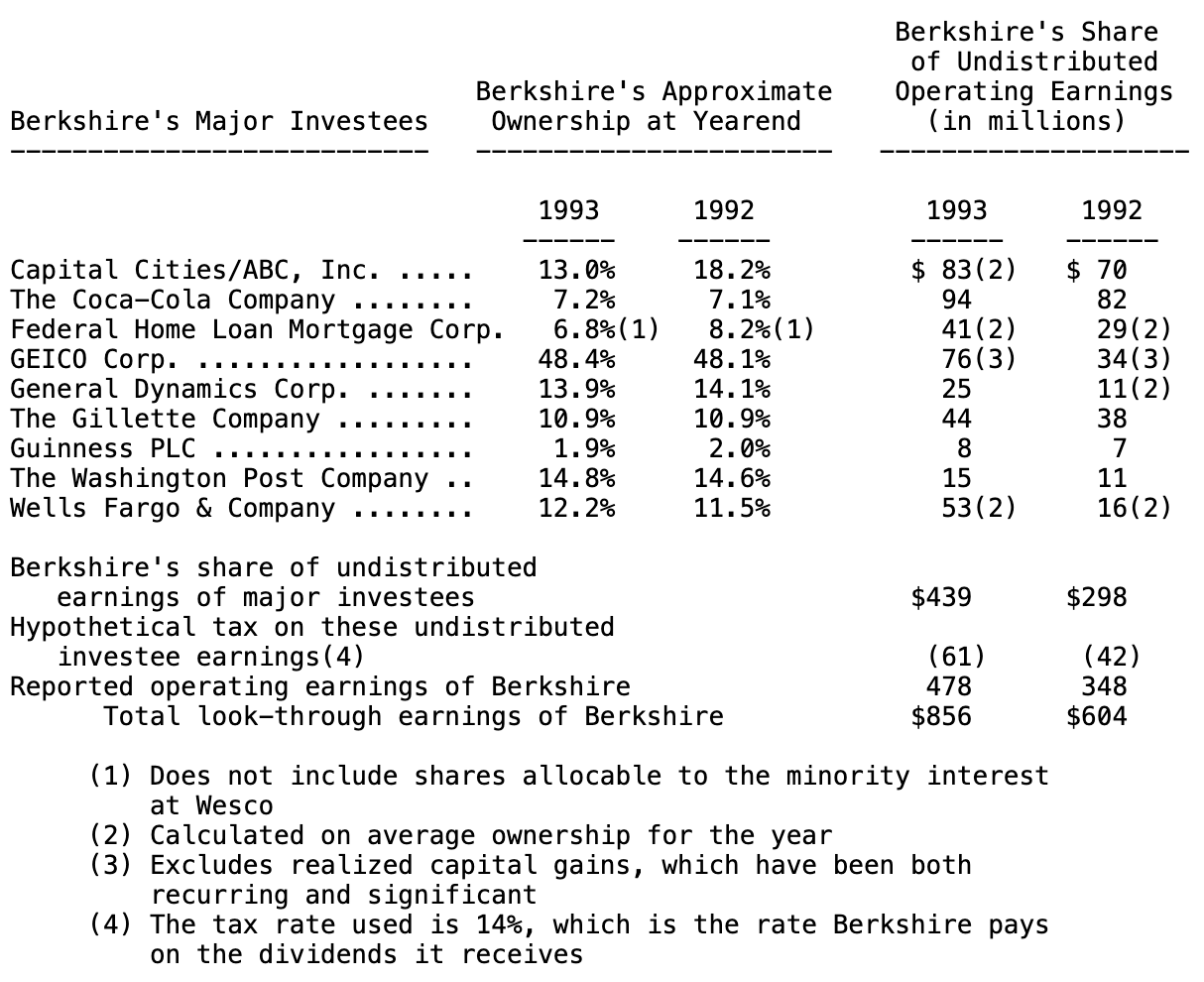
We have told you that we expect the undistributed, hypothetically-taxed earnings of our investees to produce at least equivalent gains in Berkshire’s intrinsic value. To date, we have far exceeded that expectation. For example, in 1986 we bought three million shares of Capital Cities/ABC for $172.50 per share and late last year sold one-third of that holding for $630 per share. After paying 35% capital gains taxes, we realized a $297 million profit from the sale. In contrast, during the eight years we held these shares, the retained earnings of Cap Cities attributable to them—hypothetically taxed at a lower 14% in accordance with our look-through method—were only $152 million. In other words, we paid a much larger tax bill than our look-through presentations to you have assumed and nonetheless realized a gain that far exceeded the undistributed earnings allocable to these shares.
我们曾告诉你:我们预计,被投资企业“未分配、并按假设税率计税”的那部分收益,至少应当在 Berkshire 的内在价值上带来等量的增益。迄今为止,我们取得的结果远远超过了这一预期。举例来说:1986 年,我们以每股 172.50 美元的价格买入了 Capital Cities/ABC 的 300 万股;而在去年年底,我们以每股 630 美元的价格卖出了其中三分之一。缴纳 35% 的资本利得税后,我们从这笔出售中实现了 2.97 亿美元的利润。相比之下,在我们持有这些股票的 8 年间,Cap Cities 归属于这些股份的留存收益——按我们的 look-through 方法以较低的 14% 假设税率计税——只有 1.52 亿美元。换句话说,我们最终缴纳的税款远高于我们向你展示的 look-through 口径所假设的税负,但即便如此,我们实现的收益仍然远超这些股份所对应的未分配留存收益。
We expect such pleasant outcomes to recur often in the future and therefore believe our look-through earnings to be a conservative representation of Berkshire’s true economic earnings.
我们预计,这类“令人愉快”的结果在未来还会经常出现。因此,我们认为:我们所披露的 look-through earnings 是对 Berkshire 真实经济收益的一种偏保守的表达。
Taxes
税收
As our Cap Cities sale emphasizes, Berkshire is a substantial payer of federal income taxes. In aggregate, we will pay 1993 federal income taxes of $390 million, about $200 million of that attributable to operating earnings and $190 million to realized capital gains. Furthermore, our share of the 1993 federal and foreign income taxes paid by our investees is well over $400 million, a figure you don’t see on our financial statements but that is nonetheless real. Directly and indirectly, Berkshire’s 1993 federal income tax payments will be about 1/2 of 1% of the total paid last year by all American corporations.
正如我们出售 Cap Cities 的交易所强调的那样,Berkshire 是联邦所得税的重要纳税人。合计而言,我们将支付 1993 年联邦所得税 3.90 亿美元,其中约 2.00 亿来自经营收益,约 1.90 亿来自已实现资本利得。此外,我们所持被投资企业在 1993 年缴纳的联邦及海外所得税中,按我们的份额计算远超 4.00 亿美元——这笔数字不会出现在我们的财务报表中,但它是真实存在的。直接与间接相加,Berkshire 在 1993 年支付的联邦所得税大约相当于美国所有公司去年所缴联邦所得税总额的 0.5%。
Speaking for our own shares, Charlie and I have absolutely no complaint about these taxes. We know we work in a market-based economy that rewards our efforts far more bountifully than it does the efforts of others whose output is of equal or greater benefit to society. Taxation should, and does, partially redress this inequity. But we still remain extraordinarily well-treated.
就我们自身所持股份而言,Charlie 和我对这些税款毫无怨言。我们知道,我们身处的是一个以市场为基础的经济体系,它对我们的努力给予的回报,远比对其他一些人的努力回报得丰厚——即便后者的产出对社会的益处同等甚至更大。税收应当、并且确实在一定程度上纠正这种不均衡。但即便如此,我们仍然得到了格外优厚的对待。
Berkshire and its shareholders, in combination, would pay a much smaller tax if Berkshire operated as a partnership or “S” corporation, two structures often used for business activities. For a variety of reasons, that’s not feasible for Berkshire to do. However, the penalty our corporate form imposes is mitigated—though far from eliminated—by our strategy of investing for the long term. Charlie and I would follow a buy-and-hold policy even if we ran a tax-exempt institution. We think it the soundest way to invest, and it also goes down the grain of our personalities. A third reason to favor this policy, however, is the fact that taxes are due only when gains are realized.
如果 Berkshire 以合伙企业或 “S” corporation(两种常用于经营活动的结构)方式运作,那么 Berkshire 与股东合并计算所缴纳的税负会小得多。出于多种原因,Berkshire 不可能采用这种结构。不过,我们公司制所带来的税负惩罚,被我们“长期投资”的策略所缓解——尽管远未被消除。即便我们经营的是一家免税机构,Charlie 和我也会坚持买入并长期持有的政策。我们认为这是一种最稳健的投资方式,同时也符合我们的性格取向。不过,偏好这一政策还有第三个原因:税款只有在收益被实现时才需要缴纳。
Through my favorite comic strip, Li’l Abner, I got a chance during my youth to see the benefits of delayed taxes, though I missed the lesson at the time. Making his readers feel superior, Li’l Abner bungled happily, but moronically, through life in Dogpatch. At one point he became infatuated with a New York temptress, Appassionatta Van Climax, but despaired of marrying her because he had only a single silver dollar and she was interested solely in millionaires. Dejected, Abner took his problem to Old Man Mose, the font of all knowledge in Dogpatch. Said the sage: Double your money 20 times and Appassionatta will be yours (1, 2, 4, 8 . . . . 1,048,576).
通过我最喜欢的连环漫画 Li’l Abner,我在少年时代其实有机会看到“延迟纳税”的好处,只是当时没领会。为了让读者觉得自己更聪明,Li’l Abner 在 Dogpatch 这个地方一生“快乐但愚蠢”地把事情办砸。有一次他迷上了一位来自纽约的妖娆女子 Appassionatta Van Climax,但因为自己只有一枚银元,而她只对百万富翁感兴趣,他便绝望地认为不可能娶到她。垂头丧气的 Abner 去找 Dogpatch 的“万事通” Old Man Mose 求教。那位智者说:把你的钱翻倍 20 次,Appassionatta 就是你的(1、2、4、8……1,048,576)。
My last memory of the strip is Abner entering a roadhouse, dropping his dollar into a slot machine, and hitting a jackpot that spilled money all over the floor. Meticulously following Mose’s advice, Abner picked up two dollars and went off to find his next double. Whereupon I dumped Abner and began reading Ben Graham.
我对这部漫画最后的记忆是:Abner 走进一家路边酒吧,把那一美元塞进老虎机,然后中了头奖,硬币钞票哗啦啦洒满地板。Abner 一丝不苟地照着 Mose 的建议做:他只捡起两美元,就去寻找下一次翻倍。就在那一刻,我抛弃了 Abner,开始读 Ben Graham。
Mose clearly was overrated as a guru: Besides failing to anticipate Abner’s slavish obedience to instructions, he also forgot about taxes. Had Abner been subject, say, to the 35% federal tax rate that Berkshire pays, and had he managed one double annually, he would after 20 years only have accumulated $22,370. Indeed, had he kept on both getting his annual doubles and paying a 35% tax on each, he would have needed 7 1/2 years more to reach the $1 million required to win Appassionatta.
Mose 显然被高估成“导师”了:他不仅没预见 Abner 会如此机械地服从指令,他还忘了一件事——税。如果 Abner 也像 Berkshire 一样,须缴纳 35% 的联邦税率,并且他每年能做到一次翻倍,那么 20 年后他手里也只会积累到 22,370 美元。事实上,如果他既能坚持每年翻倍、又每次翻倍都缴 35% 的税,他还需要再多 7 年半,才能达到赢得 Appassionatta 所需的 100 万美元。
But what if Abner had instead put his dollar in a single investment and held it until it doubled the same 27 1/2 times? In that case, he would have realized about $200 million pre-tax or, after paying a $70 million tax in the final year, about $130 million after-tax. For that, Appassionatta would have crawled to Dogpatch. Of course, with 27 1/2 years having passed, how Appassionatta would have looked to a fellow sitting on $130 million is another question.
但如果 Abner 不是一年年翻倍并不断纳税,而是把这一美元投入到一项投资中,长期持有,直到它同样完成 27 年半里的 27 又 1/2 次翻倍呢?那样的话,他税前将实现大约 2 亿美元;在最后一年缴纳 7,000 万美元税后,税后大约还能剩 1.3 亿美元。为了这 1.3 亿美元,Appassionatta 会爬到 Dogpatch 来。当然,27 年半过去了,一个坐拥 1.3 亿美元的人眼里,Appassionatta 看起来会是什么样子,那又是另一个问题。
What this little tale tells us is that tax-paying investors will realize a far, far greater sum from a single investment that compounds internally at a given rate than from a succession of investments compounding at the same rate. But I suspect many Berkshire shareholders figured that out long ago.
这个小故事告诉我们:对于需要纳税的投资者而言,在某一固定回报率下,“单笔投资在内部持续复利并把纳税推迟到最后”所能得到的最终金额,将远远、远远高于“同样回报率下不断更换投资、每次实现收益就纳税”的做法。但我猜,许多 Berkshire 股东早就把这个道理想明白了。
Insurance Operations
保险业务
At this point in the report we’ve customarily provided you with a table showing the annual “combined ratio” of the insurance industry for the preceding decade. This ratio compares total insurance costs (losses incurred plus expenses) to revenue from premiums. For many years, the ratio has been above 100, a level indicating an underwriting loss. That is, the industry has taken in less money each year from its policyholders than it has had to pay for operating expenses and for loss events that occurred during the year.
在报告的这一部分,我们往常会给你提供一张表,列示过去十年保险行业每年的“综合成本率(combined ratio)”。这个指标把保险总成本(已发生损失 + 费用)与保费收入进行比较。多年来,这个比率一直高于 100,这意味着承保亏损。也就是说,行业每年从投保人收取的保费,少于其需要支付的经营费用以及当年发生的赔付损失。
Offsetting this grim equation is a happier fact: Insurers get to hold on to their policyholders’ money for a time before paying it out. This happens because most policies require that premiums be prepaid and, more importantly, because it often takes time to resolve loss claims. Indeed, in the case of certain lines of insurance, such as product liability or professional malpractice, many years may elapse between the loss event and payment.
与这种阴沉的算式相抵消的,是一个更“开心”的事实:保险公司在实际支付赔款之前,可以在一段时间内持有投保人的资金。之所以如此,是因为多数保单要求保费预付;更重要的是,理赔通常需要时间才能最终结案。事实上,在某些险种中——例如产品责任险或职业责任险——从损失事件发生到最终赔付,可能会相隔很多年。
To oversimplify the matter somewhat, the total of the funds prepaid by policyholders and the funds earmarked for incurred-but-not-yet-paid claims is called “the float.” In the past, the industry was able to suffer a combined ratio of 107 to 111 and still break even from its insurance writings because of the earnings derived from investing this float.
为了稍微简化一点:投保人预付的资金,加上为“已发生但尚未支付”的赔款而预留的资金,其总和被称为“浮存金(float)”。过去,行业即便综合成本率在 107 到 111 之间(也就是承保端亏损),仍可能在保险业务层面实现不亏不盈,因为投资这些浮存金所获得的收益足以弥补承保亏损。
As interest rates have fallen, however, the value of float has substantially declined. Therefore, the data that we have provided in the past are no longer useful for year-to-year comparisons of industry profitability. A company writing at the same combined ratio now as in the 1980’s today has a far less attractive business than it did then.
然而,随着利率下降,浮存金的价值已显著降低。因此,我们过去提供的那些数据,如今已不再适合用来做行业盈利能力的年度比较。今天一家公司的综合成本率如果与 1980 年代相同,它的生意吸引力会远远低于当年。
Only by making an analysis that incorporates both underwriting results and the current risk-free earnings obtainable from float can one evaluate the true economics of the business that a property-casualty insurer writes. Of course, the actual investment results that an insurer achieves from the use of both float and stockholders’ funds is also of major importance and should be carefully examined when an investor is assessing managerial performance. But that should be a separate analysis from the one we are discussing here. The value of float funds—in effect, their transfer price as they move from the insurance operation to the investment operation—should be determined simply by the risk-free, long-term rate of interest.
只有把“承保结果”与“当前无风险利率下浮存金可获得的收益”同时纳入分析,才能评估一家财产险公司的真实经济性。当然,保险公司在运用浮存金与股东资金进行投资时取得的实际投资结果也非常重要,投资者在评价管理层表现时应当认真审视。但这应当是一个独立于我们此处讨论的分析。浮存金的价值——也就是它从承保业务“转移”到投资业务时的内部转移价格——应当仅由无风险的长期利率来决定。
On the next page we show the numbers that count in an evaluation of Berkshire’s insurance business. We calculate our float—which we generate in exceptional amounts relative to our premium volume—by adding loss reserves, loss adjustment reserves and unearned premium reserves and then subtracting agent’s balances, prepaid acquisition costs and deferred charges applicable to assumed reinsurance. Our cost of float is determined by our underwriting loss or profit. In those years when we have had an underwriting profit, which includes 1993, our cost of float has been negative, and we have determined our insurance earnings by adding underwriting profit to float income.
下一页我们将展示:评估 Berkshire 保险业务时真正关键的数字。我们计算浮存金的方法是:将损失准备金(loss reserves)、损失调整准备金(loss adjustment reserves)以及未赚保费准备金(unearned premium reserves)相加,然后扣除代理人余额(agent’s balances)、预付收购成本(prepaid acquisition costs)以及与分入再保险相关的递延费用(deferred charges applicable to assumed reinsurance)。我们浮存金的“成本”由承保亏损或承保利润决定。在那些我们取得承保利润的年份(包括 1993 年),浮存金成本为负;此时,我们通过把承保利润与浮存金收益相加来计算我们的保险收益。
As you can see, in our insurance operation last year we had the use of $2.6 billion at no cost; in fact we were paid $31 million, our underwriting profit, to hold these funds. This sounds good —is good—but is far from as good as it sounds.
如你所见,我们去年的保险业务让我们能够无成本使用 26 亿美元;事实上,我们还“被支付了”3,100 万美元——也就是我们的承保利润——来持有这些资金。这听起来很好——也确实很好——但远没有听上去那么好。
We temper our enthusiasm because we write a large volume of “super-cat” policies (which other insurance and reinsurance companies buy to recover part of the losses they suffer from mega-catastrophes) and because last year we had no losses of consequence from this activity. As that suggests, the truly catastrophic Midwestern floods of 1993 did not trigger super-cat losses, the reason being that very few flood policies are purchased from private insurers.
我们之所以要收敛兴奋,是因为我们承保了大量“super-cat”(超级巨灾)保单(其他保险公司与再保险公司购买它们,用以分担自身在超大型灾难中的部分损失),而且去年这块业务并未发生任何重要损失。正如这所暗示的那样:1993 年美国中西部那场真正灾难性的洪水,并没有触发 super-cat 损失;原因在于,私人保险公司承保的洪水保单极少。
It would be fallacious, however, to conclude from this single-year result that the super-cat business is a wonderful one, or even a satisfactory one. A simple example will illustrate the fallacy: Suppose there is an event that occurs 25 times in every century. If you annually give 5-for-1 odds against its occurrence that year, you will have many more winning years than losers. Indeed, you may go a straight six, seven or more years without loss. You also will eventually go broke.
但如果仅凭这一年的结果就断言 super-cat 生意很棒,甚至哪怕只是“还算可以”,那都是一种谬误。一个简单例子可以说明这种谬误:假设某类事件在每个世纪发生 25 次。如果你每年都以 5 比 1 的赔率押它“今年不会发生”,你赢的年份会远多于输的年份。事实上,你完全可能连续六年、七年甚至更多年毫无损失。但你最终也一定会破产。
At Berkshire, we naturally believe we are obtaining adequate premiums and giving more like 3 1/2-for-1 odds. But there is no way for us—or anyone else—to calculate the true odds on super-cat coverages. In fact, it will take decades for us to find out whether our underwriting judgment has been sound.
在 Berkshire,我们当然相信自己收取的保费是足够的,我们给出的赔率更像是 3.5 比 1。但我们——以及任何人——都无法计算 super-cat 保障的真实赔率。事实上,我们需要几十年时间才能知道:我们的承保判断究竟是否可靠。
What we do know is that when a loss comes, it’s likely to be a lulu. There may well be years when Berkshire will suffer losses from the super-cat business equal to three or four times what we earned from it in 1993. When Hurricane Andrew blew in 1992, we paid out about $125 million. Because we’ve since expanded our super-cat business, a similar storm today could cost us $600 million.
但我们确实知道的是:一旦发生损失,很可能会是个“狠角色”。完全可能出现这样的年份:Berkshire 在 super-cat 业务上的损失,会是我们 1993 年从该业务赚到的钱的三倍或四倍。1992 年 Hurricane Andrew 来袭时,我们赔付了约 1.25 亿美元。由于此后我们扩大了 super-cat 业务,若今天发生类似风暴,可能会让我们付出 6 亿美元的代价。
So far, we have been lucky in 1994. As I write this letter, we are estimating that our losses from the Los Angeles earthquake will be nominal. But if the quake had been a 7.5 instead of a 6.8, it would have been a different story.
截至 1994 年目前,我们还算走运。当我写这封信时,我们预计 Los Angeles 地震带来的损失将微不足道。但如果震级是 7.5 而不是 6.8,故事就会完全不同。
Berkshire is ideally positioned to write super-cat policies. In Ajit Jain, we have by far the best manager in this business. Additionally, companies writing these policies need enormous capital, and our net worth is ten to twenty times larger than that of our main competitors. In most lines of insurance, huge resources aren’t that important: An insurer can diversify the risks it writes and, if necessary, can lay off risks to reduce concentration in its portfolio. That isn’t possible in the super-cat business. So these competitors are forced into offering far smaller limits than those we can provide. Were they bolder, they would run the risk that a mega-catastrophe—or a confluence of smaller catastrophes—would wipe them out.
Berkshire 处在承保 super-cat(超级巨灾)保单的理想位置。我们拥有 Ajit Jain——毫无疑问是这一业务中最优秀的经理人。此外,承保这类保单需要极其雄厚的资本,而我们的净资产规模是主要竞争对手的 10 到 20 倍。在大多数保险业务中,雄厚资源并没有那么关键:保险公司可以通过分散承保风险,并在必要时通过分出保险来降低组合的集中度。但在 super-cat 业务中,这些手段行不通。因此,我们的竞争对手被迫提供远小于我们所能提供的保额上限。如果他们胆子更大,就会冒着这样的风险:一次超大型灾难——或者多起较小灾难的叠加——足以把他们直接抹掉。
普通财险(比如小额车险、一般责任)能靠“多事件、低相关”的大数定律分散:今天佛州出险,明天加州出险,彼此独立性较强;单个事件损失上限相对可控。
super-cat 的核心特征是:单一事件就能同时打到很多保单、很多地区、很多公司(高度相关)。你买再保险也好,层层分出去也好,遇到 Andrew 级别飓风或更大的系统性灾害,大家一起亏。这导致“看起来分散了”,实则还是同一个尾部因子在主导。
One indication of our premier strength and reputation is that each of the four largest reinsurance companies in the world buys very significant reinsurance coverage from Berkshire. Better than anyone else, these giants understand that the test of a reinsurer is its ability and willingness to pay losses under trying circumstances, not its readiness to accept premiums when things look rosy.
我们顶级实力与声誉的一个证明是:全球最大的四家再保险公司,每一家都从 Berkshire 购买了规模非常可观的再保险保障。这些行业巨头比任何人都更明白:衡量一家再保险公司的关键,不在于“形势看起来一片大好时愿不愿意收保费”,而在于“在艰难局面下有没有能力、并且有没有意愿去赔付损失”。
One caution: There has recently been a substantial increase in reinsurance capacity. Close to $5 billion of equity capital has been raised by reinsurers, almost all of them newly-formed entities. Naturally these new entrants are hungry to write business so that they can justify the projections they utilized in attracting capital. This new competition won’t affect our 1994 operations; we’re filled up there, primarily with business written in 1993. But we are now seeing signs of price deterioration. If this trend continues, we will resign ourselves to much-reduced volume, keeping ourselves available, though, for the large, sophisticated buyer who requires a super-cat insurer with large capacity and a sure ability to pay losses.
提醒一句:最近再保险市场的承保能力出现了显著增长。再保险公司新增募集的股权资本接近 50 亿美元,其中几乎全部来自新设立的机构。很自然,这些新进入者会急于承保业务,以便证明当初吸引资本时所用的那些预测成立。新增竞争不会影响我们 1994 年的经营:我们当年的额度基本已被填满,主要来自 1993 年承保的业务。但我们已经看到价格走弱的迹象。如果这种趋势持续,我们会接受业务量大幅下降的现实;不过,我们仍会保持“随时可用”的状态,专门服务那些大型、成熟的买家——他们需要一家能提供巨大承保能力、且在损失发生时确定能赔付的 super-cat 保险人。
In other areas of our insurance business, our homestate operation, led by Rod Eldred; our workers’ compensation business, headed by Brad Kinstler; our credit-card operation, managed by the Kizer family; and National Indemnity’s traditional auto and general liability business, led by Don Wurster, all achieved excellent results. In combination, these four units produced a significant underwriting profit and substantial float.
在我们保险业务的其他领域,我们在本州的业务(由 Rod Eldred 领导)、工伤保险业务(由 Brad Kinstler 负责)、信用卡保险业务(由 Kizer 家族管理),以及 National Indemnity 的传统车险与一般责任险业务(由 Don Wurster 领导),都取得了出色业绩。合计而言,这四个单位带来了显著的承保利润和可观的浮存金(float)。
All in all, we have a first-class insurance business. Though its results will be highly volatile, this operation possesses an intrinsic value that exceeds its book value by a large amount—larger, in fact, than is the case at any other Berkshire business.
总体而言,我们拥有一家一流的保险企业。尽管其结果会高度波动,但这项业务的内在价值显著高于其账面价值——事实上,这种“内在价值相对账面价值的超额”比 Berkshire 任何其他业务都更大。
Common Stock Investments
普通股投资
Below we list our common stockholdings having a value of over $250 million. A small portion of these investments belongs to subsidiaries of which Berkshire owns less than 100%.
下面我们列出市值超过 2.5 亿美元的普通股持仓。其中一小部分投资属于一些子公司,而 Berkshire 对这些子公司的持股比例并非 100%。
Considering the similarity of this year’s list and the last, you may decide your management is hopelessly comatose. But we continue to think that it is usually foolish to part with an interest in a business that is both understandable and durably wonderful. Business interests of that kind are simply too hard to replace.
鉴于今年的名单与去年几乎一样,你也许会觉得管理层已经“昏迷不醒”。但我们依然认为:把自己在一家“既容易理解、又长期卓越”的企业中的权益卖掉,通常是愚蠢的。因为这类企业权益实在太难被替代。
Interestingly, corporate managers have no trouble understanding that point when they are focusing on a business they operate: A parent company that owns a subsidiary with superb long-term economics is not likely to sell that entity regardless of price. “Why,” the CEO would ask, “should I part with my crown jewel?” Yet that same CEO, when it comes to running his personal investment portfolio, will offhandedly—and even impetuously—move from business to business when presented with no more than superficial arguments by his broker for doing so. The worst of these is perhaps, “You can’t go broke taking a profit.” Can you imagine a CEO using this line to urge his board to sell a star subsidiary? In our view, what makes sense in business also makes sense in stocks: An investor should ordinarily hold a small piece of an outstanding business with the same tenacity that an owner would exhibit if he owned all of that business.
有趣的是,公司经理人在经营自己实际控制的业务时,对这一点一点也不难理解:一家母公司如果拥有一家长期经济性极佳的子公司,几乎不可能因为“价格合适”就把它卖掉。“为什么,”CEO 会问,“我要把我的皇冠上的宝石卖出去?”然而同样一个 CEO,在管理自己的个人投资组合时,却可能因为经纪人给出的几句肤浅理由,就轻率甚至冲动地从一个生意跳到另一个生意。其中最糟糕的说法之一,可能就是:“落袋为安,赚了就不会破产(You can’t go broke taking a profit)。”你能想象一个 CEO 用这句话去劝董事会卖掉一家明星子公司吗?在我们看来,生意上讲得通的道理,用在股票上也同样讲得通:投资者通常应当以与“全资拥有者”同样的韧性,去持有一家杰出企业的一小部分股权。
Earlier I mentioned the financial results that could have been achieved by investing $40 in The Coca-Cola Co. in 1919. In 1938, more than 50 years after the introduction of Coke, and long after the drink was firmly established as an American icon, Fortune did an excellent story on the company. In the second paragraph the writer reported: “Several times every year a weighty and serious investor looks long and with profound respect at Coca-Cola’s record, but comes regretfully to the conclusion that he is looking too late. The specters of saturation and competition rise before him.”
前面我提到过:如果在 1919 年用 40 美元投资 The Coca-Cola Co.,长期下来会得到怎样的财务结果。1938 年,在 Coke 推出已经超过 50 年、而且早已成为美国标志性产品很久之后,Fortune 曾写过一篇关于这家公司的优秀报道。该文第二段写道:“一年之中会有好几次,一位举足轻重、严肃认真的投资者,会长久地、怀着深深敬意地凝视 Coca-Cola 的历史记录,但最终只能遗憾地得出结论:他看得太晚了。‘饱和’与‘竞争’的幽灵,在他面前升起。”
Yes, competition there was in 1938 and in 1993 as well. But it’s worth noting that in 1938 The Coca-Cola Co. sold 207 million cases of soft drinks (if its gallonage then is converted into the 192-ounce cases used for measurement today) and in 1993 it sold about 10.7 billion cases, a 50-fold increase in physical volume from a company that in 1938 was already dominant in its very major industry. Nor was the party over in 1938 for an investor: Though the $40 invested in 1919 in one share had (with dividends reinvested) turned into $3,277 by the end of 1938, a fresh $40 then invested in Coca-Cola stock would have grown to $25,000 by yearend 1993.
是的,1938 年有竞争,1993 年同样有竞争。但值得注意的是:1938 年 The Coca-Cola Co. 卖出了 2.07 亿箱软饮料(如果把当时按加仑计量的销量换算成今天使用的 192 盎司/箱的口径),而 1993 年它卖出了约 107 亿箱——实体销量增长了 50 倍。要知道,1938 年这家公司在其极为重要的行业里就已经处于主导地位了。对投资者而言,“派对”在 1938 年也远未结束:1919 年投入在一股股票上的 40 美元(股息再投资)到 1938 年底已变成 3,277 美元;而如果在 1938 年再投入一笔新的 40 美元买 Coca-Cola 股票,到 1993 年底会增长到 25,000 美元。
I can’t resist one more quote from that 1938 Fortune story: “It would be hard to name any company comparable in size to Coca-Cola and selling, as Coca-Cola does, an unchanged product that can point to a ten-year record anything like Coca-Cola’s.” In the 55 years that have since passed, Coke’s product line has broadened somewhat, but it’s remarkable how well that description still fits.
我忍不住还想再引一句 1938 年 Fortune 那篇文章的话:“要举出一家与 Coca-Cola 规模相当的公司很难,而像 Coca-Cola 这样销售一种几乎不变的产品、却能展示出类似 Coca-Cola 那样的十年纪录的公司,就更难了。”此后过去了 55 年,Coke 的产品线确实有所扩展,但令人惊讶的是,这段描述直到今天仍然高度贴切。
国内有一家做冰淇淋的,叫“野人先生”,参考:《 对话野人先生:野蛮生长的中国冰淇淋》,这个店在新加坡刚开了分店:《Sweet Arrival: YEAH GELATO 野人先生 Opens in Singapore!》。
Charlie and I decided long ago that in an investment lifetime it’s just too hard to make hundreds of smart decisions. That judgment became ever more compelling as Berkshire’s capital mushroomed and the universe of investments that could significantly affect our results shrank dramatically. Therefore, we adopted a strategy that required our being smart—and not too smart at that—only a very few times. Indeed, we’ll now settle for one good idea a year. (Charlie says it’s my turn.)
Charlie 和我很早就认定:在一生的投资生涯里,做出几百个“聪明决定”实在太难了。随着 Berkshire 的资本规模像蘑菇一样膨胀,而能对我们结果产生显著影响的投资标的范围急剧收缩,这个判断变得更加有说服力。因此,我们采用了一种策略:它要求我们只需要在极少数时候聪明——而且不必聪明过头。事实上,现在我们一年能有一个好点子就满足了。(Charlie 说轮到我了。)
The strategy we’ve adopted precludes our following standard diversification dogma. Many pundits would therefore say the strategy must be riskier than that employed by more conventional investors. We disagree. We believe that a policy of portfolio concentration may well decrease risk if it raises, as it should, both the intensity with which an investor thinks about a business and the comfort-level he must feel with its economic characteristics before buying into it. In stating this opinion, we define risk, using dictionary terms, as “the possibility of loss or injury.”
我们采用的策略,决定了我们不可能遵循标准的“分散化教条”。因此,许多评论家会说:这种策略必然比更传统投资者的做法风险更高。我们不同意。我们认为:如果投资组合的集中能像它应当做到的那样——同时提升投资者思考一家企业的强度,以及在买入之前对其经济特征必须达到的“舒适程度”——那么集中持仓的政策反而可能降低风险。在这里,我们按字典的含义来定义风险:即“发生损失或伤害的可能性”。
Academics, however, like to define investment “risk” differently, averring that it is the relative volatility of a stock or portfolio of stocks—that is, their volatility as compared to that of a large universe of stocks. Employing data bases and statistical skills, these academics compute with precision the “beta” of a stock—its relative volatility in the past—and then build arcane investment and capital-allocation theories around this calculation. In their hunger for a single statistic to measure risk, however, they forget a fundamental principle: It is better to be approximately right than precisely wrong.
然而,学者们喜欢用另一种方式定义投资“风险”:他们认为风险就是股票或股票组合的相对波动性——也就是相对于一个大型股票集合而言的波动程度。借助数据库与统计技能,这些学者会精确计算一只股票的 “beta”(过去的相对波动性),并围绕这一计算建立起晦涩的投资与资本配置理论。但在他们渴望用一个单一统计指标来衡量风险时,却忘了一个基本原则:大致正确胜过精确地错误(It is better to be approximately right than precisely wrong)。
For owners of a business—and that’s the way we think of shareholders—the academics’ definition of risk is far off the mark, so much so that it produces absurdities. For example, under beta-based theory, a stock that has dropped very sharply compared to the market—as had Washington Post when we bought it in 1973—becomes “riskier” at the lower price than it was at the higher price. Would that description have then made any sense to someone who was offered the entire company at a vastly-reduced price?
对于一家企业的所有者——而我们正是这样看待股东的——学者们对风险的定义偏离得太远了,远到会推导出荒谬结论。比如,在以 beta 为基础的理论下,一只相对于大盘大幅下跌的股票——就像我们 1973 年买入时的 Washington Post——在更低的价格反而会被判定为“更高风险”,而不是在更高的价格更高风险。对一个被以大幅折价报价“整家公司”的人来说,这样的描述当时能有什么意义?
In fact, the true investor welcomes volatility. Ben Graham explained why in Chapter 8 of The Intelligent Investor. There he introduced “Mr. Market,” an obliging fellow who shows up every day to either buy from you or sell to you, whichever you wish. The more manic-depressive this chap is, the greater the opportunities available to the investor. That’s true because a wildly fluctuating market means that irrationally low prices will periodically be attached to solid businesses. It is impossible to see how the availability of such prices can be thought of as increasing the hazards for an investor who is totally free to either ignore the market or exploit its folly.
事实上,真正的投资者欢迎波动。Ben Graham 在《The Intelligent Investor》第 8 章解释了原因:他在那里介绍了“Mr. Market”——一个每天都会出现的热心人,随时准备按你希望的方向,要么向你买入,要么向你卖出。这个家伙越是躁狂抑郁,投资者可得的机会就越大。原因很简单:剧烈波动的市场意味着,理性上很扎实的企业会周期性地被贴上非理性低价。对于一个完全自由、既可以忽略市场、也可以利用市场愚蠢行为的投资者而言,很难理解为什么“能以这种价格买到好公司”会被认为是在增加风险。
In assessing risk, a beta purist will disdain examining what a company produces, what its competitors are doing, or how much borrowed money the business employs. He may even prefer not to know the company’s name. What he treasures is the price history of its stock. In contrast, we’ll happily forgo knowing the price history and instead will seek whatever information will further our understanding of the company’s business. After we buy a stock, consequently, we would not be disturbed if markets closed for a year or two. We don’t need a daily quote on our 100% position in See’s or H. H. Brown to validate our well-being. Why, then, should we need a quote on our 7% interest in Coke?
在评估风险时,一个 beta 纯粹主义者会不屑于研究公司生产什么、竞争对手在做什么、企业用了多少借款。他甚至可能更愿意不知道公司的名字。他珍视的是股票的价格历史。相比之下,我们宁可完全不了解价格历史,而去寻找一切能增进我们对企业经营理解的信息。因此,买入股票后,即便市场关闭一两年,我们也不会因此不安。我们并不需要 See’s 或 H. H. Brown 这类我们 100% 持股的企业每天给个报价来证明我们过得很好。那我们又为什么需要对我们仅持有 7% 的 Coke 每天看一个报价呢?
In our opinion, the real risk that an investor must assess is whether his aggregate after-tax receipts from an investment (including those he receives on sale) will, over his prospective holding period, give him at least as much purchasing power as he had to begin with, plus a modest rate of interest on that initial stake. Though this risk cannot be calculated with engineering precision, it can in some cases be judged with a degree of accuracy that is useful. The primary factors bearing upon this evaluation are:
在我们看来,投资者必须评估的真正风险,是:在他预期持有期内,一项投资为他带来的税后总回款(包括出售时收到的款项)是否至少能给他带来——(1)不低于起初那笔投入的购买力;并且(2)在这笔初始投入之上再加上一点温和的利息回报。尽管这种风险无法用工程学那样的精度去计算,但在某些情况下,它能以对决策有用的准确度被判断出来。影响这一判断的主要因素包括:
1.The certainty with which the long-term economic characteristics of the business can be evaluated;
对一家企业长期经济特征能够被评估的确定性;
2.The certainty with which management can be evaluated, both as to its ability to realize the full potential of the business and to wisely employ its cash flows;
对管理层能够被评估的确定性——既包括其实现企业全部潜力的能力,也包括其明智运用现金流的能力;
3.The certainty with which management can be counted on to channel the rewards from the business to the shareholders rather than to itself;
对管理层是否可以被指望把企业回报导向股东、而非导向自身的确定性;
4.The purchase price of the business;
企业的买入价格;
5.The levels of taxation and inflation that will be experienced and that will determine the degree by which an investor’s purchasing-power return is reduced from his gross return.
未来将经历的税收与通胀水平——它们将决定投资者的“购买力回报”相对于名义回报会被削减到何种程度。
These factors will probably strike many analysts as unbearably fuzzy, since they cannot be extracted from a data base of any kind. But the difficulty of precisely quantifying these matters does not negate their importance nor is it insuperable. Just as Justice Stewart found it impossible to formulate a test for obscenity but nevertheless asserted, “I know it when I see it,” so also can investors—in an inexact but useful way—”see” the risks inherent in certain investments without reference to complex equations or price histories.
这些因素在许多分析师看来,恐怕会“模糊得让人受不了”,因为它们无法从任何数据库中提取出来。但无法精确量化,并不意味着这些问题不重要;也不意味着困难不可克服。就像 Justice Stewart 认为他无法为“淫秽”制定一个可操作的测试标准,却仍然断言:“我一看就知道(I know it when I see it)。”同样,投资者也可以在不精确但有用的意义上,在不依赖复杂方程或价格历史的前提下,“看见”某些投资中内含的风险。
Is it really so difficult to conclude that Coca-Cola and Gillette possess far less business risk over the long term than, say, any computer company or retailer? Worldwide, Coke sells about 44% of all soft drinks, and Gillette has more than a 60% share (in value) of the blade market. Leaving aside chewing gum, in which Wrigley is dominant, I know of no other significant businesses in which the leading company has long enjoyed such global power.
真的有那么难得出这样的结论吗:从长期看,Coca-Cola 和 Gillette 的商业风险远远小于任何一家电脑公司或零售商?在全球范围内,Coke 卖出了约 44% 的所有软饮料,而 Gillette 在刀片市场的份额(按价值计)超过 60%。如果不算 Wrigley 主导的口香糖业务,我不知道还有哪一个重要行业里,龙头企业能长期享有如此强大的全球统治力。
刀片的“注意力密度”更高:每天在脖子上做决策,鞋的“注意力密度”通常更低、更分散,巴菲特可能真的认为刀片上的承诺更有确定性。
Moreover, both Coke and Gillette have actually increased their worldwide shares of market in recent years. The might of their brand names, the attributes of their products, and the strength of their distribution systems give them an enormous competitive advantage, setting up a protective moat around their economic castles. The average company, in contrast, does battle daily without any such means of protection. As Peter Lynch says, stocks of companies selling commodity-like products should come with a warning label: “Competition may prove hazardous to human wealth.”
此外,Coke 与 Gillette 近些年实际上还提高了它们在全球市场的份额。它们品牌名称的威力、产品属性,以及分销体系的强大,使它们拥有巨大的竞争优势——在其经济城堡周围挖出了一条保护性的护城河。相比之下,普通公司每天都在没有任何这种防护手段的情况下作战。正如 Peter Lynch 所说:销售“近似大宗商品”产品的公司股票,应该贴上一张警示标签——“竞争可能对人类财富有害(Competition may prove hazardous to human wealth)。”
The competitive strengths of a Coke or Gillette are obvious to even the casual observer of business. Yet the beta of their stocks is similar to that of a great many run-of-the-mill companies who possess little or no competitive advantage. Should we conclude from this similarity that the competitive strength of Coke and Gillette gains them nothing when business risk is being measured? Or should we conclude that the risk in owning a piece of a company—its stock—is somehow divorced from the long-term risk inherent in its business operations? We believe neither conclusion makes sense and that equating beta with investment risk also makes no sense.
像 Coke 或 Gillette 这样的竞争优势,即便是随意观察商业的人也能看得很清楚。然而,它们股票的 beta 却与许多平庸公司相差无几,而那些公司几乎没有竞争优势。我们是否应当从这种相似性得出结论:当用来衡量商业风险时,Coke 与 Gillette 的竞争优势并没有带来任何好处?或者我们是否应当得出结论:持有一家公司的“一部分”——也就是它的股票——其风险不知怎么地与该公司经营中内含的长期风险脱钩了?我们认为这两种结论都不合理;把 beta 等同于投资风险同样不合理。
The theoretician bred on beta has no mechanism for differentiating the risk inherent in, say, a single-product toy company selling pet rocks or hula hoops from that of another toy company whose sole product is Monopoly or Barbie. But it’s quite possible for ordinary investors to make such distinctions if they have a reasonable understanding of consumer behavior and the factors that create long-term competitive strength or weakness. Obviously, every investor will make mistakes. But by confining himself to a relatively few, easy-to-understand cases, a reasonably intelligent, informed and diligent person can judge investment risks with a useful degree of accuracy.
一个在 beta 理论中长大的人,并没有机制来区分这样两类风险:比如,一家只有单一产品的玩具公司,卖的是 pet rocks(宠物石头)或 hula hoops(呼拉圈),与另一家玩具公司,唯一产品却是 Monopoly(大富翁)或 Barbie(芭比娃娃)。但只要对消费者行为以及决定长期竞争强弱的因素有合理理解,普通投资者完全可以作出这种区分。当然,每个投资者都会犯错。但如果把研究范围限制在少数几个容易理解的案例上,一个相对聪明、信息充分、且勤勉的人,就能以对决策有用的准确度去判断投资风险。
In many industries, of course, Charlie and I can’t determine whether we are dealing with a “pet rock” or a “Barbie.” We couldn’t solve this problem, moreover, even if we were to spend years intensely studying those industries. Sometimes our own intellectual shortcomings would stand in the way of understanding, and in other cases the nature of the industry would be the roadblock. For example, a business that must deal with fast-moving technology is not going to lend itself to reliable evaluations of its long-term economics. Did we foresee thirty years ago what would transpire in the television-manufacturing or computer industries? Of course not. (Nor did most of the investors and corporate managers who enthusiastically entered those industries.) Why, then, should Charlie and I now think we can predict the future of other rapidly-evolving businesses? We’ll stick instead with the easy cases. Why search for a needle buried in a haystack when one is sitting in plain sight?
当然,在许多行业里,Charlie 和我并不能判断我们面对的究竟是“pet rock”还是“Barbie”。即便我们花上几年时间深入研究这些行业,也未必能解决这个问题。有时是我们自身智识上的短板妨碍理解;另一些时候,则是行业本身的性质构成障碍。比如,一个必须应对快速技术变迁的行业,就很难让人对其长期经济性做出可靠评估。三十年前,我们能预见电视制造业或计算机行业会发生什么吗?当然不能。(多数当年热情进入这些行业的投资者与企业管理者也不能。)既然如此,我们又为什么现在会认为自己能预测其他快速演化行业的未来?我们宁愿坚持做那些“容易的案例”。当一根针就明晃晃地放在眼前时,何必去找一根埋在草堆里的针?
有没有长期的经济前景?既需要事实层面的支持,也需要合格的心理状态。
Of course, some investment strategies—for instance, our efforts in arbitrage over the years—require wide diversification. If significant risk exists in a single transaction, overall risk should be reduced by making that purchase one of many mutually-independent commitments. Thus, you may consciously purchase a risky investment—one that indeed has a significant possibility of causing loss or injury—if you believe that your gain, weighted for probabilities, considerably exceeds your loss, comparably weighted, and if you can commit to a number of similar, but unrelated opportunities. Most venture capitalists employ this strategy. Should you choose to pursue this course, you should adopt the outlook of the casino that owns a roulette wheel, which will want to see lots of action because it is favored by probabilities, but will refuse to accept a single, huge bet.
当然,有些投资策略——例如我们多年进行的套利——需要广泛分散。如果单笔交易本身存在显著风险,那么把它作为许多相互独立承诺中的一笔,就能降低整体风险。因此,如果你相信:按概率加权后的潜在收益显著高于按概率加权后的潜在损失,并且你能够做出若干类似但彼此无关的承诺,那么你可以有意识地买入一项“高风险投资”——它确实有显著的可能导致损失或伤害。多数风险投资人采用的就是这种策略。如果你选择走这条路,你应当采取一种“赌场思维”:赌场拥有轮盘赌,它希望看到大量下注,因为赔率对它有利;但它会拒绝接受一笔单一的、巨额的赌注。
类似于再保险,需要考虑最坏的情况(不至于重头再来),除分散以外有一个封顶的损失,整体上只能作为补充而不是主干的商业模式,这类业务做多了可能会影响Attention的偏离。
Another situation requiring wide diversification occurs when an investor who does not understand the economics of specific businesses nevertheless believes it in his interest to be a long-term owner of American industry. That investor should both own a large number of equities and space out his purchases. By periodically investing in an index fund, for example, the know-nothing investor can actually out-perform most investment professionals. Paradoxically, when “dumb” money acknowledges its limitations, it ceases to be dumb.
另一种需要广泛分散的情形是:当一位投资者并不理解具体企业的经济特征,但仍认为自己做美国工业的长期所有者符合自身利益时。这位投资者应当同时做到两点:持有大量股票,并把买入分散在时间上(分批买入)。例如,通过定期投资指数基金,这位“什么都不懂”的投资者,实际上可以跑赢大多数投资专业人士。悖论在于:当“笨钱”承认自己的局限时,它就不再是笨钱了。
一个基本的事实:无法独立思考的不是学会思考,而是承认自己不能独立思考,对于一条鱼来说,看到猴子在树上跳来跳去,不是想办法向猴学习而是承认自己是条鱼。
On the other hand, if you are a know-something investor, able to understand business economics and to find five to ten sensibly-priced companies that possess important long-term competitive advantages, conventional diversification makes no sense for you. It is apt simply to hurt your results and increase your risk. I cannot understand why an investor of that sort elects to put money into a business that is his 20th favorite rather than simply adding that money to his top choices—the businesses he understands best and that present the least risk, along with the greatest profit potential. In the words of the prophet Mae West: “Too much of a good thing can be wonderful.”
另一方面,如果你是“懂一些”的投资者——能够理解商业经济性,并能找到 5 到 10 家价格合理、且具备重要长期竞争优势的公司——那么传统意义上的分散化对你就毫无意义。它往往只会伤害你的结果,并增加你的风险。我无法理解:这类投资者为什么要把钱投向自己“第 20 喜欢”的生意,而不是把这笔钱继续加到自己最看好的选择上——那些他最理解、风险最小、同时利润潜力最大的企业。用“女先知” Mae West 的话说:“好东西太多,可能会更美妙(Too much of a good thing can be wonderful)。”
Corporate Governance
公司治理
At our annual meetings, someone usually asks “What happens to this place if you get hit by a truck?” I’m glad they are still asking the question in this form. It won’t be too long before the query becomes: “What happens to this place if you don’t get hit by a truck?”
在我们的年度会议上,总有人问:“如果你被卡车撞了,这里会怎么样?”我很高兴他们仍以这种方式提问。用不了太久,这个问题就会变成:“如果你没被卡车撞,这里会怎么样?”
Such questions, in any event, raise a reason for me to discuss corporate governance, a hot topic during the past year. In general, I believe that directors have stiffened their spines recently and that shareholders are now being treated somewhat more like true owners than was the case not long ago. Commentators on corporate governance, however, seldom make any distinction among three fundamentally different manager/owner situations that exist in publicly-held companies. Though the legal responsibility of directors is identical throughout, their ability to effect change differs in each of the cases. Attention usually falls on the first case, because it prevails on the corporate scene. Since Berkshire falls into the second category, however, and will someday fall into the third, we will discuss all three variations.
无论如何,这类问题引出了我讨论公司治理的理由——这是过去一年里的热门话题。总体而言,我认为董事们最近“腰杆更硬”了,股东也开始被更像真正的所有者那样对待,相比不久前有所改善。然而,讨论公司治理的评论者很少区分上市公司里存在的三种根本不同的“经理人/所有者”关系。尽管董事在法律上的责任在三种情形下完全相同,但他们实际推动改变的能力却各不相同。关注点通常落在第一种情形上,因为它在公司世界里最常见。但由于 Berkshire 属于第二类,并且未来某一天会落入第三类,我们将把这三种变体都讨论一遍。
The first, and by far most common, board situation is one in which a corporation has no controlling shareholder. In that case, I believe directors should behave as if there is a single absentee owner, whose long-term interest they should try to further in all proper ways. Unfortunately, “long-term” gives directors a lot of wiggle room. If they lack either integrity or the ability to think independently, directors can do great violence to shareholders while still claiming to be acting in their long-term interest. But assume the board is functioning well and must deal with a management that is mediocre or worse. Directors then have the responsibility for changing that management, just as an intelligent owner would do if he were present. And if able but greedy managers over-reach and try to dip too deeply into the shareholders’ pockets, directors must slap their hands.
第一种、也是迄今最常见的董事会情形是:公司没有控股股东。在这种情况下,我认为董事应当像面对一位“缺席的单一所有者”那样行事,并以一切适当方式去增进他的长期利益。不幸的是,“长期”这个词给了董事太多回旋余地。如果董事缺乏诚信,或缺乏独立思考的能力,他们完全可以对股东造成巨大伤害,却仍声称自己是在为股东的长期利益行事。但假设董事会运作良好,同时必须面对一个平庸甚至更差的管理层,那么董事就有责任去更换管理层——就像一位聪明的所有者如果在场,也会这么做一样。而如果管理者能力强却贪婪过度,伸手伸得太深,试图从股东口袋里掏走太多东西,董事就必须把他们的手打回去。
In this plain-vanilla case, a director who sees something he doesn’t like should attempt to persuade the other directors of his views. If he is successful, the board will have the muscle to make the appropriate change. Suppose, though, that the unhappy director can’t get other directors to agree with him. He should then feel free to make his views known to the absentee owners. Directors seldom do that, of course. The temperament of many directors would in fact be incompatible with critical behavior of that sort. But I see nothing improper in such actions, assuming the issues are serious. Naturally, the complaining director can expect a vigorous rebuttal from the unpersuaded directors, a prospect that should discourage the dissenter from pursuing trivial or non-rational causes.
在这种“标准模板”的情形下,一个董事如果看见了自己不喜欢的事情,应该努力说服其他董事接受他的观点。如果他成功了,董事会就具备力量去做出恰当的改变。可是假设这位不满的董事无法让其他董事同意他的看法,那他就应当可以自由地把自己的观点告知“缺席的所有者”(也就是股东)。当然,董事很少这么做。事实上,许多董事的性格与这种“批评性行为”并不相容。但只要问题足够严重,我看不出这种做法有什么不妥。当然,这位提出异议的董事也可以预期:那些未被说服的董事会对他进行激烈反驳——这种前景理应让异议者不至于为琐碎或非理性的理由而轻易开战。
For the boards just discussed, I believe the directors ought to be relatively few in number—say, ten or less—and ought to come mostly from the outside. The outside board members should establish standards for the CEO’s performance and should also periodically meet, without his being present, to evaluate his performance against those standards.
对于刚才讨论的那类董事会,我认为董事人数应当相对少——比如不超过 10 人——并且主要来自外部。外部董事应当为 CEO 的业绩建立评估标准,并且还应定期在 CEO 不在场的情况下开会,依据这些标准评估他的表现。
The requisites for board membership should be business savvy, interest in the job, and owner-orientation. Too often, directors are selected simply because they are prominent or add diversity to the board. That practice is a mistake. Furthermore, mistakes in selecting directors are particularly serious because appointments are so hard to undo: The pleasant but vacuous director need never worry about job security.
担任董事所需的条件应当是:商业判断力、对这份工作的投入,以及以所有者为导向。太多时候,董事之所以被选中,仅仅因为他们“有名望”,或者能为董事会“增加多样性”。这种做法是错误的。更糟的是,选错董事的代价尤其高,因为这种任命极难撤销:一个令人愉快但空洞的董事,几乎不必担心自己的职位安全。
The second case is that existing at Berkshire, where the controlling owner is also the manager. At some companies, this arrangement is facilitated by the existence of two classes of stock endowed with disproportionate voting power. In these situations, it’s obvious that the board does not act as an agent between owners and management and that the directors cannot effect change except through persuasion. Therefore, if the owner/manager is mediocre or worse—or is over-reaching—there is little a director can do about it except object. If the directors having no connections to the owner/manager make a unified argument, it may well have some effect. More likely it will not.
第二种情形是 Berkshire 所处的:控股所有者同时也是管理者。在一些公司里,这种安排借助双重股权结构实现——其中一类股票拥有不成比例的投票权。在这种情况下,董事会显然不会作为“所有者与管理层之间的代理人”去行动;董事也几乎无法推动改变,除非靠说服。因此,如果所有者/管理者平庸甚至更差——或者伸手过度——董事除了反对几乎无能为力。如果那些与所有者/管理者没有任何关联的董事能形成一致的论证,或许会产生一些影响;但更可能是不会。
If change does not come, and the matter is sufficiently serious, the outside directors should resign. Their resignation will signal their doubts about management, and it will emphasize that no outsider is in a position to correct the owner/manager’s shortcomings.
如果改变没有到来,而问题又足够严重,那么外部董事就应当辞职。他们的辞职将向外界传递他们对管理层的怀疑,并强调:没有任何外部人士处在能够纠正“所有者/管理者”缺陷的位置上。
The third governance case occurs when there is a controlling owner who is not involved in management. This case, examples of which are Hershey Foods and Dow Jones, puts the outside directors in a potentially useful position. If they become unhappy with either the competence or integrity of the manager, they can go directly to the owner (who may also be on the board) and report their dissatisfaction. This situation is ideal for an outside director, since he need make his case only to a single, presumably interested owner, who can forthwith effect change if the argument is persuasive. Even so, the dissatisfied director has only that single course of action. If he remains unsatisfied about a critical matter, he has no choice but to resign.
第三种治理情形是:存在控股所有者,但他并不参与管理。这种情况的例子包括 Hershey Foods 和 Dow Jones,它使外部董事处在一个可能很有用的位置。如果外部董事对管理者的能力或诚信不满,他们可以直接向控股所有者(他也可能在董事会里)报告自己的不满。对外部董事而言,这种情形近乎理想:他只需要向一个(按理应当很关心此事的)所有者陈述自己的理由;只要论证有说服力,这位所有者可以立刻推动改变。即便如此,不满的董事也只有这一条路可走。如果在关键问题上他仍然无法释怀,那就只能辞职。
Logically, the third case should be the most effective in insuring first-class management. In the second case the owner is not going to fire himself, and in the first case, directors often find it very difficult to deal with mediocrity or mild over-reaching. Unless the unhappy directors can win over a majority of the board—an awkward social and logistical task, particularly if management’s behavior is merely odious, not egregious—their hands are effectively tied. In practice, directors trapped in situations of this kind usually convince themselves that by staying around they can do at least some good. Meanwhile, management proceeds unfettered.
从逻辑上说,第三种情形应当最有效地确保一流管理:在第二种情形下,所有者不可能“开除自己”;在第一种情形下,董事往往很难处理平庸或轻度的越界行为。除非不满的董事能争取到董事会多数——这在社交和组织层面都很尴尬、也很困难,尤其当管理层的行为只是令人厌恶而非严重越轨时——否则他们的手脚实际上被绑住了。现实中,困在这类局面里的董事通常会说服自己:只要留下来,至少还能做一点好事。与此同时,管理层则不受约束地继续推进。
In the third case, the owner is neither judging himself nor burdened with the problem of garnering a majority. He can also insure that outside directors are selected who will bring useful qualities to the board. These directors, in turn, will know that the good advice they give will reach the right ears, rather than being stifled by a recalcitrant management. If the controlling owner is intelligent and self-confident, he will make decisions in respect to management that are meritocratic and pro-shareholder. Moreover—and this is critically important—he can readily correct any mistake he makes.
在第三种情形下,控股所有者既不需要评判自己,也不必费力争取多数。他还可以确保选出的外部董事具备对董事会有用的素质。反过来,这些董事也知道:他们给出的好建议会进入“正确的耳朵”,而不会被顽固的管理层扼杀。如果控股所有者聪明且自信,他对管理层的决策就会是择优的、并且以股东利益为导向。更进一步——而这点至关重要——他还能很容易纠正自己做出的任何错误决定。
容易纠正是对的,但也可能无法做出正确的决策。
At Berkshire we operate in the second mode now and will for as long as I remain functional. My health, let me add, is excellent. For better or worse, you are likely to have me as an owner/manager for some time.
在 Berkshire,我们现在以第二种模式运作,并且只要我还能正常工作就会一直如此。顺便说一句,我的健康状况非常好。不管你觉得这是好事还是坏事,你很可能还要在相当一段时间里继续拥有我这个“所有者/管理者”。
After my death, all of my stock will go to my wife, Susie, should she survive me, or to a foundation if she dies before I do. In neither case will taxes and bequests require the sale of consequential amounts of stock.
我去世之后,如果我的妻子 Susie 比我长寿,那么我所有的股票都会转给她;如果她先于我去世,则转给一个基金会。无论哪一种情况,税负与遗赠都不需要出售数量可观的股票。
When my stock is transferred to either my wife or the foundation, Berkshire will enter the third governance mode, going forward with a vitally interested, but non-management, owner and with a management that must perform for that owner. In preparation for that time, Susie was elected to the board a few years ago, and in 1993 our son, Howard, joined the board. These family members will not be managers of the company in the future, but they will represent the controlling interest should anything happen to me. Most of our other directors are also significant owners of Berkshire stock, and each has a strong owner-orientation. All in all, we’re prepared for “the truck.”
当我的股票被转移给我妻子或基金会时,Berkshire 将进入第三种治理模式:未来将由一位高度关切、但不参与管理的所有者持有控股权,而管理层必须向这位所有者交出业绩。为此,我们提前做了准备:Susie 几年前就已进入董事会,而在 1993 年,我们的儿子 Howard 也加入了董事会。这些家庭成员未来不会担任公司管理者,但如果我发生什么意外,他们会代表控股权益。我们其他大多数董事同样是 Berkshire 股票的重要持有人,并且都具有强烈的所有者导向。总而言之,我们已经为“那辆卡车”做好了准备。
公司传承说到底是想一直留在同一条船上,可能不存在这样的逻辑。
Shareholder-Designated Contributions
股东指定捐赠
About 97% of all eligible shares participated in Berkshire’s 1993 shareholder-designated contributions program. Contributions made through the program were $9.4 million and 3,110 charities were recipients.
在 Berkshire 1993 年的“股东指定捐赠”项目中,约 97% 的合格股份参与了该计划。通过该计划完成的捐赠总额为 940 万美元,共有 3,110 家慈善机构成为受赠方。
Berkshire’s practice in respect to discretionary philanthropy—as contrasted to its policies regarding contributions that are clearly related to the company’s business activities—differs significantly from that of other publicly-held corporations. There, most corporate contributions are made pursuant to the wishes of the CEO (who often will be responding to social pressures), employees (through matching gifts), or directors (through matching gifts or requests they make of the CEO).
Berkshire 在“自主慈善”(与公司业务活动明确相关的捐赠政策相对)方面的做法,与其他上市公司有显著不同。在其他公司里,大多数企业捐赠往往遵循 CEO 的意愿(他常常是在回应社会压力)、员工的意愿(通过配捐机制),或董事的意愿(通过配捐或他们向 CEO 提出的请求)。
At Berkshire, we believe that the company’s money is the owners’ money, just as it would be in a closely-held corporation, partnership, or sole proprietorship. Therefore, if funds are to be given to causes unrelated to Berkshire’s business activities, it is the charities favored by our owners that should receive them. We’ve yet to find a CEO who believes he should personally fund the charities favored by his shareholders. Why, then, should they foot the bill for his picks?
在 Berkshire,我们认为公司的钱就是所有者的钱——正如在一家封闭式公司、合伙企业或个人独资企业中那样。因此,如果资金要被捐给与 Berkshire 业务活动无关的事业,那么应当得到这笔钱的,是我们所有者所偏好的慈善机构。我们至今还没见过哪位 CEO 会认为:他应当用自己的钱去资助股东偏好的慈善机构。既然如此,股东又为什么要替他为自己挑选的机构买单呢?
Let me add that our program is easy to administer. Last fall, for two months, we borrowed one person from National Indemnity to help us implement the instructions that came from our 7,500 registered shareholders. I’d guess that the average corporate program in which employee gifts are matched incurs far greater administrative costs. Indeed, our entire corporate overhead is less than half the size of our charitable contributions. (Charlie, however, insists that I tell you that $1.4 million of our $4.9 million overhead is attributable to our corporate jet, The Indefensible.)
再补充一点:我们的项目管理起来很容易。去年秋天我们用两个月时间,从 National Indemnity 借调了一个人,来协助执行我们 7,500 名登记股东的捐赠指令。我猜,那些“员工捐赠公司配捐”的典型企业项目,其行政成本要高得多。事实上,我们整个公司的管理费用(corporate overhead)还不到我们慈善捐赠的一半规模。(不过 Charlie 坚持要我告诉你:我们 490 万美元管理费用中有 140 万美元来自我们的公司飞机——The Indefensible。)
Below is a list showing the largest categories to which our shareholders have steered their contributions.
下面列出的是:股东把捐赠资金导向的最大几类受赠方向。
(a) 347 churches and synagogues received 569 gifts
347 家教堂与犹太会堂共收到 569 笔捐赠
(b) 283 colleges and universities received 670 gifts
283 所学院校与大学共收到 670 笔捐赠
(c) 244 K-12 schools (about two-thirds secular, one- third religious) received 525 gifts
244 所 K-12 学校(约三分之二为世俗学校,三分之一为宗教学校)共收到 525 笔捐赠
(d) 288 institutions dedicated to art, culture or the humanities received 447 gifts
288 家专注于艺术、文化或人文学科的机构共收到 447 笔捐赠
(e) 180 religious social-service organizations (split about equally between Christian and Jewish) received 411 gifts
180 家宗教背景的社会服务组织(基督教与犹太教大致各占一半)共收到 411 笔捐赠
(f) 445 secular social-service organizations (about 40% youth-related) received 759 gifts
445 家世俗社会服务组织(其中约 40% 与青少年相关)共收到 759 笔捐赠
(g) 153 hospitals received 261 gifts
153 家医院共收到 261 笔捐赠
(h) 186 health-related organizations (American Heart Association, American Cancer Society, etc.) received 320 gifts
186 家健康相关组织(American Heart Association、American Cancer Society 等)共收到 320 笔捐赠
Three things about this list seem particularly interesting to me. First, to some degree it indicates what people choose to give money to when they are acting of their own accord, free of pressure from solicitors or emotional appeals from charities. Second, the contributions programs of publicly-held companies almost never allow gifts to churches and synagogues, yet clearly these institutions are what many shareholders would like to support. Third, the gifts made by our shareholders display conflicting philosophies: 130 gifts were directed to organizations that believe in making abortions readily available for women and 30 gifts were directed to organizations (other than churches) that discourage or are opposed to abortion.
关于这份清单,有三点让我尤其觉得有意思。第一,它在某种程度上反映了:当人们完全出于自愿、免于募捐者压力或慈善机构情感诉求时,会把钱捐给哪些对象。第二,上市公司的捐赠项目几乎从不允许把钱捐给教堂和犹太会堂,但显然这些机构正是许多股东希望支持的对象。第三,我们股东的捐赠体现了相互冲突的理念:有 130 笔捐赠流向了相信应让女性更容易获得堕胎服务的组织;另有 30 笔捐赠流向了(教堂以外的)反对或劝阻堕胎的组织。
Last year I told you that I was thinking of raising the amount that Berkshire shareholders can give under our designated-contributions program and asked for your comments. We received a few well-written letters opposing the entire idea, on the grounds that it was our job to run the business and not our job to force shareholders into making charitable gifts. Most of the shareholders responding, however, noted the tax efficiency of the plan and urged us to increase the designated amount. Several shareholders who have given stock to their children or grandchildren told me that they consider the program a particularly good way to get youngsters thinking at an early age about the subject of giving. These people, in other words, perceive the program to be an educational, as well as philanthropic, tool. The bottom line is that we did raise the amount in 1993, from $8 per share to $10.
去年我告诉你,我正在考虑提高 Berkshire 股东在“指定捐赠”项目中可捐的额度,并征求你的意见。我们收到了一些写得很好的来信,反对整个想法,理由是:我们的工作是经营企业,而不是把股东“推”去做慈善捐赠。不过,回信的大多数股东提到了该计划的税务效率,并敦促我们提高指定额度。有几位已把股票赠与子女或孙辈的股东告诉我:他们认为这个项目尤其适合让孩子们在很小的时候就开始思考“捐赠”这个主题。换句话说,这些人把该项目视为一种教育工具,同时也是慈善工具。最终结果是:我们确实在 1993 年把额度从每股 8 美元提高到了每股 10 美元。
In addition to the shareholder-designated contributions that Berkshire distributes, our operating businesses make contributions, including merchandise, averaging about $2.5 million annually. These contributions support local charities, such as The United Way, and produce roughly commensurate benefits for our businesses.
除了 Berkshire 通过“股东指定捐赠”项目进行的捐赠外,我们的运营企业也会进行捐赠(包括实物商品),年均约 250 万美元。这些捐赠主要支持本地慈善机构,例如 The United Way,并且能为我们的业务带来大致相称的回报。
We suggest that new shareholders read the description of our shareholder-designated contributions program that appears on pages 50-51. To participate in future programs, you must make sure your shares are registered in the name of the actual owner, not in the nominee name of a broker, bank or depository. Shares not so registered on August 31, 1994 will be ineligible for the 1994 program.
我们建议新股东阅读第 50–51 页对“股东指定捐赠”项目的说明。要参与未来的项目,你必须确保你的股份登记在实际所有者名下,而不是登记在经纪商、银行或托管机构的代持名义下。若截至 1994 年 8 月 31 日,你的股份未以这种方式登记,那么将不具备参加 1994 年项目的资格。
A Few Personal Items
一些个人小事
Mrs. B—Rose Blumkin—had her 100th birthday on December 3, 1993. (The candles cost more than the cake.) That was a day on which the store was scheduled to be open in the evening. Mrs. B, who works seven days a week, for however many hours the store operates, found the proper decision quite obvious: She simply postponed her party until an evening when the store was closed.
Mrs. B——Rose Blumkin——在 1993 年 12 月 3 日迎来了她的 100 岁生日。(蜡烛比蛋糕还贵。)那天店里原计划晚上也营业。Mrs. B 每周七天工作——只要店开门,她就工作多少小时——在她看来该怎么做显而易见:她把生日派对干脆推迟到了一个商店晚上不营业的日子。
Mrs. B’s story is well-known but worth telling again. She came to the United States 77 years ago, unable to speak English and devoid of formal schooling. In 1937, she founded the Nebraska Furniture Mart with $500. Last year the store had sales of $200 million, a larger amount by far than that recorded by any other home furnishings store in the United States. Our part in all of this began ten years ago when Mrs. B sold control of the business to Berkshire Hathaway, a deal we completed without obtaining audited financial statements, checking real estate records, or getting any warranties. In short, her word was good enough for us.
Mrs. B 的故事众所周知,但仍值得再讲一遍。她 77 年前来到美国,不会说英语,也没有受过正规教育。1937 年,她用 500 美元创办了 Nebraska Furniture Mart。去年,这家店的销售额达到 2 亿美元,远远超过美国任何其他家居家具零售店。我们与这段故事的交集始于十年前:Mrs. B 把企业的控制权卖给了 Berkshire Hathaway。我们完成这笔交易时,没有取得经审计的财务报表、没有核查房地产记录、也没有索取任何保证条款。简而言之,她的一句话就足够让我们成交。
Naturally, I was delighted to attend Mrs. B’s birthday party. After all, she’s promised to attend my 100th.
当然,我很高兴参加 Mrs. B 的生日派对。毕竟,她答应了要来参加我 100 岁生日的庆祝。
* * * * * * * * * * * *
Katharine Graham retired last year as the chairman of The Washington Post Company, having relinquished the CEO title three years ago. In 1973, we purchased our stock in her company for about $10 million. Our holding now garners $7 million a year in dividends and is worth over $400 million. At the time of our purchase, we knew that the economic prospects of the company were good. But equally important, Charlie and I concluded that Kay would prove to be an outstanding manager and would treat all shareholders honorably. That latter consideration was particularly important because The Washington Post Company has two classes of stock, a structure that we’ve seen some managers abuse.
Katharine Graham 去年从 The Washington Post Company 董事长职位上退休;而在三年前,她已交出了 CEO 的头衔。1973 年,我们以大约 1,000 万美元买入了她公司股票。如今,我们这笔持股每年能拿到 700 万美元股息,市值已超过 4 亿美元。在我们买入时,我们知道这家公司的经济前景不错。但同样重要的是,Charlie 和我判断:Kay 会是一位杰出的管理者,并且会以正直方式对待所有股东。后一点尤其重要,因为 The Washington Post Company 采用双重股权结构,我们见过一些管理层滥用这种结构。
All of our judgments about this investment have been validated by events. Kay’s skills as a manager were underscored this past year when she was elected by Fortune’s Board of Editors to the Business Hall of Fame. On behalf of our shareholders, Charlie and I had long ago put her in Berkshire’s Hall of Fame.
我们对这项投资的所有判断都已被事实验证。去年,Kay 作为管理者的才能再次得到凸显:她被 Fortune 的编辑委员会选入“商业名人堂(Business Hall of Fame)”。代表我们的股东,Charlie 和我早就把她列入了 Berkshire 的“名人堂”。
* * * * * * * * * * * *
Another of last year’s retirees was Don Keough of Coca-Cola, although, as he puts it, his retirement lasted “about 14 hours.” Don is one of the most extraordinary human beings I’ve ever known—a man of enormous business talent, but, even more important, a man who brings out the absolute best in everyone lucky enough to associate with him. Coca-Cola wants its product to be present at the happy times of a person’s life. Don Keough, as an individual, invariably increases the happiness of those around him. It’s impossible to think about Don without feeling good.
去年另一位退休的人是 Coca-Cola 的 Don Keough——不过按他自己的说法,他的退休“持续了大约 14 个小时”。Don 是我认识的最非凡的人之一——他拥有极高的商业才华,但更重要的是,他能把所有有幸与他共事的人身上最好的部分都激发出来。Coca-Cola 希望它的产品出现在一个人生命中快乐的时刻;而作为一个人,Don Keough 总能提升身边人的快乐。想到 Don,就让人心情变好,这几乎是不可能避免的。
I will edge up to how I met Don by slipping in a plug for my neighborhood in Omaha: Though Charlie has lived in California for 45 years, his home as a boy was about 200 feet away from the house where I now live; my wife, Susie, grew up 1 1/2 blocks away; and we have about 125 Berkshire shareholders in the zip code. As for Don, in 1958 he bought the house directly across the street from mine. He was then a coffee salesman with a big family and a small income.
我会用一段“给我所在的 Omaha 社区打广告”的方式,慢慢讲到我如何认识 Don:虽然 Charlie 在 California 已经住了 45 年,但他少年时的家离我现在住的房子大约只有 200 英尺;我的妻子 Susie 在 1.5 个街区外长大;而我们在这个邮编区域里大约有 125 位 Berkshire 股东。至于 Don,他在 1958 年买下了我家正对面那栋房子。当时他是一个咖啡推销员,家里孩子多,收入不高。
The impressions I formed in those days about Don were a factor in my decision to have Berkshire make a record $1 billion investment in Coca-Cola in 1988-89. Roberto Goizueta had become CEO of Coke in 1981, with Don alongside as his partner. The two of them took hold of a company that had stagnated during the previous decade and moved it from $4.4 billion of market value to $58 billion in less than 13 years. What a difference a pair of managers like this makes, even when their product has been around for 100 years.
我在那段日子里对 Don 形成的印象,是我后来决定让 Berkshire 在 1988–89 年对 Coca-Cola 做出创纪录的 10 亿美元投资的因素之一。Roberto Goizueta 在 1981 年成为 Coke 的 CEO,而 Don 作为他的搭档并肩工作。两人接手了一家在此前十年陷入停滞的公司,并在不到 13 年里,把公司的市值从 44 亿美元提升到 580 亿美元。即便产品已存在 100 年,一对这样的经理人也能带来如此巨大的改变。
* * * * * * * * * * * *
Frank Rooney did double duty last year. In addition to leading H. H. Brown to record profits—35% above the 1992 high—he also was key to our merger with Dexter.
Frank Rooney 去年一人承担了两项重任。除了带领 H. H. Brown 创下创纪录的利润——比 1992 年的高点高出 35%——他还是我们与 Dexter 合并的关键推动者。
Frank has known Harold Alfond and Peter Lunder for decades, and shortly after our purchase of H. H. Brown, told me what a wonderful operation they managed. He encouraged us to get together and in due course we made a deal. Frank told Harold and Peter that Berkshire would provide an ideal corporate “home” for Dexter, and that assurance undoubtedly contributed to their decision to join with us.
Frank 与 Harold Alfond 和 Peter Lunder 相识数十年。我们收购 H. H. Brown 不久后,他就告诉我:他们管理着一家多么出色的企业。他鼓励我们坐下来谈一谈,最终我们在合适的时机达成了交易。Frank 告诉 Harold 和 Peter:Berkshire 会为 Dexter 提供一个理想的公司“家园”,而这一保证无疑促成了他们决定与我们携手。
I’ve told you in the past of Frank’s extraordinary record in building Melville Corp. during his 23 year tenure as CEO. Now, at 72, he’s setting an even faster pace at Berkshire. Frank has a low-key, relaxed style, but don’t let that fool you. When he swings, the ball disappears far over the fence.
我过去曾向你讲过 Frank 在担任 Melville Corp. CEO 的 23 年间所取得的卓越成绩。如今,72 岁的他在 Berkshire 的节奏更快。Frank 风格低调、从容,但别被这迷惑。他一旦出手,球就直接消失在远远的外野之外。
The Annual Meeting
年度股东大会
This year the Annual Meeting will be held at the Orpheum Theater in downtown Omaha at 9:30 a.m. on Monday, April 25, 1994. A record 2,200 people turned up for the meeting last year, but the theater can handle many more. We will have a display in the lobby featuring many of our consumer products—candy, spray guns, shoes, cutlery, encyclopedias, and the like. Among my favorites slated to be there is a See’s candy assortment that commemorates Mrs. B’s 100th birthday and that features her picture, rather than Mrs. See’s, on the package.
今年的年度股东大会将于 1994 年 4 月 25 日(星期一)上午 9:30 在 Omaha 市中心的 Orpheum Theater 举行。去年有创纪录的 2,200 人参加会议,但剧院还能容纳更多人。我们将在大厅设置展台,展示许多消费品——糖果、喷枪、鞋子、刀具、百科全书等等。我最喜欢、也计划展出的之一,是 See’s 的一款糖果礼盒:它用 Mrs. B 的照片(而不是 Mrs. See’s)作为包装主图,用来纪念 Mrs. B 的 100 岁生日。
We recommend that you promptly get hotel reservations at one of these hotels: (1) The Radisson-Redick Tower, a small (88 rooms) but nice hotel across the street from the Orpheum; (2) the much larger Red Lion Hotel, located about a five-minute walk from the Orpheum; or (3) the Marriott, located in West Omaha about 100 yards from Borsheim’s, which is a twenty-minute drive from downtown. We will have buses at the Marriott that will leave at 8:30 and 8:45 for the meeting and return after it ends.
我们建议你尽快在以下酒店之一预订房间:(1)The Radisson-Redick Tower——一家小型(88 间客房)但不错的酒店,就在 Orpheum 对面;(2)规模更大的 Red Lion Hotel——步行到 Orpheum 大约五分钟;或(3)Marriott——位于 West Omaha,距离 Borsheim’s 约 100 码,从那里开车到市中心约 20 分钟。我们会在 Marriott 安排大巴,分别在 8:30 和 8:45 出发去会场,并在会议结束后返回。
An attachment to our proxy material explains how you can obtain the card you will need for admission to the meeting. With the admission card, we will enclose information about parking facilities located near the Orpheum. If you are driving, come a little early. Nearby lots fill up quickly and you may have to walk a few blocks.
我们随委托代理材料附带的说明,将解释你如何取得入场所需的卡片。随入场卡,我们还会附上 Orpheum 附近停车设施的信息。如果你开车前往,请稍微提前一些到达。附近停车场很快会满,你可能需要步行几个街区。
As usual, we will have buses to take you to Nebraska Furniture Mart and Borsheim’s after the meeting and to take you from there to downtown hotels or the airport later. Those of you arriving early can visit the Furniture Mart any day of the week; it is open from 10 a.m. to 5:30 p.m. on Saturdays and from noon to 5:30 p.m. on Sundays. Borsheim’s normally is closed on Sunday but will be open for shareholders and their guests from noon to 6 p.m. on Sunday, April 24.
照惯例,我们会安排大巴在会议结束后送你去 Nebraska Furniture Mart 和 Borsheim’s,并在你参观结束后再把你从那里送回市中心酒店或机场。提前抵达的朋友可以在一周中的任何一天参观 Furniture Mart;它在周六的营业时间是上午 10 点到下午 5:30,周日是中午 12 点到下午 5:30。Borsheim’s 通常周日不营业,但在 4 月 24 日(周日)中午 12 点到下午 6 点,会为股东及其来宾开放。
In past trips to Borsheim’s, many of you have met Susan Jacques. Early in 1994, Susan was made President and CEO of the company, having risen in 11 years from a $4-an-hour job that she took at the store when she was 23. Susan will be joined at Borsheim’s on Sunday by many of the managers of our other businesses, and Charlie and I will be there as well.
以往去 Borsheim’s 的行程中,你们中的许多人都见过 Susan Jacques。1994 年初,Susan 被任命为公司总裁兼 CEO——她在 11 年里从 23 岁时进店做的一份时薪 4 美元的工作一路升上来。周日当天,Susan 会在 Borsheim’s 与我们其他业务的多位管理者一起接待大家,Charlie 和我也会到场。
On the previous evening, Saturday, April 23, there will be a baseball game at Rosenblatt Stadium between the Omaha Royals and the Nashville Sounds (which could turn out to be Michael Jordan’s team). As you may know, a few years ago I bought 25% of the Royals (a capital-allocation decision for which I will not become famous) and this year the league has cooperatively scheduled a home stand at Annual Meeting time.
前一晚,也就是 4 月 23 日(周六)晚上,Rosenblatt Stadium 将举行一场棒球比赛:Omaha Royals 对阵 Nashville Sounds(这可能会是 Michael Jordan 的球队)。你可能知道,几年前我买下了 Royals 25% 的股份(这项资本配置决策不会让我成名),而今年联盟也“配合”地把年度会议期间安排成了一段主场赛程。
I will throw the first pitch on the 23rd, and it’s a certainty that I will improve on last year’s humiliating performance. On that occasion, the catcher inexplicably called for my “sinker” and I dutifully delivered a pitch that barely missed my foot. This year, I will go with my high hard one regardless of what the catcher signals, so bring your speed-timing devices. The proxy statement will include information about obtaining tickets to the game. I regret to report that you won’t have to buy them from scalpers.
我会在 23 日开球(投出第一球),而且可以肯定的是:我会比去年那次丢脸的表现强。那一次,接球手莫名其妙地要求我投“下沉球(sinker)”,而我也老老实实投了一球,差点砸到自己的脚。今年无论接球手怎么比划,我都会投我的“高速直球”,所以请带上测速设备。委托书(proxy statement)里会包含如何获取比赛门票的信息。我遗憾地报告:你们不需要从黄牛那里买票。
March 1, 1994
Warren E. Buffett
Chairman of the Board
热门主题
Recent Articles
2026-04-04 Andrej Karpathy.LLM Wiki
Refer To:《2026-04-04 Andrej Karpathy.LLM Wiki》。 LLM Wiki A pattern for building personal knowledge bases using LLMs. 一种使用 LLM 构建个人知识库的模式。 This is an idea file, it is designed to be copy pasted to your own LLM Agent (e.g. OpenAI Codex, Claude Code, ...2026-04-28 潘乱.从红果到AI短剧:谁在革谁的命?
Refer To:《从红果到AI短剧:谁在革谁的命?》。 红果短剧的快速崛起与用户增长逻辑 红果短剧在三年内实现日活过亿的爆发式增长,主要得益于其免费模式和对非长视频用户的有效触达。与优爱腾等长视频平台偏向正剧的定位不同,短剧更接近于电影的消费体验,但通过广告变现降低了消费门槛。AI 漫剧作为新兴品类,在去年下半年开始崭露头角,虽然与传统大制作动漫路径不同,但其生产效率和题材丰富度正在迅速提升,成为行业新的增长点。 王小书: (00:04) Hmm. 潘乱: (00:04) ...2020-12-10 王宁.潮流玩具风靡背后的心理学
Refer To:《泡泡玛特王宁:潮流玩具风靡背后的心理学》。 于近年来以Molly、Pucky、Dimoo等各类IP受到Z世代消费者欢迎的泡泡玛特,其实已经有十年历史。 “我从自己刷墙,开第一家实体店,做零售业,是在2008年5月13号,到这周末就是整整11年了。我们是创业老兵了,单泡泡玛特这个品牌就有9年。” ...2022-01-08 王宁.不做「你死我活」的生意
Refer To:《泡泡玛特王宁:不做「你死我活」的生意》。 今年全球最火的玩具,非Labubu莫属。 6月11日,一只稀有款薄荷色Labubu以人民币108万元成交价在二级市场拍出。就是下面这只—— 图片 6月14日,因为韩国地区线下销售太火爆,恐引发安全问题,泡泡玛特发公告暂停Labubu全系列销售。 Labubu全球爆火直接拉动泡泡玛特股价飙涨,今年以来,其股价涨幅超过200%,市值超过3500亿元,创始人王宁也因此取代牧原股份秦英林,成为新晋河南首富。 ...2026-05-13 Alex Wang.Meta's AI Chief On AI Beef, New Models And Life With Zuck
Refer To:《Meta's AI Chief On AI Beef, New Models And Life With Zuck》。 Meta Superintelligence Labs Structure and Strategic Compute Advantage Meta Superintelligence Labs 的组织结构与战略算力优势 Meta Superintelligence Labs (MSL) operates through a specialized ...