2005-02-28 Warren Buffett's Letters to Berkshire Shareholders
To the Shareholders of Berkshire Hathaway Inc.:
Our gain in net worth during 2004 was $8.3 billion, which increased the per-share book value of both our Class A and Class B stock by 10.5%. Over the last 40 years (that is, since present management took over) book value has grown from $19 to $55,824, a rate of 21.9% compounded annually.*
我们在 2004 年的净资产增加了 83 亿美元,使得 Class A 与 Class B 两类股票的每股账面价值都增长了 10.5%。在过去 40 年(即现任管理层接手以来),每股账面价值从 19 美元增长到 55,824 美元,复合年增长率为 21.9%。*

*All figures used in this report apply to Berkshire’s A shares, the successor to the only stock that the company had outstanding before 1996. The B shares have an economic interest equal to 1/30th that of the A.
本报告中使用的所有数据均以 Berkshire 的 A 股为准;A 股是 1996 年之前公司唯一在外流通股票的继任者。B 股所对应的经济权益等同于 A 股的 1/30。
It’s per-share intrinsic value that counts, however, not book value. Here, the news is good: Between 1964 and 2004, Berkshire morphed from a struggling northern textile business whose intrinsic value was less than book into a diversified enterprise worth far more than book. Our 40-year gain in intrinsic value has therefore somewhat exceeded our 21.9% gain in book. (For an explanation of intrinsic value and the economic principles that guide Charlie Munger, my partner and Berkshire’s vice-chairman, and me in running Berkshire, please read our Owner’s Manual, beginning on page 73.)
然而,真正重要的是每股内在价值(intrinsic value),而不是账面价值。这里有个好消息:在 1964 到 2004 年间,Berkshire 从一家经营艰难的北方纺织企业蜕变为一家多元化企业,其内在价值远高于账面价值(当年其内在价值还低于账面价值)。因此,我们 40 年的内在价值增幅,略高于账面价值 21.9% 的增幅。(关于内在价值及 Charlie Munger——我的合伙人、Berkshire 的副董事长——和我经营 Berkshire 所遵循的经济原则,请阅读我们的 Owner’s Manual,从第 73 页开始。)
Despite their shortcomings, yearly calculations of book value are useful at Berkshire as a slightly understated gauge for measuring the long-term rate of increase in our intrinsic value. The calculations are less relevant, however, than they once were in rating any single year’s performance versus the S&P 500 index (a comparison we display on the facing page). Our equity holdings (including convertible preferreds) have fallen considerably as a percentage of our net worth, from an average of 114% in the 1980s, for example, to less than 50% in recent years. Therefore, yearly movements in the stock market now affect a much smaller portion of our net worth than was once the case, a fact that will normally cause us to underperform in years when stocks rise substantially and overperform in years when they fall.
尽管账面价值存在缺陷,但在 Berkshire,按年度计算账面价值仍然有用:它可以作为衡量我们内在价值长期增长速度的一个“略偏保守”的指标。不过,与过去相比,它在评估“单一年份”相对 S&P 500 指数的表现时已不那么相关(我们在对页展示了这项比较)。我们的权益类持仓(含可转换优先股)占净资产的比例已显著下降:例如在 1980 年代平均为 114%,而近年来已降至不足 50%。因此,如今股市的年度波动只会影响我们净资产中更小的一部分——这通常会导致:当股市大涨时我们更可能跑输,而当股市下跌时我们更可能跑赢。
However the yearly comparisons work out, Berkshire’s long-term performance versus the S&P remains all-important. Our shareholders can buy the S&P through an index fund at very low cost. Unless we achieve gains in per-share intrinsic value in the future that outdo the S&P, Charlie and I will be adding nothing to what you can accomplish on your own.
无论年度比较如何,Berkshire 相对 S&P 的长期表现仍然最重要。我们的股东可以通过低成本的指数基金买入 S&P。若未来我们不能实现“每股内在价值”的增长并超越 S&P,那么 Charlie 和我就没有为你们创造任何你们自己做不到的额外成果。
Last year, Berkshire’s book-value gain of 10.5% fell short of the index’s 10.9% return. Our lackluster performance was not due to any stumbles by the CEOs of our operating businesses: As always, they pulled more than their share of the load. My message to them is simple: Run your business as if it were the only asset your family will own over the next hundred years. Almost invariably they do just that and, after taking care of the needs of their business, send excess cash to Omaha for me to deploy.
去年,Berkshire 的账面价值增长 10.5%,略低于该指数 10.9% 的回报。我们去年的表现平平,并不是因为旗下运营企业的 CEO 们失误:一如既往,他们承担了远超其份额的责任。我对他们的要求很简单:把你的生意当作未来一百年里你家人唯一会拥有的资产来经营。几乎所有人都会这么做;在满足企业自身需要之后,他们会把多余的现金汇回 Omaha,由我来进行配置。
I didn’t do that job very well last year. My hope was to make several multi-billion dollar acquisitions that would add new and significant streams of earnings to the many we already have. But I struck out. Additionally, I found very few attractive securities to buy. Berkshire therefore ended the year with $43 billion of cash equivalents, not a happy position. Charlie and I will work to translate some of this hoard into more interesting assets during 2005, though we can’t promise success.
我去年这份工作干得并不怎么样。我的愿望是完成几笔数十亿美元级别的收购,为我们已有的众多盈利来源再新增几条重要且可观的收益流。但我一无所获。此外,我也几乎找不到值得买入的有吸引力证券。因此,Berkshire 在年末持有了 430 亿美元的现金等价物——这不是一个令人满意的状态。Charlie 和我会努力在 2005 年把这部分“囤积”的现金转换成更有意思的资产,尽管我们无法承诺一定成功。
In one respect, 2004 was a remarkable year for the stock market, a fact buried in the maze of numbers on page 2. If you examine the 35 years since the 1960s ended, you will find that an investor’s return, including dividends, from owning the S&P has averaged 11.2% annually (well above what we expect future returns to be). But if you look for years with returns anywhere close to that 11.2% — say, between 8% and 14% — you will find only one before 2004. In other words, last year’s “normal” return is anything but.
从一个角度看,2004 年对股市而言是个非常特殊的年份——这一事实被第 2 页那堆数字迷宫掩埋了。如果你回顾自 1960 年代结束以来的 35 年,会发现:投资者持有 S&P 的回报(含股息)年均为 11.2%(这明显高于我们对未来回报的预期)。但如果你去寻找那些回报“接近” 11.2% 的年份——比如在 8% 到 14% 之间——你会发现:在 2004 年之前,只有一年符合。换句话说,去年看似“正常”的回报,其实一点都不正常。
Over the 35 years, American business has delivered terrific results. It should therefore have been easy for investors to earn juicy returns: All they had to do was piggyback Corporate America in a diversified, low-expense way. An index fund that they never touched would have done the job. Instead many investors have had experiences ranging from mediocre to disastrous.
在这 35 年里,美国企业交出了极其出色的经营成绩单。因此,投资者按理说很容易赚到丰厚回报:他们只需要以分散、低费用的方式搭上 Corporate America 的顺风车即可。一个从不去折腾的指数基金就能完成这项工作。然而,现实是:很多投资者的结果从平庸到灾难不等。
There have been three primary causes: first, high costs, usually because investors traded excessively or spent far too much on investment management; second, portfolio decisions based on tips and fads rather than on thoughtful, quantified evaluation of businesses; and third, a start-and-stop approach to the market marked by untimely entries (after an advance has been long underway) and exits (after periods of stagnation or decline). Investors should remember that excitement and expenses are their enemies. And if they insist on trying to time their participation in equities, they should try to be fearful when others are greedy and greedy only when others are fearful.
主要有三个原因:第一,高成本——通常源于交易过度,或者在投资管理上花了远超应有的费用;第二,投资组合决策建立在小道消息与潮流(tips and fads)之上,而不是建立在对企业进行深思熟虑、可量化的评估之上;第三,对市场采取“断断续续”的参与方式——在上涨已持续很久后才不合时宜地入场(untimely entries),在长期停滞或下跌之后又不合时宜地退出(untimely exits)。投资者应当记住:兴奋(excitation)和费用(expenses)是你的敌人。并且,如果你执意要去择时参与股票,那么你应该努力做到:别人贪婪时你要恐惧,别人恐惧时你才贪婪。
Sector Results
分部业绩
As managers, Charlie and I want to give our owners the financial information and commentary we would wish to receive if our roles were reversed. To do this with both clarity and reasonable brevity becomes more difficult as Berkshire’s scope widens. Some of our businesses have vastly different economic characteristics from others, which means that our consolidated statements, with their jumble of figures, make useful analysis almost impossible.
作为管理者,Charlie 和我希望把“如果我们与股东角色互换时,我们自己也希望看到的”财务信息与评论,提供给我们的所有者。但随着 Berkshire 的业务版图扩大,要在清晰与适度简洁之间取得平衡就越来越难。我们的部分业务在经济特征上与其他业务差异巨大,这意味着:合并报表里那堆杂乱数字,几乎让有用的分析变得不可能。
On the following pages, therefore, we will present some balance sheet and earnings figures from our four major categories of businesses along with commentary about each. We particularly want you to understand the limited circumstances under which we will use debt, given that we typically shun it. We will not, however, inundate you with data that has no real value in estimating Berkshire’s intrinsic value. Doing so would tend to obfuscate the facts that count.
因此,在接下来的几页里,我们将把四大业务类别的一些资产负债表与盈利数据列出来,并分别配以评论。我们尤其希望你理解:在通常我们回避负债(debt)的前提下,我们会在什么“有限情形”下使用负债。不过,我们也不会用那些对估算 Berkshire 内在价值毫无实质帮助的数据来“淹没”你。那样做只会掩盖真正重要的事实。
Regulated Utility Businesses
受监管的公用事业业务
We have an 80.5% (fully diluted) interest in MidAmerican Energy Holdings, which owns a wide variety of utility operations. The largest of these are (1) Yorkshire Electricity and Northern Electric, whose 3.7 million electric customers make it the third largest distributor of electricity in the U.K.; (2) MidAmerican Energy, which serves 698,000 electric customers, primarily in Iowa; and (3) Kern River and Northern Natural pipelines, which carry 7.9% of the natural gas consumed in the U.S.
我们对 MidAmerican Energy Holdings 持有 80.5%(完全稀释口径,fully diluted)的权益;该公司拥有多元化的公用事业运营资产。其中规模最大的包括:(1)Yorkshire Electricity 与 Northern Electric,它们拥有 370 万电力客户,使其成为英国第三大电力分销商;(2)MidAmerican Energy,主要在 Iowa 为 69.8 万电力客户提供服务;(3)Kern River 与 Northern Natural 两条管道,它们输送了美国天然气消费量的 7.9%。
The remaining 19.5% of MidAmerican is owned by three partners of ours: Dave Sokol and Greg Abel, the brilliant managers of these businesses, and Walter Scott, a long-time friend of mine who introduced me to the company. Because MidAmerican is subject to the Public Utility Holding Company Act (“PUHCA”), Berkshire’s voting interest is limited to 9.9%. Voting control rests with Walter.
MidAmerican 剩余 19.5% 的股份由我们三位合伙人持有:Dave Sokol 与 Greg Abel——这些业务的杰出经营者,以及 Walter Scott——我多年的朋友,也是把我介绍给这家公司的引荐人。由于 MidAmerican 受《Public Utility Holding Company Act(PUHCA)》约束,Berkshire 的投票权(voting interest)被限制在 9.9%。投票控制权在 Walter 手中。
Our limited voting interest forces us to account for MidAmerican in an abbreviated manner. Instead of our fully incorporating the company’s assets, liabilities, revenues and expenses into Berkshire’s statements, we make one-line entries only in both our balance sheet and income account. It’s likely, though, that PUHCA will someday — perhaps soon — be repealed or that accounting rules will change. Berkshire’s consolidated figures would then incorporate all of MidAmerican, including the substantial debt it utilizes (though this debt is not now, nor will it ever be, an obligation of Berkshire).
我们受限的投票权迫使我们以一种“简化方式”来核算 MidAmerican。我们并不会把这家公司的资产、负债、收入与费用完整并入 Berkshire 的报表;相反,我们只在资产负债表与利润表中各做一条汇总式的“一行”列示。不过,PUHCA 很可能终有一天——也许不久——会被废除,或者会计规则会发生变化。届时,Berkshire 的合并报表就会把 MidAmerican 全部并入,其中也包括它所使用的可观债务(但这些债务现在不是、未来也永远不会成为 Berkshire 的义务)。
At yearend, $1.478 billion of MidAmerican’s junior debt was payable to Berkshire. This debt has allowed acquisitions to be financed without our partners needing to increase their already substantial investments in MidAmerican. By charging 11% interest, Berkshire is compensated fairly for putting up the funds needed for purchases, while our partners are spared dilution of their equity interests. Because MidAmerican made no large acquisitions last year, it paid down $100 million of what it owes us.
在年末,MidAmerican 有 14.78 亿美元的次级债务(junior debt)应付给 Berkshire。这笔债务使得收购能够在融资的同时,不必让我们的合伙人进一步增加他们在 MidAmerican 中已经相当可观的投入。通过收取 11% 的利息,Berkshire 因为为收购提供所需资金而获得了公平补偿;而我们的合伙人则避免了其股权权益被稀释。由于 MidAmerican 去年没有进行大型收购,它偿还了欠我们的 1 亿美元。

非常高的资金成本。
MidAmerican also owns a significant non-utility business, HomeServices of America, the second largest real estate broker in the country. Unlike our utility operations, this business is highly cyclical, but nevertheless one we view enthusiastically. We have an exceptional manager, Ron Peltier, who through both his acquisition and operational skills is building a brokerage powerhouse.
MidAmerican 还拥有一项重要的非公用事业业务:HomeServices of America——全美第二大房地产经纪公司。不同于我们的公用事业业务,这项业务高度周期性(highly cyclical),但我们依然对它抱有极大的热情。我们有一位卓越的经理人 Ron Peltier,他凭借并购能力与运营能力,正在打造一个经纪行业的“强力平台”。
HomeServices participated in $59.8 billion of transactions in 2004, a gain of $11.2 billion from 2003. About 24% of the increase came from six acquisitions made during the year. Through our 17 brokerage firms — all of which retain their local identities — we employ more than 18,000 brokers in 18 states. HomeServices is almost certain to grow substantially in the next decade as we continue to acquire leading localized operations.
HomeServices 在 2004 年参与完成的交易额达到 598 亿美元,较 2003 年增加了 112 亿美元。其中约 24% 的增量来自当年完成的 6 起收购。通过我们旗下 17 家经纪公司——它们都保留各自的本地品牌——我们在 18 个州雇佣了超过 18,000 名经纪人(brokers)。随着我们持续收购各地领先的本土化运营机构,HomeServices 在未来十年几乎肯定会大幅增长。
Last year MidAmerican wrote off a major investment in a zinc recovery project that was initiated in 1998 and became operational in 2002. Large quantities of zinc are present in the brine produced by our California geothermal operations, and we believed we could profitably extract the metal. For many months, it appeared that commercially-viable recoveries were imminent. But in mining, just as in oil exploration, prospects have a way of “teasing” their developers, and every time one problem was solved, another popped up. In September, we threw in the towel.
去年,MidAmerican 对一项重大的投资计提了损失(write off):这是一个锌回收项目,1998 年启动、2002 年投产。我们在加州地热业务中产出的卤水(brine)含有大量锌,我们原以为可以以盈利方式把金属提取出来。曾有好几个月,看上去商业上可行的回收(commercially-viable recoveries)已近在眼前。但在采矿业,就像在石油勘探中一样,项目往往会“吊着”开发者:每解决一个问题,就会冒出另一个问题。最终在 9 月,我们选择放弃。
Our failure here illustrates the importance of a guideline — stay with simple propositions — that we usually apply in investments as well as operations. If only one variable is key to a decision, and the variable has a 90% chance of going your way, the chance for a successful outcome is obviously 90%. But if ten independent variables need to break favorably for a successful result, and each has a 90% probability of success, the likelihood of having a winner is only 35%. In our zinc venture, we solved most of the problems. But one proved intractable, and that was one too many. Since a chain is no stronger than its weakest link, it makes sense to look for — if you’ll excuse an oxymoron — mono-linked chains.
这次失败说明了一条原则的重要性——坚持简单命题(stay with simple propositions)——我们通常在投资与运营中都遵循它。若一个决策只取决于一个关键变量,而该变量有 90% 的概率朝有利方向发展,那么成功的概率显然就是 90%。但如果成功需要 10 个相互独立的变量都朝有利方向变化,并且每个变量成功概率都是 90%,那么最终“赢”的概率只有 35%。在我们的锌项目中,我们解决了大多数问题,但有一个问题始终无法攻克——而这一个就已经“多一个都不行”。因为一条链条的强度取决于最薄弱的一环,所以更合理的做法是去寻找——请原谅这个自相矛盾的说法——“单环链条”(mono-linked chains)。
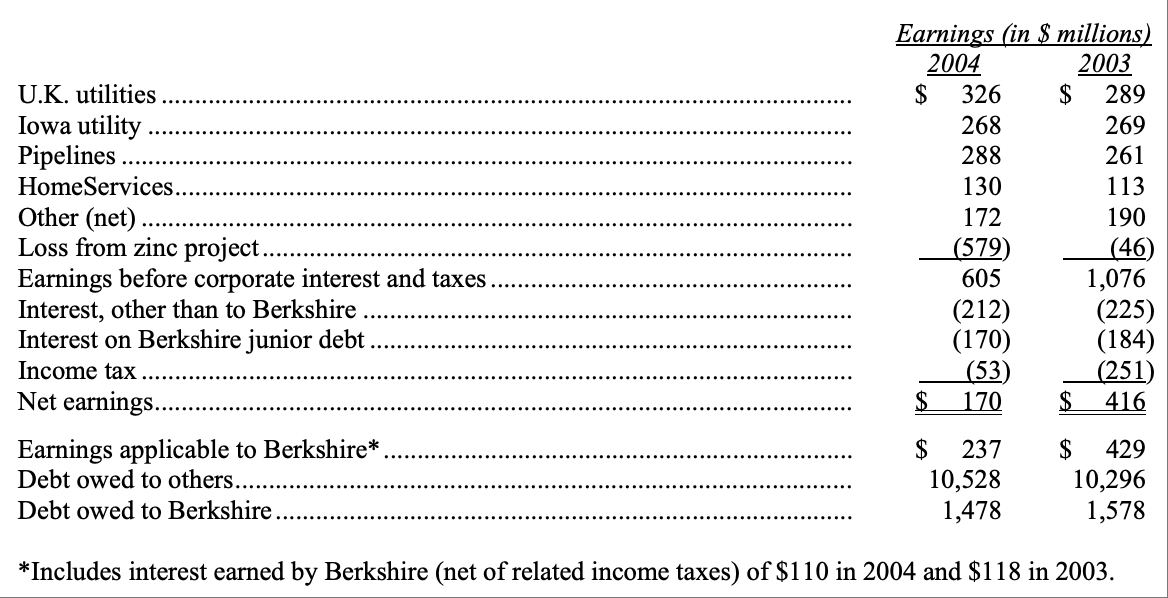
A breakdown of MidAmerican’s results follows. In 2004, the “other” category includes a $72.2 million profit from sale of an Enron receivable that was thrown in when we purchased Northern Natural two years earlier. Walter, Dave and I, as natives of Omaha, view this unanticipated gain as war reparations — partial compensation for the loss our city suffered in 1986 when Ken Lay moved Northern to Houston, after promising to leave the company here. (For details, see Berkshire’s 2002 annual report.)
下面给出 MidAmerican 业绩的拆分。2004 年,“其他(other)”类别包含一项 7,220 万美元的利润:来自出售一笔 Enron 应收款(receivable)。这笔应收款是在我们两年前收购 Northern Natural 时“附送”的。Walter、Dave 和我都是 Omaha 人,我们把这笔意外收益视作战争赔款(war reparations)——用来部分补偿我们城市在 1986 年遭受的损失:当时 Ken Lay 在承诺会把公司留在这里之后,仍把 Northern 迁去了 Houston。(详情见 Berkshire 2002 年年报。)
Here are some key figures on MidAmerican's operations:
下面是 MidAmerican 运营的一些关键数据:
Insurance
保险业务
Since Berkshire purchased National Indemnity (“NICO”) in 1967, property-casualty insurance has been our core business and the propellant of our growth. Insurance has provided a fountain of funds with which we’ve acquired the securities and businesses that now give us an ever-widening variety of earnings streams. So in this section, I will be spending a little time telling you how we got where we are.
自从 Berkshire 在 1967 年收购 National Indemnity(“NICO”)以来,财产-意外险(property-casualty insurance)一直是我们的核心业务,也是推动我们增长的推进剂(propellant)。保险为我们提供了源源不断的资金之泉,使我们得以收购证券与企业,而这些资产如今又为我们带来了越来越多元的盈利来源。因此在这一部分,我会花一点时间讲讲我们是如何走到今天的。
The source of our insurance funds is “float,” which is money that doesn’t belong to us but that we temporarily hold. Most of our float arises because (1) premiums are paid upfront though the service we provide — insurance protection — is delivered over a period that usually covers a year and; (2) loss events that occur today do not always result in our immediately paying claims, because it sometimes takes many years for losses to be reported (asbestos losses would be an example), negotiated and settled. The $20 million of float that came with our 1967 purchase has now increased — both by way of internal growth and acquisitions — to $46.1 billion.
我们保险资金的来源是“float”(浮存金),也就是一笔不属于我们、但我们暂时持有的资金。我们的浮存金大多来自两个原因:(1)保费是预先收取的,但我们提供的服务——保险保障——是在一段时间内逐步交付的,这段期间通常覆盖一年;(2)今天发生的损失事件,并不一定会让我们立刻支付理赔,因为有时损失需要很多年后才会被报告(石棉相关损失就是例子)、协商并最终结案。我们在 1967 年收购时带来的 2,000 万美元浮存金,如今已通过内生增长与收购扩大到 461 亿美元。
Float is wonderful — if it doesn’t come at a high price. Its cost is determined by underwriting results, meaning how the expenses and losses we will ultimately pay compare with the premiums we have received. When an underwriting profit is achieved — as has been the case at Berkshire in about half of the 38 years we have been in the insurance business — float is better than free. In such years, we are actually paid for holding other people’s money. For most insurers, however, life has been far more difficult: In aggregate, the property-casualty industry almost invariably operates at an underwriting loss. When that loss is large, float becomes expensive, sometimes devastatingly so.
浮存金很美妙——前提是它的“价格”不高。它的成本由承保结果(underwriting results)决定,也就是:我们最终要支付的费用与赔付,与我们已经收取的保费相比究竟如何。当我们取得承保利润(underwriting profit)时——这在 Berkshire 从事保险业务的 38 年里大约有一半年份做到了——浮存金就不只是“免费”,甚至比免费还好:在这些年份里,我们实际上是“拿着别人的钱还能收取报酬”。但对大多数保险公司而言,日子要艰难得多:整体来看,财产-意外险行业几乎总是处于承保亏损状态。当亏损很大时,浮存金就会变得昂贵,甚至带来毁灭性后果。
Insurers have generally earned poor returns for a simple reason: They sell a commodity-like product. Policy forms are standard, and the product is available from many suppliers, some of whom are mutual companies (“owned” by policyholders rather than stockholders) with profit goals that are limited. Moreover, most insureds don’t care from whom they buy. Customers by the millions say “I need some Gillette blades” or “I’ll have a Coke” but we wait in vain for “I’d like a National Indemnity policy, please.” Consequently, price competition in insurance is usually fierce. Think airline seats.
保险公司通常回报很差,原因很简单:它们卖的是一种近似大宗商品的产品(commodity-like)。保单条款(policy forms)相当标准化,市场上供应者众多,其中一些还是互助保险公司(mutual companies,“由保单持有人而非股东‘拥有’”),其盈利目标天然受限。更重要的是,大多数被保险人并不在乎从谁那里买保险。成千上万的消费者会说“我需要一些 Gillette 刀片”或“我要一杯 Coke”,但我们却很难听到有人说“请给我一份 National Indemnity 的保单。”因此,保险行业的价格竞争通常异常激烈。想想航空公司机票座位就知道了。
So, you may ask, how do Berkshire’s insurance operations overcome the dismal economics of the industry and achieve some measure of enduring competitive advantage? We’ve attacked that problem in several ways. Let’s look first at NICO’s strategy.
那么你可能会问:Berkshire 的保险业务是如何克服行业糟糕的经济性,并获得某种可持续的竞争优势的?我们从几个方向去解决这个问题。先从 NICO 的策略讲起。
When we purchased the company — a specialist in commercial auto and general liability insurance — it did not appear to have any attributes that would overcome the industry’s chronic troubles. It was not well-known, had no informational advantage (the company has never had an actuary), was not a low-cost operator, and sold through general agents, a method many people thought outdated. Nevertheless, for almost all of the past 38 years, NICO has been a star performer. Indeed, had we not made this acquisition, Berkshire would be lucky to be worth half of what it is today.
当我们收购这家公司时——它专注于商业车险(commercial auto)和一般责任险(general liability insurance)——它看起来并不具备任何足以克服行业长期困境的优势。它不出名,没有信息优势(公司从来没有雇过精算师),也不是低成本运营者,而且通过一般代理人(general agents)渠道销售——许多人认为这种方式已经过时。尽管如此,在过去 38 年中的几乎所有年份里,NICO 都是明星级的表现者。事实上,如果当年我们没有完成这笔收购,Berkshire 今天的价值能有现在的一半就算走运了。
What we’ve had going for us is a managerial mindset that most insurers find impossible to replicate. Take a look at the facing page. Can you imagine any public company embracing a business model that would lead to the decline in revenue that we experienced from 1986 through 1999? That colossal slide, it should be emphasized, did not occur because business was unobtainable. Many billions of premium dollars were readily available to NICO had we only been willing to cut prices. But we instead consistently priced to make a profit, not to match our most optimistic competitor. We never left customers — but they left us.
我们真正的优势,是一种大多数保险公司根本无法复制的管理者心态(managerial mindset)。看看对页的数据:你能想象有任何一家上市公司,会主动拥抱一种商业模式——它会导致我们在 1986 到 1999 年间经历的那种营收下滑吗?必须强调的是,这种断崖式下滑并不是因为拿不到业务。只要我们愿意降价,市场上有“数十亿美元”的保费规模可以轻易被 NICO 拿到。但我们始终坚持:定价的目标是赚取利润,而不是去匹配我们最乐观的竞争对手的价格。我们从未离开客户——是客户离开了我们。
Most American businesses harbor an “institutional imperative” that rejects extended decreases in volume. What CEO wants to report to his shareholders that not only did business contract last year but that it will continue to drop? In insurance, the urge to keep writing business is also intensified because the consequences of foolishly-priced policies may not become apparent for some time. If an insurer is optimistic in its reserving, reported earnings will be overstated, and years may pass before true loss costs are revealed (a form of self-deception that nearly destroyed GEICO in the early 1970s).
大多数美国企业都有一种“制度性冲动”(institutional imperative),它会本能地排斥长期的业务量下降。哪个 CEO 愿意向股东报告:不仅去年业务收缩了,而且未来还会继续下滑?而在保险业,这种“继续承保、继续做大规模”的冲动会更强,因为愚蠢定价的保单所带来的后果,往往要过一段时间才会显现。如果一家保险公司在准备金计提(reserving)上过于乐观,那么其报表利润就会被高估,而且可能要过很多年,真实的损失成本才会暴露出来。(这是一种自我欺骗,其形式几乎在 1970 年代初毁掉了 GEICO。)
* It takes a long time to learn the true profitability of any given year. First, many claims are received after the end of the year, and we must estimate how many of these there will be and what they will cost. (In insurance jargon, these claims are termed IBNR — incurred but not reported.) Second, claims often take years, or even decades, to settle, which means there can be many surprises along the way. For these reasons, the results in this column simply represent our best estimate at the end of 2004 as to how we have done in prior years. Profit margins for the years through 1999 are probably close to correct because these years are “mature,” in the sense that they have few claims still outstanding. The more recent the year, the more guesswork is involved. In particular, the results shown for 2003 and 2004 are apt to change significantly.
要真正弄清某一年到底赚没赚钱,需要很长时间。首先,很多理赔会在年底之后才收到,我们必须估计会有多少此类理赔、以及它们将花多少钱。(用保险行话说,这类理赔叫 IBNR——incurred but not reported,已发生但未报案。)其次,理赔往往需要多年、甚至几十年才能结案,这意味着过程中可能不断出现意外。基于这些原因,本栏里的结果仅代表我们在 2004 年末对过往年份经营表现的“最佳估计”。截至 1999 年的那些年份,其利润率大概率较为接近真实情况,因为这些年份已经“成熟”(mature):仍未结清的理赔很少。年份越近,猜测成分越大。尤其是表中 2003 年和 2004 年的结果,很可能会发生显著变化。
Finally, there is a fear factor at work, in that a shrinking business usually leads to layoffs. To avoid pink slips, employees will rationalize inadequate pricing, telling themselves that poorly-priced business must be tolerated in order to keep the organization intact and the distribution system happy. If this course isn’t followed, these employees will argue, the company will not participate in the recovery that they invariably feel is just around the corner.
最后,还有一个“恐惧因素”在起作用:业务收缩通常会导致裁员。为了避免拿到解雇通知(pink slips),员工会为不合理的定价找理由——告诉自己:为了让组织不散、让销售/渠道体系满意,必须容忍那些定价过低的业务。他们还会争辩说,如果不这么做,公司就无法参与到他们“总觉得就在眼前”的那轮复苏中。
To combat employees’ natural tendency to save their own skins, we have always promised NICO’s workforce that no one will be fired because of declining volume, however severe the contraction. (This is not Donald Trump’s sort of place.) NICO is not labor-intensive, and, as the table suggests, can live with excess overhead. It can’t live, however, with underpriced business and the breakdown in underwriting discipline that accompanies it. An insurance organization that doesn’t care deeply about underwriting at a profit this year is unlikely to care next year either.
为了对抗员工“先保自己饭碗”的自然倾向,我们一直向 NICO 的员工承诺:无论业务萎缩得多严重,都不会因为保费规模下降而解雇任何人。(这里不是 Donald Trump 那种地方。)NICO 并不是劳动密集型企业,而且正如表格所示,它可以承受一定的冗余管理费用(excess overhead)。但它承受不了的是:低价承保,以及随之而来的承保纪律(underwriting discipline)崩坏。一个今年都不在乎“以盈利承保”的保险组织,明年也大概率不会在乎。

嘴欠的地方,20年后吃点小亏。
Naturally, a business that follows a no-layoff policy must be especially careful to avoid overstaffing when times are good. Thirty years ago Tom Murphy, then CEO of Cap Cities, drove this point home to me with a hypothetical tale about an employee who asked his boss for permission to hire an assistant. The employee assumed that adding $20,000 to the annual payroll would be inconsequential. But his boss told him the proposal should be evaluated as a $3 million decision, given that an additional person would probably cost at least that amount over his lifetime, factoring in raises, benefits and other expenses (more people, more toilet paper). And unless the company fell on very hard times, the employee added would be unlikely to be dismissed, however marginal his contribution to the business.
当然,一个实行“不裁员政策”的企业,在景气时就必须格外小心,避免人员扩张过头。三十年前,Cap Cities 的 CEO Tom Murphy 用一个假想故事把这个道理牢牢钉进了我的脑子:某位员工向老板申请许可,想招一个助理。这位员工以为,每年多付 2 万美元工资无关紧要。但老板告诉他:这个提议应该被当作一项 300 万美元的决策来评估——因为算上加薪、福利以及其他开销,一个新增员工在其职业生涯里很可能至少要花掉这么多钱(人多了,厕纸也用得更多)。并且,除非公司遭遇极其艰难的时期,否则这个新增员工很可能不会被解雇——无论他对业务的贡献多么边际化。
It takes real fortitude — embedded deep within a company’s culture — to operate as NICO does. Anyone examining the table can scan the years from 1986 to 1999 quickly. But living day after day with dwindling volume — while competitors are boasting of growth and reaping Wall Street’s applause — is an experience few managers can tolerate. NICO, however, has had four CEOs since its formation in 1940 and none have bent. (It should be noted that only one of the four graduated from college. Our experience tells us that extraordinary business ability is largely innate.)
要像 NICO 这样运作,需要真正的坚韧(fortitude),而且这种坚韧必须深深嵌入公司的文化之中。任何看这张表的人,都可以很快扫过 1986 到 1999 年。但在现实中,日复一日地承受业务量不断萎缩——与此同时竞争对手吹嘘增长、收获华尔街掌声——这种体验几乎没几个管理者能忍受。然而,NICO 自 1940 年成立以来换过四位 CEO,没有一位弯过腰。(值得一提的是,这四位里只有一位大学毕业。我们的经验告诉我们:非凡的商业能力在很大程度上是天生的。)
The current managerial star — make that superstar — at NICO is Don Wurster (yes, he’s “the graduate”), who has been running things since 1989. His slugging percentage is right up there with Barry Bonds’ because, like Barry, Don will accept a walk rather than swing at a bad pitch. Don has now amassed $950 million of float at NICO that over time is almost certain to be proved the negative-cost kind. Because insurance prices are falling, Don’s volume will soon decline very significantly and, as it does, Charlie and I will applaud him ever more loudly.
NICO 现任的管理明星——不,应该说是超级明星——是 Don Wurster(没错,他就是“那个毕业生”),自 1989 年起一直负责公司运营。他的“长打率”(slugging percentage)几乎可以和 Barry Bonds 相提并论,因为和 Barry 一样,Don 宁可接受保送(walk),也不愿对一个坏球挥棒。Don 迄今已在 NICO 累积了 9.5 亿美元的浮存金(float),从长期看,几乎可以确定会被证明是那种“负成本”的浮存金。由于保险价格正在下行,Don 的保费规模很快会显著下降;而当这种下降发生时,Charlie 和我会更加热烈地为他鼓掌。
* * * * * * * * * * * *
Another way to prosper in a commodity-type business is to be the low-cost operator. Among auto insurers operating on a broad scale, GEICO holds that cherished title. For NICO, as we have seen, an ebb-and-flow business model makes sense. But a company holding a low-cost advantage must pursue an unrelenting foot-to-the-floor strategy. And that’s just what we do at GEICO.
在类似大宗商品(commodity-type)的行业里,另一个致胜之道是成为低成本运营者(low-cost operator)。在全国性规模经营的车险公司中,GEICO 拥有这个令人向往的头衔。对 NICO 来说,正如我们所见,“涨落有致”(ebb-and-flow)的经营模式是合理的。但一家拥有低成本优势的公司,必须采取“油门踩到底、永不松脚”的策略(unrelenting foot-to-the-floor strategy)。这正是我们在 GEICO 所做的。
NICO、GEICO,两种应对商品化产品的策略。
A century ago, when autos first appeared, the property-casualty industry operated as a cartel. The major companies, most of which were based in the Northeast, established “bureau” rates and that was it. No one cut prices to attract business. Instead, insurers competed for strong, well-regarded agents, a focus that produced high commissions for agents and high prices for consumers.
大约一个世纪前,当汽车刚出现时,财产-意外险行业以一种“卡特尔”(cartel)的方式运作。几家大公司——多数位于美国东北部——制定所谓的“bureau”统一费率,就这么定了。没有人会通过降价来吸引业务。相反,保险公司竞争的是那些强势、声望高的代理人;这种竞争导致代理人佣金很高、消费者价格也很高。
In 1922, State Farm was formed by George Mecherle, a farmer from Merna, Illinois, who aimed to take advantage of the pricing umbrella maintained by the high-cost giants of the industry. State Farm employed a “captive” agency force, a system keeping its acquisition costs lower than those incurred by the bureau insurers (whose “independent” agents successfully played off one company against another). With its low-cost structure, State Farm eventually captured about 25% of the personal lines (auto and homeowners) business, far outdistancing its once-mighty competitors. Allstate, formed in 1931, put a similar distribution system into place and soon became the runner-up in personal lines to State Farm. Capitalism had worked its magic, and these low-cost operations looked unstoppable.
1922 年,来自伊利诺伊州 Merna 的农民 George Mecherle 创立了 State Farm,目的是利用行业高成本巨头维持的“价格保护伞”(pricing umbrella)。State Farm 采用“专属”(captive)代理人体系,使其获客成本低于那些“bureau 保险公司”(它们依赖“独立”(independent)代理人,而独立代理人会在多家公司之间周旋比价,从而抬高保险公司的获客成本)。凭借低成本结构,State Farm 最终拿下了约 25% 的个人险(personal lines:车险与房屋险)市场份额,远远甩开昔日强大的竞争对手。成立于 1931 年的 Allstate 也建立了类似的渠道体系,很快成为个人险领域仅次于 State Farm 的第二名。资本主义施展了它的魔法:这些低成本运营看起来势不可挡。
But a man named Leo Goodwin had an idea for an even more efficient auto insurer and, with a skimpy $200,000, started GEICO in 1936. Goodwin’s plan was to eliminate the agent entirely and to deal instead directly with the auto owner. Why, he asked himself, should there be any unnecessary and expensive links in the distribution mechanism when the product, auto insurance, was both mandatory and costly. Purchasers of business insurance, he reasoned, might well require professional advice, but most consumers knew what they needed in an auto policy. That was a powerful insight.
但有个叫 Leo Goodwin 的人,想出了一个更高效率的车险公司模式,并用区区 20 万美元在 1936 年创办了 GEICO。Goodwin 的计划是把代理人这一环彻底拿掉,直接与车主交易。他问自己:既然车险既是强制性的(mandatory)又昂贵,那么在销售分销机制里,为什么要保留那些不必要且昂贵的链条(links)?他认为,购买商业保险的客户可能确实需要专业建议,但大多数消费者其实清楚一份车险保单需要什么。这是一个非常强的洞见。
Originally, GEICO mailed its low-cost message to a limited audience of government employees. Later, it widened its horizons and shifted its marketing emphasis to the phone, working inquiries that came from broadcast and print advertising. And today the Internet is coming on strong.
最初,GEICO 把“低成本”理念通过邮寄(mailed)的方式传递给一个小众群体:政府雇员。后来,公司拓宽视野,把营销重点转向电话(phone),通过广播与印刷广告带来的咨询电话来促成投保。而今天,互联网正在强势崛起。
Between 1936 and 1975, GEICO grew from a standing start to a 4% market share, becoming the country’s fourth largest auto insurer. During most of this period, the company was superbly managed, achieving both excellent volume gains and high profits. It looked unstoppable. But after my friend and hero Lorimer Davidson retired as CEO in 1970, his successors soon made a huge mistake by under-reserving for losses. This produced faulty cost information, which in turn produced inadequate pricing. By 1976, GEICO was on the brink of failure.
1936 到 1975 年间,GEICO 从零起步增长到 4% 的市场份额,成为美国第四大车险公司。在这段时期的大部分时间里,公司管理极其出色,同时实现了可观的规模增长与高利润。它看起来同样势不可挡。但在我的朋友与英雄 Lorimer Davidson 于 1970 年卸任 CEO 之后,继任者很快犯下一个巨大错误:对损失准备金计提不足(under-reserving for losses)。这导致成本信息失真,进而导致定价不足。到 1976 年,GEICO 已濒临失败。
Jack Byrne then joined GEICO as CEO and, almost single-handedly, saved the company by heroic efforts that included major price increases. Though GEICO’s survival required these, policyholders fled the company, and by 1980 its market share had fallen to 1.8%. Subsequently, the company embarked on some unwise diversification moves. This shift of emphasis away from its extraordinary core business stunted GEICO’s growth, and by 1993 its market share had grown only fractionally, to 1.9%. Then Tony Nicely took charge.
随后 Jack Byrne 出任 GEICO 的 CEO,几乎凭一己之力通过一系列英雄式举措挽救了公司,其中包括大幅提价。虽然 GEICO 的生存必须如此,但保单持有人纷纷逃离,到 1980 年其市场份额跌至 1.8%。之后,公司又进行了一些不明智的多元化尝试。这种把重心从其非凡核心业务上移开的做法抑制了 GEICO 的增长,到 1993 年其市场份额只略微回升到 1.9%。随后,Tony Nicely 接手。
And what a difference that’s made: In 2005 GEICO will probably secure a 6% market share. Better yet, Tony has matched growth with profitability. Indeed, GEICO delivers all of its constituents major benefits: In 2004 its customers saved $1 billion or so compared to what they would otherwise have paid for coverage, its associates earned a $191 million profit-sharing bonus that averaged 24.3% of salary, and its owner — that’s us — enjoyed excellent financial returns.
而 Tony 上任带来的变化之大,令人惊叹:到 2005 年,GEICO 很可能将拿下 6% 的市场份额。更重要的是,Tony 做到了“增长与盈利并行”。事实上,GEICO 给所有利益相关方都带来了重大好处:2004 年,GEICO 的客户相比其他方案大约节省了 10 亿美元的保费;GEICO 的员工(associates)拿到了 1.91 亿美元的利润分享奖金,平均相当于工资的 24.3%;而它的所有者——也就是我们——则享受了极佳的财务回报。
There’s more good news. When Jack Byrne was rescuing the company in 1976, New Jersey refused to grant him the rates he needed to operate profitably. He therefore promptly — and properly — withdrew from the state. Subsequently, GEICO avoided both New Jersey and Massachusetts, recognizing them as two jurisdictions in which insurers were destined to struggle.
还有更多好消息。1976 年 Jack Byrne 在拯救公司时,新泽西州拒绝批准他需要的费率,导致他无法实现盈利运营。因此他立刻——而且是正确地——退出了该州。此后,GEICO 也一直回避新泽西与马萨诸塞,因为我们认为:这两个司法辖区(jurisdictions)里,保险公司注定会举步维艰。
In 2003, however, New Jersey took a new look at its chronic auto-insurance problems and enacted legislation that would curb fraud and allow insurers a fair playing field. Even so, one might have expected the state’s bureaucracy to make change slow and difficult.
不过在 2003 年,新泽西重新审视了其长期存在的车险问题,并通过立法以遏制欺诈,同时让保险公司能够在一个公平的环境中竞争。即便如此,人们可能仍会预期:州政府官僚体系会让改革推进缓慢、执行艰难。
But just the opposite occurred. Holly Bakke, the New Jersey insurance commissioner, who would be a success in any line of work, was determined to turn the law’s intent into reality. With her staff’s cooperation, GEICO ironed out the details for re-entering the state and was licensed last August. Since then, we’ve received a response from New Jersey drivers that is multiples of my expectations.
然而,事实恰恰相反。新泽西保险监管官 Holly Bakke——无论做哪一行都能成功的人——决心把法律的“意图”变成现实。在她和团队的配合下,GEICO 把重新进入该州的各项细节都理顺了,并在去年 8 月拿到了执照。从那以后,新泽西司机给我们的反馈,远远超出我的预期,成倍增长。
We are now serving 140,000 policyholders — about 4% of the New Jersey market — and saving them substantial sums (as we do drivers everywhere). Word-of-mouth recommendations within the state are causing inquiries to pour in. And once we hear from a New Jersey prospect, our closure rate — the percentage of policies issued to inquiries received — is far higher in the state than it is nationally.
我们现在服务着 140,000 名投保人——约占新泽西市场的 4%——并为他们节省了可观的费用(就像我们在所有地区为车主做的一样)。州内的口碑推荐使得咨询量不断涌入。而且,一旦新泽西的潜在客户(prospect)联系到我们,我们的“成交率”(closure rate:咨询转化为出单的比例)在该州显著高于全国水平。
We make no claim, of course, that we can save everyone money. Some companies, using rating systems that are different from ours, will offer certain classes of drivers a lower rate than we do. But we believe GEICO offers the lowest price more often than any other national company that serves all segments of the public. In addition, in most states, including New Jersey, Berkshire shareholders receive an 8% discount. So gamble fifteen minutes of your time and go to GEICO.com — or call 800-847-7536 — to see whether you can save big money (which you might want to use, of course, to buy other Berkshire products).
当然,我们并不声称能让每个人都省钱。某些公司采用与我们不同的评级(rating)体系,会对某些类别的司机给出比我们更低的费率。但我们相信:在服务所有公众细分人群(all segments of the public)的全国性公司中,GEICO 以更高的频率提供最低价格。除此之外,在大多数州(包括新泽西),Berkshire 股东还能享受 8% 的折扣。所以,拿 15 分钟赌一把,去 GEICO.com 看看——或者拨打 800-847-7536——看看你是否能省下一大笔钱(当然,你也许会想把省下的钱用来购买其他 Berkshire 的产品)。
* * * * * * * * * * * *
Reinsurance — insurance sold to other insurers who wish to lay off part of the risks they have assumed — should not be a commodity product. At bottom, any insurance policy is simply a promise, and as everyone knows, promises vary enormously in their quality.
再保险(Reinsurance)——也就是卖给其他保险公司的保险;这些公司希望把自己已经承担的一部分风险转移出去(lay off)——按理说不应该是一种大宗商品式的产品(commodity product)。归根结底,任何保险保单不过是一种承诺(promise),而众所周知,承诺的质量差异极大。
NICO和Ajit的再保险是真正的重点,而不是Geico。
At the primary insurance level, nevertheless, just who makes the promise is often of minor importance. In personal-lines insurance, for example, states levy assessments on solvent companies to pay the policyholders of companies that go broke. In the business-insurance field, the same arrangement applies to workers’ compensation policies. “Protected” policies of these types account for about 60% of the property-casualty industry’s volume. Prudently-run insurers are irritated by the need to subsidize poor or reckless management elsewhere, but that’s the way it is.
然而在原保险(primary insurance)的层面,“承诺是谁做出的”往往并没那么重要。比如在个人险(personal-lines)中,州政府会向仍具偿付能力的公司征收评估费(assessments),用来赔付那些破产公司的保单持有人。在商业险领域,工伤赔偿险(workers’ compensation)也有同样安排。这类被“保护”的保单大约占财产-意外险行业保费规模的 60%。经营谨慎的保险公司当然会对“被迫补贴别处糟糕或鲁莽的管理”感到恼火,但现实就是如此。
Other forms of business insurance at the primary level involve promises that carry greater risks for the insured. When Reliance Insurance and Home Insurance were run into the ground, for example, their promises proved to be worthless. Consequently, many holders of their business policies (other than those covering workers’ compensation) suffered painful losses.
而原保险层面的其他商业险,则意味着被保险人要承担更高的“承诺风险”。例如,当 Reliance Insurance 和 Home Insurance 被经营到破产时,它们的承诺就被证明一文不值。结果,许多持有它们商业险保单的人(工伤赔偿险除外)遭受了痛苦的损失。
The solvency risk in primary policies, however, pales in comparison to that lurking in reinsurance policies. When a reinsurer goes broke, staggering losses almost always strike the primary companies it has dealt with. This risk is far from minor: GEICO has suffered tens of millions in losses from its careless selection of reinsurers in the early 1980s.
但即便如此,原保险保单的偿付能力风险(solvency risk),与再保险保单中潜伏的风险相比,也显得小巫见大巫。一旦再保险公司破产,与其交易过的原保险公司几乎总会遭受惊人的损失。这种风险绝非细枝末节:GEICO 就曾因为在 1980 年代初不谨慎地选择再保险人(reinsurers),而遭受过数千万美元的损失。
Were a true mega-catastrophe to occur in the next decade or two — and that’s a real possibility — some reinsurers would not survive. The largest insured loss to date is the World Trade Center disaster, which cost the insurance industry an estimated $35 billion. Hurricane Andrew cost insurers about $15.5 billion in 1992 (though that loss would be far higher in today’s dollars). Both events rocked the insurance and reinsurance world. But a $100 billion event, or even a larger catastrophe, remains a possibility if either a particularly severe earthquake or hurricane hits just the wrong place. Four significant hurricanes struck Florida during 2004, causing an aggregate of $25 billion or so in insured losses. Two of these — Charley and Ivan — could have done at least three times the damage they did had they entered the U.S. not far from their actual landing points.
如果在未来一二十年发生一次真正的“超级灾难”(true mega-catastrophe)——这确实有可能——一些再保险公司将无法生存。迄今为止最大的已保险损失是 World Trade Center 灾难,给保险业造成的损失估计约 350 亿美元。1992 年的 Hurricane Andrew 给保险公司造成的损失约 155 亿美元(按今天币值,这个数字会高得多)。这两件事都震撼了保险与再保险世界。但如果一次特别严重的地震或飓风在“最糟的地点”登陆,1000 亿美元级别的事件——甚至更大的灾难——仍然是可能发生的。2004 年有四场重要飓风袭击佛罗里达,合计造成约 250 亿美元的已保险损失。其中两场——Charley 和 Ivan——如果进入美国的位置离其实际登陆点稍有偏差,造成的损失至少可能是现实的三倍。
Many insurers regard a $100 billion industry loss as “unthinkable” and won’t even plan for it. But at Berkshire, we are fully prepared. Our share of the loss would probably be 3% to 5%, and earnings from our investments and other businesses would comfortably exceed that cost. When “the day after” arrives, Berkshire’s checks will clear.
许多保险公司认为“保险业损失 1000 亿美元”是不可想象(unthinkable)的,甚至不会为此做规划。但在 Berkshire,我们完全做好了准备。我们承担的损失份额大概会是 3% 到 5%;而我们投资与其他业务的盈利,将足以轻松覆盖这项成本。当“灾后第二天”(the day after)到来时,Berkshire 开出的支票一定能兑付。
Though the hurricanes hit us with a $1.25 billion loss, our reinsurance operations did well last year. At General Re, Joe Brandon has restored a long-admired culture of underwriting discipline that, for a time, had lost its way. The excellent results he realized in 2004 on current business, however, were offset by adverse developments from the years before he took the helm. At NICO’s reinsurance operation, Ajit Jain continues to successfully underwrite huge risks that no other reinsurer is willing or able to accept. Ajit’s value to Berkshire is enormous.
尽管这些飓风让我们遭受了 12.5 亿美元的损失,我们的再保险业务去年仍表现不错。在 General Re,Joe Brandon 重新恢复了那种长期以来令人钦佩的“承保纪律文化”(underwriting discipline),而这套文化在一段时间里曾经迷失方向。不过,他在 2004 年对当前业务实现的优异结果,被他上任之前那些年份的负面发展(adverse developments)所抵消。在 NICO 的再保险业务中,Ajit Jain 继续成功承保那些其他任何再保险人都不愿意或无法承接的巨大风险。Ajit 对 Berkshire 的价值极其巨大。
* * * * * * * * * * * *
Our insurance managers, maximizing the competitive strengths I’ve mentioned in this section, again delivered first-class underwriting results last year. As a consequence, our float was better than costless. Here’s the scorecard:
我们的保险业务经理们,充分发挥了我在本节提到的竞争优势,去年再次交出了“一流”的承保结果。于是,我们的浮存金(float)不仅是“无成本”的,甚至是“负成本”的。下面是成绩单:
Berkshire’s float increased $1.9 billion in 2004, even though a few insureds opted to commute (that is, unwind) certain reinsurance contracts. We agree to such commutations only when we believe the economics are favorable to us (after giving due weight to what we might earn in the future on the money we are returning).
2004 年,Berkshire 的浮存金增加了 19 亿美元,尽管有少数被保险方选择对某些再保险合同进行“commute”(也就是提前结清、解除/反向平仓这些合同)。我们只有在确信对我们而言经济上划算时才会同意这种 commutation(并且会充分考虑:我们把钱退回去之后,未来本可以用这笔钱赚到多少收益)。
To summarize, last year we were paid more than $1.5 billion to hold an average of about $45.2 billion. In 2005 pricing will be less attractive than it has been. Nevertheless, absent a mega-catastrophe, we have a decent chance of achieving no-cost float again this year.
总结一下:去年我们“拿着”平均约 452 亿美元的资金,不仅没付成本,反而被支付了超过 15 亿美元。2005 年的定价会比过去更不吸引人。尽管如此,只要不发生超级灾难(mega-catastrophe),我们今年仍有相当机会再次实现“无成本浮存金”。
Finance and Finance Products
金融与金融产品
Last year in this section we discussed a potpourri of activities. In this report, we’ll skip over several that are now of lesser importance: Berkadia is down to tag ends; Value Capital has added other investors, negating our expectation that we would need to consolidate its financials into ours; and the trading operation that I run continues to shrink.
去年在这一部分我们讨论了一锅“大杂烩”(potpourri)式的活动。本报告里,我们会略过其中几项如今重要性较低的业务:Berkadia 已经只剩些零碎尾巴(down to tag ends);Value Capital 引入了其他投资者,使我们原先认为“需要把它的财务并表进我们报表”的预期不再成立;而由我负责的交易业务也在持续收缩。
• Both of Berkshire’s leasing operations rebounded last year. At CORT (office furniture), earnings remain inadequate, but are trending upward. XTRA disposed of its container and intermodal businesses in order to concentrate on trailer leasing, long its strong suit. Overhead has been reduced, asset utilization is up and decent profits are now being achieved under Bill Franz, the company’s new CEO.
Berkshire 两家租赁业务去年都出现反弹。CORT(办公家具)盈利依然不足,但趋势向上。XTRA 为了专注于其长期强项——挂车租赁(trailer leasing)——处置了集装箱与联运(container and intermodal)业务。公司削减了管理费用(overhead),资产利用率上升,在新任 CEO Bill Franz 的带领下,如今已经实现了不错的利润。
• The wind-down of Gen Re Securities continues. We decided to exit this derivative operation three years ago, but getting out is easier said than done. Though derivative instruments are purported to be highly liquid — and though we have had the benefit of a benign market while liquidating ours — we still had 2,890 contracts outstanding at yearend, down from 23,218 at the peak. Like Hell, derivative trading is easy to enter but difficult to leave. (Other similarities come to mind as well.)
Gen Re Securities 的收缩/退出仍在继续。三年前我们决定退出这项衍生品业务(derivative operation),但“退出”说起来容易做起来难。尽管衍生品工具号称流动性很强——并且我们在清算时也赶上了相对温和(benign)的市场环境——但到年末我们仍有 2,890 份合约未了结,而在高峰时期这一数字曾高达 23,218 份。就像地狱一样,衍生品交易“进来容易,出去难”。(另外一些相似之处我也想得到。)
Gen Re’s derivative contracts have always been required to be marked to market, and I believe the company’s management conscientiously tried to make realistic “marks.” The market prices of derivatives, however, can be very fuzzy in a world in which settlement of a transaction is sometimes decades away and often involves multiple variables as well. In the interim the marks influence the managerial and trading bonuses that are paid annually. It’s small wonder that phantom profits are often recorded.
Gen Re 的衍生品合约一直都要求按市价计价(marked to market)。我相信公司管理层也确实尽责地尝试给出现实的“估值标记”(marks)。但在一个“交易结算有时要几十年以后才发生、并且往往还涉及多个变量”的世界里,衍生品的市场价格可能非常模糊。在此期间,这些估值标记会影响每年发放的管理层与交易员奖金。因此,账面上记录出“幽灵利润”(phantom profits)也就不足为奇了。
Investors should understand that in all types of financial institutions, rapid growth sometimes masks major underlying problems (and occasionally fraud). The real test of the earning power of a derivatives operation is what it achieves after operating for an extended period in a no-growth mode. You only learn who has been swimming naked when the tide goes out.
投资者应当明白:在各类金融机构里,“快速增长”有时会掩盖重大的潜在问题(偶尔甚至是欺诈)。衡量一家衍生品业务真正赚钱能力的关键测试,是看它在长期“零增长模式”(no-growth mode)下能取得什么结果。只有当潮水退去,你才知道谁一直在裸泳。
股票市场也是如此,指数零增长的情况下做的怎么样。
• After 40 years, we’ve finally generated a little synergy at Berkshire: Clayton Homes is doing well and that’s in part due to its association with Berkshire. The manufactured home industry continues to reside in the intensive care unit of Corporate America, having sold less than 135,000 new homes last year, about the same as in 2003. Volume in these years was the lowest since 1962, and it was also only about 40% of annual sales during the years 1995-99. That era, characterized by irresponsible financing and naïve funders, was a fool’s paradise for the industry. Because one major lender after another has fled the field, financing continues to bedevil manufacturers, retailers and purchasers of manufactured homes. Here Berkshire’s support has proven valuable to Clayton. We stand ready to fund whatever makes sense, and last year Clayton’s management found much that qualified.
40 年后,我们终于在 Berkshire 产生了一点“协同效应”(synergy):Clayton Homes 经营得不错,而这部分归功于它与 Berkshire 的关联。预制房(manufactured home)行业仍然躺在 Corporate America 的“重症监护室”(intensive care unit)里:去年新房销量不足 135,000 套,和 2003 年差不多。这两年的销量是自 1962 年以来最低的,同时也仅相当于 1995-99 年间年销量的约 40%。那个时期的特点是:不负责任的融资与天真的资金提供者——对行业而言简直是“傻瓜乐园”(fool’s paradise)。由于一个又一个主要放贷机构退出,这个行业在融资上依然深受折磨,制造商、零售商与买家都难以幸免。这里 Berkshire 对 Clayton 的支持证明了价值:我们随时准备为一切“有道理的事”提供资金,而 Clayton 的管理层去年发现了不少符合这一标准的机会。
As we explained in our 2003 report, we believe in using borrowed money to support profitable, interest-bearing receivables. At the beginning of last year, we had borrowed $2 billion to relend to Clayton (at a one percentage-point markup) and by January 2005 the total was $7.35 billion. Most of the dollars added were borrowed by us on January 4, 2005, to finance a seasoned portfolio that Clayton purchased on December 30, 2004 from a bank exiting the business.
正如我们在 2003 年报告中解释的那样,我们相信:用借来的钱来支持那些有利可图、能计息的应收款(interest-bearing receivables)是合理的。去年年初,我们借入了 20 亿美元,再转贷给 Clayton(在利率上加 1 个百分点的加价,one percentage-point markup);到 2005 年 1 月,这个总额已达到 73.5 亿美元。新增的大部分资金,是我们在 2005 年 1 月 4 日借入的,用来为一组“成熟”(seasoned)的资产组合融资——该组合由 Clayton 在 2004 年 12 月 30 日从一家退出该业务的银行手中买入。
We now have two additional portfolio purchases in the works, totaling about $1.6 billion, but it’s quite unlikely that we will secure others of any significance. Therefore, Clayton’s receivables (in which originations will roughly offset payoffs) will probably hover around $9 billion for some time and should deliver steady earnings. This pattern will be far different from that of the past, in which Clayton, like all major players in its industry, “securitized” its receivables, causing earnings to be front-ended. In the last two years, the securitization market has dried up. The limited funds available today come only at higher cost and with harsh terms. Had Clayton remained independent in this period, it would have had mediocre earnings as it struggled with financing.
我们现在还有两笔额外的资产组合收购在推进中,总计约 16 亿美元,但我们几乎不可能再拿到其他任何有分量的收购。因此,Clayton 的应收款规模(新增发放大致会抵消回收款项)在未来一段时间里大概率会维持在约 90 亿美元附近,并应当带来稳定的盈利。这种模式将与过去大不相同:过去 Clayton 和行业所有主要参与者一样,会把应收款“证券化”(securitized),从而使利润前置确认(front-ended)。但在过去两年里,证券化市场已经干涸。今天仅剩的有限资金不仅成本更高,而且条款苛刻。如果 Clayton 在这段时期仍是独立公司,它会在融资困境中挣扎,盈利表现大概只是平平。
In April, Clayton completed the acquisition of Oakwood Homes and is now the industry’s largest producer and retailer of manufactured homes. We love putting more assets in the hands of Kevin Clayton, the company’s CEO. He is a prototype Berkshire manager. Today, Clayton has 11,837 employees, up from 7,136 when we purchased it, and Charlie and I are pleased that Berkshire has been useful in facilitating this growth.
4 月,Clayton 完成了对 Oakwood Homes 的收购,现在已成为行业最大的预制房制造商与零售商。我们喜欢把更多资产交到公司 CEO Kevin Clayton 手里。他是典型的 Berkshire 式经理人。如今 Clayton 拥有 11,837 名员工,而我们收购时是 7,136 人;Charlie 和我很高兴 Berkshire 在促进这份增长上发挥了作用。
For simplicity’s sake, we include all of Clayton’s earnings in this sector, though a sizable portion of these are derived from areas other than consumer finance.
为简便起见,我们把 Clayton 的全部盈利都计入本分部,尽管其中相当一部分并非来自消费金融领域。
Manufacturing, Service and Retailing Operations
制造、服务与零售业务
Our activities in this category cover the waterfront. But let’s look at a summary balance sheet and earnings statement consolidating the entire group.
我们在这一类别中的业务几乎无所不包(cover the waterfront)。但先来看一张汇总资产负债表与利润表,把整个集团合并在一起。
This eclectic group, which sells products ranging from Dilly Bars to fractional interests in Boeing 737s, earned a very respectable 21.7% on average tangible net worth last year, compared to 20.7% in 2003. It’s noteworthy that these operations used only minor financial leverage in achieving these returns. Clearly, we own some very good businesses. We purchased many of them, however, at substantial premiums to net worth — a matter that is reflected in the goodwill item shown on the balance sheet — and that fact reduces the earnings on our average carrying value to 9.9%.
这个风格各异的业务组合,从卖 Dilly Bars(冰淇淋甜品)到出售 Boeing 737 的分割权益(fractional interests),去年在“平均有形净资产”(average tangible net worth)上的回报率达到了相当可观的 21.7%,而 2003 年为 20.7%。值得注意的是,这些业务在取得上述回报时只使用了很少的财务杠杆(minor financial leverage)。显然,我们拥有一些非常优秀的企业。不过,我们收购其中许多公司时,支付的价格相对其净资产有显著溢价(substantial premiums to net worth)——这点体现在资产负债表里的 goodwill(商誉)项目中——而这一事实会把“按我们平均账面计价成本(average carrying value)计算的盈利回报”拉低到 9.9%。
Here are the pre-tax earnings for the larger categories or units.
下面是较大类别或业务单元的税前利润(pre-tax earnings)。
• In the building-products sector and at Shaw, we’ve experienced staggering cost increases for both raw-materials and energy. By December, for example, steel costs at MiTek (whose primary business is connectors for roof trusses) were running 100% over a year earlier. And MiTek uses 665 million pounds of steel every year. Nevertheless, the company continues to be an outstanding performer. Since we purchased MiTek in 2001, Gene Toombs, its CEO, has made some brilliant “bolt-on” acquisitions and is on his way to creating a mini-Berkshire.
在建材(building-products)板块以及 Shaw,我们经历了原材料与能源成本的惊人上涨。比如到 12 月,MiTek 的钢材成本较一年前高出 100%。MiTek 的主营业务是屋架(roof trusses)连接件(connectors),而它每年要用 6.65 亿磅钢材。尽管如此,公司依然表现卓越。自从我们在 2001 年收购 MiTek 以来,其 CEO Gene Toombs 做出了一些非常精彩的“补强式”(bolt-on)收购,正走在打造一个“迷你 Berkshire”的路上。
Shaw fielded a barrage of price increases in its main fiber materials during the year, a hit that added more than $300 million to its costs. (When you walk on carpet you are, in effect, stepping on processed oil.) Though we followed these hikes in costs with price increases of our own, there was an inevitable lag. Therefore, margins narrowed as the year progressed and remain under pressure today. Despite these roadblocks, Shaw, led by Bob Shaw and Julian Saul, earned an outstanding 25.6% on tangible equity in 2004. The company is a powerhouse and has a bright future.
Shaw 在一年中遭遇了主要纤维原材料价格的连番上涨,这一冲击使其成本增加了超过 3 亿美元。(当你踩在地毯上时,从某种意义上说,你踩的是“加工后的石油”。)虽然我们也通过提价来跟进成本上升,但两者之间不可避免存在滞后。因此,随着年度推进,利润率逐渐收窄,且至今仍承受压力。尽管有这些障碍,Shaw 在 Bob Shaw 与 Julian Saul 的领导下,2004 年仍在有形权益(tangible equity)上实现了出色的 25.6% 回报。公司是行业强者,未来光明。
• In apparel, Fruit of the Loom increased unit sales by 10 million dozen, or 14%, with shipments of intimate apparel for women and girls growing by 31%. Charlie, who is far more knowledgeable than I am on this subject, assures me that women are not wearing more underwear. With this expert input, I can only conclude that our market share in the women’s category must be growing rapidly. Thanks to John Holland, Fruit is on the move.
在服装业务方面,Fruit of the Loom 的销量(unit sales)增加了 1,000 万打(dozen),即增长 14%;其中女性与女童贴身衣物(intimate apparel)的出货量增长了 31%。Charlie 在这个话题上比我懂得多,他向我保证:女性并没有穿更多内衣。有了这位专家的输入,我只能得出结论:我们在女性品类中的市场份额一定在快速提升。感谢 John Holland,Fruit 正在加速前进。
A smaller operation, Garan, also had an excellent year. Led by Seymour Lichtenstein and Jerry Kamiel, this company manufactures the popular Garanimals line for children. Next time you are in a Wal-Mart, check out this imaginative product.
规模更小的 Garan 也度过了非常出色的一年。在 Seymour Lichtenstein 与 Jerry Kamiel 的带领下,这家公司生产深受欢迎的儿童品牌 Garanimals。下次你去 Wal-Mart 的时候,不妨看看这款富有创意的产品。
• Among our retailers, Ben Bridge (jewelry) and R. C. Willey (home furnishings) were particular standouts last year.
在我们的零售业务中,Ben Bridge(珠宝)与 R. C. Willey(家居)去年表现尤为突出。
At Ben Bridge same-store sales grew 11.4%, the best gain among the publicly-held jewelers whose reports I have seen. Additionally, the company’s profit margin widened. Last year was not a fluke: During the past decade, the same-store sales gains of the company have averaged 8.8%.
在 Ben Bridge,可比门店销售(same-store sales)增长了 11.4%,这是我所见过的上市珠宝商报告中最高的增幅之一。此外,公司利润率也扩大了。去年的表现并非偶然:在过去十年里,公司可比门店销售的年均增幅达到了 8.8%。
非常好的业绩。
Ed and Jon Bridge are fourth-generation managers and run the business exactly as if it were their own — which it is in every respect except for Berkshire’s name on the stock certificates. The Bridges have expanded successfully by securing the right locations and, more importantly, by staffing these stores with enthusiastic and knowledgeable associates. We will move into Minneapolis-St. Paul this year.
Ed 和 Jon Bridge 是第四代管理者,他们经营这门生意完全就像它是他们自己的——而在除了股票证书上写着 Berkshire 的名字之外,它在所有意义上也确实就是他们自己的。Bridges 家族通过拿下正确的门店位置成功扩张;更重要的是,他们为这些门店配备了热情且专业的员工(associates)。今年我们将进入 Minneapolis–St. Paul 市场。
At Utah-based R. C. Willey, the gains from expansion have been even more dramatic, with 41.9% of 2004 sales coming from out-of-state stores that didn’t exist before 1999. The company also improved its profit margin in 2004, propelled by its two new stores in Las Vegas.
在总部位于 Utah 的 R. C. Willey,扩张带来的增长更为显著:2004 年销售额中有 41.9% 来自州外门店,而这些门店在 1999 年之前根本不存在。公司在 2004 年也提升了利润率,主要由其在 Las Vegas 新开的两家门店推动。
I would like to tell you that these stores were my idea. In truth, I thought they were mistakes. I knew, of course, how brilliantly Bill Child had run the R. C. Willey operation in Utah, where its market share had long been huge. But I felt our closed-on-Sunday policy would prove disastrous away from home. Even our first out-of-state store in Boise, which was highly successful, left me unconvinced. I kept asking whether Las Vegas residents, conditioned to seven-day-a-week retailers, would adjust to us. Our first Las Vegas store, opened in 2001, answered this question in a resounding manner, immediately becoming our number one unit.
我真希望我能告诉你:这些门店是我的主意。但事实是,我当时觉得它们是错误。我当然知道 Bill Child 在 Utah 把 R. C. Willey 经营得极其出色,公司在当地的市场份额长期巨大。但我认为,我们“周日不营业”(closed-on-Sunday)的政策一旦离开本土市场就会是灾难。即便我们在州外开的第一家 Boise 门店非常成功,也没能让我信服。我一直在问:习惯了每周七天都能购物的 Las Vegas 居民,会不会适应我们这种节奏?我们在 2001 年开出的第一家 Las Vegas 门店,以极其响亮的方式回答了这个问题——它立刻成为我们销量第一的门店。
Bill and Scott Hymas, his successor as CEO, then proposed a second Las Vegas store, only about 20 minutes away. I felt this expansion would cannibalize the first unit, adding significant costs but only modest sales. The result? Each store is now doing about 26% more volume than any other store in the chain and is consistently showing large year-over-year gains.
随后,Bill 以及继任 CEO 的 Scott Hymas 提议在 Las Vegas 再开第二家门店,距离第一家大约只有 20 分钟车程。我觉得这种扩张会蚕食(cannibalize)第一家门店:成本明显上升,而新增销售却有限。结果呢?现在这两家门店的单店销量都比连锁体系里任何其他门店高出大约 26%,并且持续实现显著的同比增长。
R. C. Willey will soon open in Reno. Before making this commitment, Bill and Scott again asked for my advice. Initially, I was pretty puffed up about the fact that they were consulting me. But then it dawned on me that the opinion of someone who is always wrong has its own special utility to decision-makers.
R. C. Willey 很快将在 Reno 开店。在做出这个决定前,Bill 和 Scott 又一次来征求我的意见。一开始,我还因为他们向我咨询而有点飘飘然。但随后我突然意识到:一个“总是判断错误的人”的意见,对决策者而言也有一种特殊用途。
• Earnings improved in flight services. At FlightSafety, the world’s leader in pilot training, profits rose as corporate aviation rebounded and our business with regional airlines increased. We now operate 283 simulators with an original cost of $1.2 billion. Pilots are trained one at a time on this expensive equipment. This means that as much as $3.50 of capital investment is required to produce $1 of annual revenue. With this level of capital intensity, FlightSafety requires very high operating margins in order to obtain reasonable returns on capital, which means that utilization rates are all-important. Last year, FlightSafety’s return on tangible equity improved to 15.1% from 8.4% in 2003.
飞行服务(flight services)的盈利有所改善。在 FlightSafety——全球领先的飞行员培训公司——随着公务航空(corporate aviation)回暖以及我们对地区性航空公司(regional airlines)的业务增加,利润上升。我们目前运营 283 台模拟机(simulators),其原始成本为 12 亿美元。飞行员在这些昂贵设备上以“一次一人”的方式接受训练。这意味着:每产生 1 美元的年收入,大约需要 3.50 美元的资本投入。如此高的资本密集度(capital intensity)要求 FlightSafety 必须具备很高的经营利润率(operating margins),才能获得合理的资本回报;因此,设备利用率(utilization rates)至关重要。去年,FlightSafety 的有形权益回报率(return on tangible equity)从 2003 年的 8.4% 提升至 15.1%。
In another 2004 event, Al Ueltschi, who founded FlightSafety in 1951 with $10,000, turned over the CEO position to Bruce Whitman, a 43-year veteran at the company. (But Al’s not going anywhere; I won’t let him.) Bruce shares Al’s conviction that flying an aircraft is a privilege to be extended only to people who regularly receive the highest quality of training and are undeniably competent. A few years ago, Charlie was asked to intervene with Al on behalf of a tycoon friend whom FlightSafety had flunked. Al’s reply to Charlie: “Tell your pal he belongs in the back of the plane, not the cockpit.”
在 2004 年的另一件事中,Al Ueltschi——他在 1951 年用 1 万美元创办了 FlightSafety——把 CEO 职位交给了 Bruce Whitman,后者已在公司服务 43 年。(但 Al 哪儿也不会去;我不会让他走。)Bruce 与 Al 一样坚信:驾驶飞机是一种特权,只应授予那些经常接受最高质量训练、且能力无可置疑的人。几年前,Charlie 曾被要求代表一位大亨朋友出面,请 Al 通融——因为那位朋友被 FlightSafety 判定不合格(flunked)。Al 对 Charlie 的回应是:“告诉你那位朋友,他该坐在飞机后舱,而不是坐进驾驶舱。”
FlightSafety’s number one customer is NetJets, our aircraft fractional-ownership subsidiary. Its 2,100 pilots spend an average of 18 days a year in training. Additionally, these pilots fly only one aircraft type whereas many flight operations juggle pilots among several types. NetJets’ high standards on both fronts are two of the reasons I signed up with the company years before Berkshire bought it.
FlightSafety 的第一大客户是 NetJets——我们旗下的飞机分割所有权(fractional-ownership)子公司。NetJets 的 2,100 名飞行员平均每年要训练 18 天。此外,这些飞行员只飞一种机型,而很多飞行运营会在多种机型之间调配飞行员。NetJets 在这两方面的高标准,是我在 Berkshire 收购 NetJets 之前很多年就选择使用它的两个原因。
Fully as important in my decisions to both use and buy NetJets, however, was the fact that the company was managed by Rich Santulli, the creator of the fractional-ownership industry and a fanatic about safety and service. I viewed the selection of a flight provider as akin to picking a brain surgeon: you simply want the best. (Let someone else experiment with the low bidder.)
不过,在我决定既使用、又收购 NetJets 的原因中,同样重要的一点是:公司由 Rich Santulli 管理——他是分割所有权行业的开创者,并且对安全与服务近乎偏执。我把选择飞行服务提供商看作类似选择一位脑外科医生:你只想要最好的。(让别人去尝试最低报价者吧。)
一句话就能说清楚的商业模式。
Last year NetJets again gained about 70% of the net new business (measured by dollar value) going to the four companies that dominate the industry. A portion of our growth came from the 25-hour card offered by Marquis Jet Partners. Marquis is not owned by NetJets, but is instead a customer that repackages the purchases it makes from us into smaller packages that it sells through its card. Marquis deals exclusively with NetJets, utilizing the power of our reputation in its marketing.
去年,NetJets 再次拿下了行业四大主导公司所获得“净新增业务”(按美元口径衡量)的约 70%。我们增长的一部分来自 Marquis Jet Partners 提供的 25 小时卡。Marquis 并不归 NetJets 所有,它是我们的客户:把从我们这里购买的飞行小时再打包成更小的产品,通过卡的形式出售。Marquis 只与 NetJets 合作,并在营销中利用我们声誉的力量。
Our U.S. contracts, including Marquis customers, grew from 3,877 to 4,967 in 2004 (versus approximately 1,200 contracts when Berkshire bought NetJets in 1998). Some clients (including me) enter into multiple contracts because they wish to use more than one type of aircraft, selecting for any given trip whichever type best fits the mission at hand.
我们的美国合同(包括 Marquis 客户)在 2004 年从 3,877 份增长到 4,967 份(而 Berkshire 在 1998 年收购 NetJets 时约为 1,200 份)。一些客户(包括我)会签多份合同,因为他们希望使用不止一种机型;每次出行都可选择最适合当次任务(mission)的机型。
NetJets earned a modest amount in the U.S. last year. But what we earned domestically was largely offset by losses in Europe. We are now, however, generating real momentum abroad. Contracts (including 25-hour cards that we ourselves market in Europe) increased from 364 to 693 during the year. We will again have a very significant European loss in 2005, but domestic earnings will likely put us in the black overall.
去年 NetJets 在美国实现了小幅盈利。但我们在美国赚到的利润,很大程度上被欧洲的亏损所抵消。不过,我们现在正在海外形成真正的增长势能。欧洲合同数(包括我们自己在欧洲销售的 25 小时卡)在一年中从 364 份增长到 693 份。2005 年我们在欧洲仍会出现相当可观的亏损,但美国业务的盈利很可能使我们总体上实现盈利。
Europe has been expensive for NetJets — far more expensive than I anticipated — but it is essential to building a flight operation that will forever be in a class by itself. Our U.S. owners already want a quality service wherever they travel and their wish for flight hours abroad is certain to grow dramatically in the decades ahead. Last year, U.S. owners made 2,003 flights in Europe, up 22% from the previous year and 137% from 2000. Just as important, our European owners made 1,067 flights in the U.S., up 65% from 2003 and 239% from 2000.
欧洲对 NetJets 来说代价高昂——远远超出我原先的预期——但这对于打造一个“永远独一档”的飞行运营体系是必不可少的。我们的美国客户已经希望无论去哪里旅行都能获得高品质服务,而他们在海外的飞行小时需求,在未来几十年几乎必然会大幅增长。去年,美国客户在欧洲完成了 2,003 次飞行,较上一年增长 22%,较 2000 年增长 137%。同样重要的是,我们的欧洲客户在美国完成了 1,067 次飞行,较 2003 年增长 65%,较 2000 年增长 239%。
Investments
投资
We show below our common stock investments. Those that had a market value of more than $600 million at the end of 2004 are itemized.
我们在下表列示了我们的普通股投资。凡在 2004 年末市值超过 6 亿美元的持仓,都将逐项列出。
Some people may look at this table and view it as a list of stocks to be bought and sold based upon chart patterns, brokers’ opinions, or estimates of near-term earnings. Charlie and I ignore such distractions and instead view our holdings as fractional ownerships in businesses. This is an important distinction. Indeed, this thinking has been the cornerstone of my investment behavior since I was 19. At that time I read Ben Graham’s The Intelligent Investor, and the scales fell from my eyes. (Previously, I had been entranced by the stock market, but didn’t have a clue about how to invest.)
有些人可能会把这张表当作一份“股票清单”,然后基于走势图形、经纪人观点或对短期盈利的预测来决定买卖。Charlie 和我无视这些干扰,相反,我们把持股视为对企业的“分割所有权”(fractional ownerships)。这是一个非常重要的区别。事实上,这种思维从我 19 岁起就成了我投资行为的基石。那一年我读了 Ben Graham 的《The Intelligent Investor》,顿时醍醐灌顶。(在此之前,我被股市迷住了,但对如何投资完全没概念。)
Let’s look at how the businesses of our “Big Four” — American Express, Coca-Cola, Gillette and Wells Fargo — have fared since we bought into these companies. As the table shows, we invested $3.83 billion in the four, by way of multiple transactions between May 1988 and October 2003. On a composite basis, our dollar-weighted purchase date is July 1992. By yearend 2004, therefore, we had held these “business interests,” on a weighted basis, about 12½ years.
我们来看看我们的“四大核心持股”(Big Four)——American Express、Coca-Cola、Gillette 和 Wells Fargo——自我们买入以来,它们的经营表现如何。正如表格显示的,我们通过 1988 年 5 月到 2003 年 10 月间的多次交易,总计在这四家公司投入了 38.3 亿美元。综合计算后,我们按资金加权的平均买入日期(dollar-weighted purchase date)是 1992 年 7 月。因此到 2004 年末,我们按加权口径持有这些“企业权益”大约 12 年半。
In 2004, Berkshire’s share of the group’s earnings amounted to $1.2 billion. These earnings might legitimately be considered “normal.” True, they were swelled because Gillette and Wells Fargo omitted option costs in their presentation of earnings; but on the other hand they were reduced because Coke had a non-recurring write-off.
2004 年,Berkshire 按持股比例享有的这四家公司合计利润为 12 亿美元。这些利润可以合理地被视为“正常水平”(normal)。确实,它们被“抬高”了一些,因为 Gillette 与 Wells Fargo 在其盈利展示中没有计入期权成本(option costs);但另一方面,它们也被“压低”了一些,因为 Coke 发生了一次非经常性的资产减记(non-recurring write-off)。
Our share of the earnings of these four companies has grown almost every year, and now amounts to about 31.3% of our cost. Their cash distributions to us have also grown consistently, totaling $434 million in 2004, or about 11.3% of cost. All in all, the Big Four have delivered us a satisfactory, though far from spectacular, business result.
我们来自这四家公司的利润份额几乎每年都在增长,现在约等于我们投入成本的 31.3%。它们向我们分配的现金也持续增长:2004 年合计向我们分配了 4.34 亿美元,约相当于成本的 11.3%。总体而言,“四大核心持股”给我们带来了令人满意、但远谈不上惊艳的经营回报。
That’s true as well of our experience in the market with the group. Since our original purchases, valuation gains have somewhat exceeded earnings growth because price/earnings ratios have increased. On a year-to-year basis, however, the business and market performances have often diverged, sometimes to an extraordinary degree. During The Great Bubble, market-value gains far outstripped the performance of the businesses. In the aftermath of the Bubble, the reverse was true.
我们在二级市场上的体验也同样如此。自最初买入以来,由于市盈率(price/earnings ratios)上升,估值收益(valuation gains)在一定程度上超过了盈利增长。但在逐年层面,企业经营表现与股价表现经常背离,有时甚至背离得非常夸张。在 The Great Bubble(大泡沫)期间,市值增长远远超过企业实际表现;而在泡沫破裂后的时期,则恰好相反:企业表现好于市场表现。
Clearly, Berkshire’s results would have been far better if I had caught this swing of the pendulum. That may seem easy to do when one looks through an always-clean, rear-view mirror. Unfortunately, however, it’s the windshield through which investors must peer, and that glass is invariably fogged. Our huge positions add to the difficulty of our nimbly dancing in and out of holdings as valuations swing.
显然,如果我能抓住这次“钟摆摆动”的机会,Berkshire 的结果会好得多。站在永远清晰的后视镜(rear-view mirror)里看,做到这一点似乎很容易。然而不幸的是,投资者必须透过挡风玻璃(windshield)去看前方,而那块玻璃总是雾蒙蒙的。我们持仓规模巨大,也进一步增加了难度:当估值来回摆动时,我们很难灵巧地在持仓之间进进出出、跳来跳去。
Nevertheless, I can properly be criticized for merely clucking about nose-bleed valuations during the Bubble rather than acting on my views. Though I said at the time that certain of the stocks we held were priced ahead of themselves, I underestimated just how severe the overvaluation was. I talked when I should have walked.
尽管如此,我确实应该受到批评:在泡沫(Bubble)期间,我只是对那些“高得离谱”(nose-bleed)的估值咂嘴抱怨,却没有把观点落实到行动上。当时我确实说过,我们持有的某些股票价格已经跑在基本面前面了,但我低估了高估的严重程度。我该走的时候却只是在说——光说不做。
What Charlie and I would like is a little action now. We don’t enjoy sitting on $43 billion of cash equivalents that are earning paltry returns. Instead, we yearn to buy more fractional interests similar to those we now own or — better still — more large businesses outright. We will do either, however, only when purchases can be made at prices that offer us the prospect of a reasonable return on our investment.
Charlie 和我现在希望看到一些“行动”。我们并不喜欢把 430 亿美元的现金等价物放在那里,赚着可怜的回报。相反,我们渴望买入更多类似于我们现有持仓的“企业分割权益”,或者——更好——直接整体收购更多大型企业。不过,无论哪一种,我们都只会在一个前提下出手:购买价格必须让我们有望获得合理的投资回报。
* * * * * * * * * * * *
We’ve repeatedly emphasized that the “realized” gains that we report quarterly or annually are meaningless for analytical purposes. We have a huge amount of unrealized gains on our books, and our thinking about when, and if, to cash them depends not at all on a desire to report earnings at one specific time or another. A further complication in our reported gains occurs because GAAP requires that foreign exchange contracts be marked to market, a stipulation that causes unrealized gains or losses in these holdings to flow through our published earnings as if we had sold our positions.
我们一再强调:我们按季度或年度报告的“已实现”(realized)收益,从分析角度看毫无意义。我们账上有大量未实现收益(unrealized gains),而我们在何时、以及是否将其变现的思考,完全不取决于“想在某个特定时点报告更漂亮的利润”。另外,我们报告的收益还有一个复杂因素:GAAP 要求外汇合约(foreign exchange contracts)按市价计价(marked to market)。这一规定会让这些持仓的未实现盈亏像“已经卖出”一样流入我们公布的利润表。
Despite the problems enumerated, you may be interested in a breakdown of the gains we reported in 2003 and 2004. The data reflect actual sales except in the case of currency gains, which are a combination of sales and marks to market.
尽管存在上述问题,你也许仍会对我们在 2003 和 2004 年报告的收益构成感兴趣。下列数据反映的都是实际出售所产生的收益;但“货币收益”(currency gains)除外,因为它同时包含了实际出售与按市价计价的变动。
The junk bond profits include a foreign exchange component. When we bought these bonds in 2001 and 2002, we focused first, of course, on the credit quality of the issuers, all of which were American corporations. Some of these companies, however, had issued bonds denominated in foreign currencies. Because of our views on the dollar, we favored these for purchase when they were available.
垃圾债(junk bond)利润中包含了一部分外汇因素。我们在 2001 和 2002 年买入这些债券时,当然首先关注的是发行人的信用质量(credit quality);这些发行人都是美国公司。不过,其中一些公司发行的是以外币计价(denominated in foreign currencies)的债券。基于我们对美元的看法,只要有机会买到,我们就更偏好这些外币计价债券。
As an example, we bought €254 million of Level 3 bonds (10 ¾% of 2008) in 2001 at 51.7% of par, and sold these at 85% of par in December 2004. This issue was traded in Euros that cost us 88¢ at the time of purchase but that brought $1.29 when we sold. Thus, of our $163 million overall gain, about $85 million came from the market’s revised opinion about Level 3’s credit quality, with the remaining $78 million resulting from the appreciation of the Euro. (In addition, we received cash interest during our holding period that amounted to about 25% annually on our dollar cost.)
举个例子:我们在 2001 年买入了 Level 3 的 2.54 亿欧元债券(2008 年到期、票息 10¾%),买入价为面值的 51.7%;并在 2004 年 12 月以面值的 85% 卖出。该债券以欧元交易,而我们买入时欧元成本为 0.88 美元,卖出时则能换到 1.29 美元。因此,在我们总计 1.63 亿美元的收益中,大约 8,500 万美元来自市场对 Level 3 信用质量的重新评估;剩余 7,800 万美元来自欧元升值。(此外,在持有期间我们还收取了现金利息,按我们的美元成本计算,年化大约为 25%。)
* * * * * * * * * * * *
The media continue to report that “Buffett buys” this or that stock. Statements like these are almost always based on filings Berkshire makes with the SEC and are therefore wrong. As I’ve said before, the stories should say “Berkshire buys.”
媒体仍不断报道“Buffett 买入”某只股票之类的消息。这类说法几乎总是基于 Berkshire 向 SEC 提交的文件,因此往往是不对的。正如我以前说过的,这些报道应该写成“Berkshire 买入”。
Even then, it is typically not I who make the buying decisions. Lou Simpson manages about $2½ billion of equities that are held by GEICO, and it is his transactions that Berkshire is usually reporting. Customarily his purchases are in the $200-$300 million range and are in companies that are smaller than the ones I focus on. Take a look at the facing page to see why Lou is a cinch to be inducted into the investment Hall of Fame.
即便如此,做出买入决策的人通常也不是我。Lou Simpson 管理着 GEICO 持有的约 25 亿美元股票投资,而 Berkshire 向外披露的交易多数其实是他的操作。通常,他的单笔买入规模在 2 亿到 3 亿美元之间,并且标的公司规模比我关注的那些更小。看看对页的数据,你就会明白:Lou 几乎注定会进入投资名人堂(investment Hall of Fame)。
You may be surprised to learn that Lou does not necessarily inform me about what he is doing. When Charlie and I assign responsibility, we truly hand over the baton — and we give it to Lou just as we do to our operating managers. Therefore, I typically learn of Lou’s transactions about ten days after the end of each month. Sometimes, it should be added, I silently disagree with his decisions. But he’s usually right.
你可能会惊讶地发现:Lou 并不一定会把他在做什么告诉我。当 Charlie 和我把责任交给某个人时,我们是真的把接力棒交出去——对 Lou 如此,对我们的运营经理也同样如此。因此,我通常会在每个月结束大约十天后,才知道 Lou 做了哪些交易。还要补充一点:有时我会在心里默默地不同意他的决定。但通常,他是对的。
Foreign Currencies
外汇
Berkshire owned about $21.4 billion of foreign exchange contracts at yearend, spread among 12 currencies. As I mentioned last year, holdings of this kind are a decided change for us. Before March 2002, neither Berkshire nor I had ever traded in currencies. But the evidence grows that our trade policies will put unremitting pressure on the dollar for many years to come — so since 2002 we’ve heeded that warning in setting our investment course. (As W.C. Fields once said when asked for a handout: “Sorry, son, all my money’s tied up in currency.”)
截至年末,Berkshire 持有约 214 亿美元的外汇合约(foreign exchange contracts),分散在 12 种货币上。正如我去年提到的,这类持仓对我们而言是一个明显的改变。在 2002 年 3 月之前,无论是 Berkshire 还是我本人,都从未交易过货币。但越来越多的证据表明:我们的贸易政策会在未来多年对美元施加持续不断的压力(unremitting pressure)。因此,自 2002 年以来,我们在制定投资路线时就把这条警告当真了。(正如 W.C. Fields 曾在被人讨钱时说的:“抱歉,孩子,我所有的钱都被‘绑’在货币里了。”)
Be clear on one point: In no way does our thinking about currencies rest on doubts about America. We live in an extraordinarily rich country, the product of a system that values market economics, the rule of law and equality of opportunity. Our economy is far and away the strongest in the world and will continue to be. We are lucky to live here.
有一点要说清楚:我们对货币的看法,丝毫不建立在对美国的怀疑之上。我们生活在一个极其富裕的国家,这得益于一种重视市场经济、法治以及机会平等的制度。我们的经济实力远远强于世界其他国家,并且将继续如此。能生活在这里,我们很幸运。
But as I argued in a November 10, 2003 article in Fortune, (available at berkshirehathaway.com), our country’s trade practices are weighing down the dollar. The decline in its value has already been substantial, but is nevertheless likely to continue. Without policy changes, currency markets could even become disorderly and generate spillover effects, both political and financial. No one knows whether these problems will materialize. But such a scenario is a far-from-remote possibility that policymakers should be considering now. Their bent, however, is to lean toward not-so-benign neglect: A 318-page Congressional study of the consequences of unremitting trade deficits was published in November 2000 and has been gathering dust ever since. The study was ordered after the deficit hit a then-alarming $263 billion in 1999; by last year it had risen to $618 billion.
但正如我在 2003 年 11 月 10 日《Fortune》的一篇文章(可在 berkshirehathaway.com 查到)里所论证的,我们国家的贸易做法正在拖累美元。美元价值的下跌已经相当显著,但仍很可能会继续。若政策不变,外汇市场甚至可能出现无序波动(disorderly),并产生外溢效应(spillover effects),既可能是政治层面的,也可能是金融层面的。没人知道这些问题是否一定会出现,但这种情景并非遥不可及,决策者现在就应当开始认真考虑。然而,他们的倾向却是走向一种不那么“温和”的放任(not-so-benign neglect):2000 年 11 月,一份长达 318 页、研究持续贸易逆差后果的国会报告发布后,至今一直在吃灰。这份研究是在 1999 年贸易逆差达到当时令人警惕的 2,630 亿美元之后下令开展的;而到去年,逆差已上升到 6,180 亿美元。
Charlie and I, it should be emphasized, believe that true trade — that is, the exchange of goods and services with other countries — is enormously beneficial for both us and them. Last year we had $1.15 trillion of such honest-to-God trade and the more of this, the better. But, as noted, our country also purchased an additional $618 billion in goods and services from the rest of the world that was unreciprocated. That is a staggering figure and one that has important consequences.
必须强调的是,Charlie 和我相信:真正的贸易——也就是与其他国家交换商品与服务——对我们和他们都极其有利。去年我们有 1.15 万亿美元这种货真价实的贸易,而且这种贸易越多越好。但是,正如前面所说,我们国家还额外从世界其他地方购买了 6,180 亿美元的商品与服务,却没有得到对等回报(unreciprocated)。这是一个惊人的数字,并且会带来重要后果。
The balancing item to this one-way pseudo-trade — in economics there is always an offset — is a transfer of wealth from the U.S. to the rest of the world. The transfer may materialize in the form of IOUs our private or governmental institutions give to foreigners, or by way of their assuming ownership of our assets, such as stocks and real estate. In either case, Americans end up owning a reduced portion of our country while non-Americans own a greater part. This force-feeding of American wealth to the rest of the world is now proceeding at the rate of $1.8 billion daily, an increase of 20% since I wrote you last year. Consequently, other countries and their citizens now own a net of about $3 trillion of the U.S. A decade ago their net ownership was negligible.
这种单向“伪贸易”(pseudo-trade)在会计上必然会有一个平衡项——经济学里总有对冲(offset)——那就是:财富从美国向世界其他地区转移。这种转移可能表现为:我们私营或政府机构给外国人的 IOU(欠条/债权凭证);也可能表现为:外国人获得我们资产的所有权,比如股票与房地产。无论哪一种,结果都是:美国人最终拥有的“本国份额”减少,而非美国人拥有的份额增加。我们把美国财富“强行喂给”世界其他地区的过程,正以每天 18 亿美元的速度推进,比我去年写信给你时的速度又增加了 20%。因此,如今其他国家及其公民对美国的净拥有(net ownership)已达到约 3 万亿美元;而在十年前,他们的净拥有几乎可以忽略不计。
The mention of trillions numbs most brains. A further source of confusion is that the current account deficit (the sum of three items, the most important by far being the trade deficit) and our national budget deficit are often lumped as “twins.” They are anything but. They have different causes and different consequences.
提到“万亿”会让大多数人的大脑直接麻木。另一个混淆来源是:经常账户逆差(current account deficit,三项之和,其中最重要的一项就是贸易逆差)与国家财政预算赤字(national budget deficit)常被合并称作“双胞胎”(twins)。但它们完全不是一回事:成因不同,后果也不同。
A budget deficit in no way reduces the portion of the national pie that goes to Americans. As long as other countries and their citizens have no net ownership of the U.S., 100% of our country’s output belongs to our citizens under any budget scenario, even one involving a huge deficit.
预算赤字并不会减少“国民蛋糕”中属于美国人的那一份。只要其他国家及其公民对美国没有净所有权,那么在任何预算情景下——哪怕是巨额预算赤字——我们国家产出的 100% 仍属于我们的公民。
As a rich “family” awash in goods, Americans will argue through their legislators as to how government should redistribute the national output — that is who pays taxes and who receives governmental benefits. If “entitlement” promises from an earlier day have to be reexamined, “family members” will angrily debate among themselves as to who feels the pain. Maybe taxes will go up; maybe promises will be modified; maybe more internal debt will be issued. But when the fight is finished, all of the family’s huge pie remains available for its members, however it is divided. No slice must be sent abroad.
作为一个物资充盈的富裕“大家庭”,美国人会通过立法者争论:政府应该如何重新分配国家产出——也就是谁缴税、谁获得政府福利。如果过去作出的“福利权利”(entitlement)承诺必须重新审视,“家庭成员”就会愤怒地在内部争吵:谁来承受痛苦。也许税会提高;也许承诺会被修改;也许会发行更多内部债务。但无论争论结果如何,这个家庭巨大的蛋糕仍然全部留在家庭内部供成员分配——不管怎么分,总之不必把任何一片送到国外。
Large and persisting current account deficits produce an entirely different result. As time passes, and as claims against us grow, we own less and less of what we produce. In effect, the rest of the world enjoys an ever-growing royalty on American output. Here, we are like a family that consistently overspends its income. As time passes, the family finds that it is working more and more for the “finance company” and less for itself.
规模巨大且持续的经常账户逆差,会带来完全不同的结果。随着时间推移,国外对我们的索取权(claims)不断累积,我们对自己产出的“所有权份额”就会越来越少。某种意义上,世界其他地区正在对美国的产出享受一项不断增长的“特许权使用费”(royalty)。在这里,我们就像一个长期入不敷出的家庭:时间越久,这个家庭发现自己工作越来越像是在为“金融公司”打工,而不是为自己。
Should we continue to run current account deficits comparable to those now prevailing, the net ownership of the U.S. by other countries and their citizens a decade from now will amount to roughly $11 trillion. And, if foreign investors were to earn only 5% on that net holding, we would need to send a net of $.55 trillion of goods and services abroad every year merely to service the U.S. investments then held by foreigners. At that date, a decade out, our GDP would probably total about $18 trillion (assuming low inflation, which is far from a sure thing). Therefore, our U.S. “family” would then be delivering 3% of its annual output to the rest of the world simply as tribute for the overindulgences of the past. In this case, unlike that involving budget deficits, the sons would truly pay for the sins of their fathers.
如果我们继续维持当前这种规模相当的经常账户逆差,那么十年后,其他国家及其公民对美国的净拥有(net ownership)将大约达到 11 万亿美元。并且,如果外国投资者在这部分净持有上只赚取 5% 的回报,那么我们每年就需要向海外净输出 0.55 万亿美元的商品与服务,仅仅用来“支付利息/服务”外国人届时持有的美国投资。到那时——十年之后——我们的 GDP 可能约为 18 万亿美元(假设低通胀,而这并不确定)。因此,我们这个美国“家庭”将把每年产出的 3% 交付给世界其他地区,作为对过去放纵消费的“贡赋”(tribute)。在这种情况下,不同于预算赤字的情形,儿子确实要为父辈的罪孽买单(the sons would truly pay for the sins of their fathers)。
This annual royalty paid the world — which would not disappear unless the U.S. massively underconsumed and began to run consistent and large trade surpluses — would undoubtedly produce significant political unrest in the U.S. Americans would still be living very well, indeed better than now because of the growth in our economy. But they would chafe at the idea of perpetually paying tribute to their creditors and owners abroad. A country that is now aspiring to an “Ownership Society” will not find happiness in — and I’ll use hyperbole here for emphasis — a “Sharecropper’s Society.” But that’s precisely where our trade policies, supported by Republicans and Democrats alike, are taking us.
这种每年向世界支付的“特许权使用费”(royalty)——除非美国出现大幅度的低消费,并开始长期、持续地实现巨额贸易顺差,否则它不会消失——无疑会在美国引发显著的政治动荡。美国人依然会过得很好,甚至会比现在更好,因为经济仍在增长。但他们会对“永远向海外债权人/资产所有者缴纳贡赋”这件事感到强烈不满。一个如今正追求“Ownership Society(拥有者社会)”的国家,不会在——我这里用夸张手法强调——“Sharecropper’s Society(佃农社会)”里找到幸福。但这正是我们两党(Republicans 和 Democrats)共同支持的贸易政策正在把我们带去的方向。
高负债,并且以银行融资为主,本来该有的样子决定了细节上的表现。
Many prominent U.S. financial figures, both in and out of government, have stated that our current-account deficits cannot persist. For instance, the minutes of the Federal Reserve Open Market Committee of June 29-30, 2004 say: “The staff noted that outsized external deficits could not be sustained indefinitely.” But, despite the constant handwringing by luminaries, they offer no substantive suggestions to tame the burgeoning imbalance.
许多美国金融界的知名人士——无论在政府内外——都表示:我们的经常账户逆差不可能持续。比如,美联储公开市场委员会(Federal Reserve Open Market Committee)2004 年 6 月 29-30 日会议纪要写道:“工作人员指出,过度扩大的对外逆差不可能无限期持续。”但尽管这些大人物不断“忧心忡忡”,他们却没有提出任何实质性建议来抑制这份不断扩大的失衡。
In the article I wrote for Fortune 16 months ago, I warned that “a gently declining dollar would not provide the answer.” And so far it hasn’t. Yet policymakers continue to hope for a “soft landing,” meanwhile counseling other countries to stimulate (read “inflate”) their economies and Americans to save more. In my view these admonitions miss the mark: There are deep-rooted structural problems that will cause America to continue to run a huge current-account deficit unless trade policies either change materially or the dollar declines by a degree that could prove unsettling to financial markets.
在我 16 个月前为《Fortune》写的那篇文章中,我警告说:“美元温和下跌并不能解决问题。”迄今为止也确实如此。然而,政策制定者仍在寄望于“软着陆”(soft landing),同时劝告其他国家刺激(也就是“通胀化”inflate)其经济、并劝告美国人多储蓄。在我看来,这些告诫都没有击中要害:除非贸易政策发生实质改变,或者美元出现一种可能令金融市场不安的深度贬值,否则有一些根深蒂固的结构性问题,会使美国继续维持巨额经常账户逆差。
Proponents of the trade status quo are fond of quoting Adam Smith: “What is prudence in the conduct of every family can scarce be folly in that of a great kingdom. If a foreign country can supply us with a commodity cheaper than we ourselves can make it, better buy it of them with some part of the produce of our own industry, employed in a way in which we have some advantage.”
支持维持现状贸易政策的人,喜欢引用 Adam Smith 的话:“一个家庭在经营上的谨慎,在一个大国的经营中也很难算是愚蠢。如果外国能以比我们自己制造更低的价格提供某种商品,那么最好就用我们本国工业产出的某一部分去购买——而这部分产出应当投入在我们更具优势的领域。”
I agree. Note, however, that Mr. Smith’s statement refers to trade of product for product, not of wealth for product as our country is doing to the tune of $.6 trillion annually. Moreover, I am sure that he would never have suggested that “prudence” consisted of his “family” selling off part of its farm every day in order to finance its overconsumption. Yet that is just what the “great kingdom” called the United States is doing.
我同意。但请注意:Smith 先生这句话谈的是“用产品换产品”的贸易,而不是像我们国家现在这样“用财富换产品”——规模达到每年 0.6 万亿美元。此外,我确信他绝不会建议说:所谓“谨慎”,就是让他的“家庭”为了资助自己的过度消费,每天卖掉农场的一部分。但这恰恰就是这个名为 United States 的“伟大王国”正在做的事。
If the U.S. was running a $.6 trillion current-account surplus, commentators worldwide would violently condemn our policy, viewing it as an extreme form of “mercantilism” — a long-discredited economic strategy under which countries fostered exports, discouraged imports, and piled up treasure. would condemn such a policy as well. But, in effect if not in intent, the rest of the world is practicing mercantilism in respect to the U.S., an act made possible by our vast store of assets and our pristine credit history. Indeed, the world would never let any other country use a credit card denominated in its own currency to the insatiable extent we are employing ours. Presently, most foreign investors are sanguine: they may view us as spending junkies, but they know we are rich junkies as well.
如果美国现在运行的是每年 0.6 万亿美元的经常账户顺差,全球评论界一定会猛烈谴责我们的政策,把它视为一种极端的“重商主义”(mercantilism)——这是一种早已被否定的经济策略:国家鼓励出口、抑制进口、并囤积财富(treasure)。我也会谴责这种政策。但现实是:即便不是出于本意,世界其他地区在对待美国时,实际上正在践行重商主义——而这种行为之所以成为可能,是因为我们拥有庞大的资产储备,以及无可挑剔的信用历史。事实上,世界绝不会允许任何其他国家像我们这样,以本国货币计价的信用卡如此无节制地刷下去。眼下,大多数外国投资者仍显得很淡定(sanguine):他们也许把我们看作“消费成瘾者”,但他们知道我们同时也是“富有的瘾君子”。
Our spendthrift behavior won’t, however, be tolerated indefinitely. And though it’s impossible to forecast just when and how the trade problem will be resolved, it’s improbable that the resolution will foster an increase in the value of our currency relative to that of our trading partners.
不过,我们这种挥霍无度(spendthrift)的行为不可能永远被容忍。虽然不可能预测贸易问题会在何时、以何种方式得到解决,但几乎可以确定:最终的解决方式不太可能推动我们的货币相对贸易伙伴升值。
We hope the U.S. adopts policies that will quickly and substantially reduce the current-account deficit. True, a prompt solution would likely cause Berkshire to record losses on its foreign-exchange contracts. But Berkshire’s resources remain heavily concentrated in dollar-based assets, and both a strong dollar and a low-inflation environment are very much in our interest.
我们希望美国能采取政策,迅速且大幅度地降低经常账户逆差。确实,若迅速解决问题,很可能会让 Berkshire 在外汇合约上记录亏损。但 Berkshire 的资源仍高度集中在以美元计价的资产上;美元强势与低通胀环境都非常符合我们的利益。
If you wish to keep abreast of trade and currency matters, read The Financial Times.This London-based paper has long been the leading source for daily international financial news and now has an excellent American edition. Both its reporting and commentary on trade are first-class.
如果你希望持续跟进贸易与货币问题,可以读《The Financial Times》。这份总部在伦敦的报纸长期以来一直是每日国际金融新闻的最佳来源,如今也有非常出色的美国版。它对贸易的报道与评论都是一流的。
* * * * * * * * * * * *
And, again, our usual caveat: macro-economics is a tough game in which few people, Charlie and I included, have demonstrated skill. We may well turn out to be wrong in our currency judgments. (Indeed, the fact that so many pundits now predict weakness for the dollar makes us uneasy.) If so, our mistake will be very public. The irony is that if we chose the opposite course, leaving all of Berkshire’s assets in dollars even as they declined significantly in value, no one would notice our mistake.
再强调一次我们一贯的提醒:宏观经济(macro-economics)是一场艰难的游戏,真正证明自己擅长的人很少——Charlie 和我也包括在内。我们对货币的判断很可能是错的。(事实上,眼下如此多的评论员都在预测美元走弱,这反而让我们不安。)如果我们错了,我们的错误会非常公开地暴露出来。讽刺的是:如果我们选择相反的路线——即便美元资产显著贬值,我们仍把 Berkshire 的全部资产都留在美元里——那我们的错误反而不会被任何人注意到。
John Maynard Keynes said in his masterful The General Theory: “Worldly wisdom teaches that it is better for reputation to fail conventionally than to succeed unconventionally.” (Or, to put it in less elegant terms, lemmings as a class may be derided but never does an individual lemming get criticized.) From a reputational standpoint, Charlie and I run a clear risk with our foreign-exchange commitment. But we believe in managing Berkshire as if we owned 100% of it ourselves. And, were that the case, we would not be following a dollar-only policy.
John Maynard Keynes 在他那本杰作《The General Theory》中说过:“世俗智慧告诉我们:在名声方面,循规蹈矩地失败,比离经叛道地成功要更好。”(用更不优雅的话说:旅鼠(lemmings)这个群体可能会被嘲笑,但从不会有人去批评某一只具体的旅鼠。)从声誉角度看,Charlie 和我在外汇承诺(foreign-exchange commitment)上承担着明确风险。但我们相信:应当像我们自己拥有 Berkshire 100% 一样去经营它。若真是那样,我们不会奉行“只持美元”的政策。
Miscellaneous
其他事项
• Last year I told you about a group of University of Tennessee finance students who played a key role in our $1.7 billion acquisition of Clayton Homes. Earlier, they had been brought to Omaha by their professor, Al Auxier — he brings a class every year — to tour Nebraska Furniture Mart and Borsheim’s, eat at Gorat’s and have a Q&A session with me at Kiewit Plaza. These visitors, like those who come for our annual meeting, leave impressed by both the city and its friendly residents.
去年我跟你讲过一群 University of Tennessee 的金融专业学生,他们在我们以 17 亿美元收购 Clayton Homes 的过程中起到了关键作用。在那之前,他们由教授 Al Auxier 带队来到 Omaha——他每年都会带一班——参观 Nebraska Furniture Mart 与 Borsheim’s,到 Gorat’s 吃饭,并在 Kiewit Plaza 与我进行一场问答交流。这些来访者和参加我们年会的人一样,离开时都会对这座城市以及友善的居民留下深刻印象。
Other colleges and universities have now come calling. This school year we will have visiting classes, ranging in size from 30 to 100 students, from Chicago, Dartmouth (Tuck), Delaware State, Florida State, Indiana, Iowa, Iowa State, Maryland, Nebraska, Northwest Nazarene, Pennsylvania (Wharton), Stanford, Tennessee, Texas, Texas A&M, Toronto (Rotman), Union and Utah. Most of the students are MBA candidates, and I’ve been impressed by their quality. They are keenly interested in business and investments, but their questions indicate that they also have more on their minds than simply making money. I always feel good after meeting them.
现在,其他学院与大学也纷纷来“敲门”。本学年,我们将接待来自以下学校的学生班级,规模从 30 到 100 人不等:Chicago、Dartmouth(Tuck)、Delaware State、Florida State、Indiana、Iowa、Iowa State、Maryland、Nebraska、Northwest Nazarene、Pennsylvania(Wharton)、Stanford、Tennessee、Texas、Texas A&M、Toronto(Rotman)、Union 和 Utah。多数学生是 MBA 候选人,我对他们的素质印象深刻。他们对商业与投资非常感兴趣,但他们的问题也显示:他们心里想的不只是赚钱。我每次见完他们,心情都很好。
At our sessions, I tell the newcomers the story of the Tennessee group and its spotting of Clayton Homes. I do this in the spirit of the farmer who enters his hen house with an ostrich egg and admonishes the flock: “I don’t like to complain, girls, but this is just a small sample of what the competition is doing.” To date, our new scouts have not brought us deals. But their mission in life has been made clear to them.
在这些交流中,我会向新来的同学讲 Tennessee 那个小组如何发现 Clayton Homes 的故事。我讲这个故事时的心态,像一个农夫拿着一枚鸵鸟蛋走进鸡舍,对着母鸡们告诫说:“姑娘们,我不想抱怨,但这只是竞争对手在做什么的一点小样。”到目前为止,我们这些新侦察兵(new scouts)还没给我们带来交易。但至少,他们的人生使命已经被我讲得很清楚了。
• You should be aware of an accounting rule that mildly distorts our financial statements in a pain-today, gain-tomorrow manner. Berkshire purchases life insurance policies from individuals and corporations who would otherwise surrender them for cash. As the new holder of the policies, we pay any premiums that become due and ultimately — when the original holder dies — collect the face value of the policies.
你还应该了解一条会计规则,它会以一种“今天受点苦、明天占点便宜”(pain-today, gain-tomorrow)的方式,轻微扭曲我们的财务报表。Berkshire 会从个人与公司手中购买人寿保险保单——这些人原本可能会选择把保单退保换取现金。作为新的保单持有人,我们会支付后续到期的保费,并最终在原持有人去世时,领取保单的面值(face value)。
The original policyholder is usually in good health when we purchase the policy. Still, the price we pay for it is always well above its cash surrender value (“CSV”). Sometimes the original policyholder has borrowed against the CSV to make premium payments. In that case, the remaining CSV will be tiny and our purchase price will be a large multiple of what the original policyholder would have received, had he cashed out by surrendering it.
原始保单持有人在我们购买时通常身体状况良好。尽管如此,我们支付的价格总是显著高于保单的现金退保价值(cash surrender value,“CSV”)。有时,原持有人为了支付保费,会用 CSV 做过保单贷款。在这种情况下,剩余的 CSV 会非常小,而我们的购买价格就会是“若他选择退保兑现所能拿到的金额”的很多倍。
Under accounting rules, we must immediately charge as a realized capital loss the excess over CSV that we pay upon purchasing the policy. We also must make additional charges each year for the amount by which the premium we pay to keep the policy in force exceeds the increase in CSV. But obviously, we don’t think these bookkeeping charges represent economic losses. If we did, we wouldn’t buy the policies.
按会计规则,我们在购买保单时,必须立刻把“我们支付的价格超过现金退保价值(CSV)的部分”计入一项已实现资本损失(realized capital loss)。此外,每一年我们还必须再计入额外的费用:即我们为维持保单有效而支付的保费,超过当年 CSV 增加额的那一部分。但显然,我们并不认为这些账面费用代表经济损失。否则,我们就不会去买这些保单。
During 2004, we recorded net “losses” from the purchase of policies (and from the premium payments required to maintain them) totaling $207 million, which was charged against realized investment gains in our earnings statement (included in “other” in the table on page 17). When the proceeds from these policies are received in the future, we will record as realized investment gain the excess over the then-CSV.
在 2004 年,我们因购买保单(以及为维持保单而支付的保费)记录的净“亏损”合计为 2.07 亿美元;这笔金额在利润表里作为“已实现投资收益”的抵减项列示(包含在第 17 页表格中的 “other” 项里)。当未来这些保单的赔付金到账时,我们会把“赔付金超过届时 CSV 的部分”计作已实现投资收益(realized investment gain)。
• Two post-bubble governance reforms have been particularly useful at Berkshire, and I fault myself for not putting them in place many years ago. The first involves regular meetings of directors without the CEO present. I’ve sat on 19 boards, and on many occasions this process would have led to dubious plans being examined more thoroughly. In a few cases, CEO changes that were needed would also have been made more promptly. There is no downside to this process, and there are many possible benefits.
有两项泡沫后(post-bubble)的公司治理改革,对 Berkshire 特别有用;我也为自己没能在很多年前就把它们落实而自责。第一项是:董事定期在 CEO 不在场的情况下开会。我在 19 家公司的董事会任过职,在很多时候,如果当时有这个流程,某些可疑计划就会被更充分地审视;在少数情况下,本应更早发生的 CEO 更换也会更及时地发生。这套流程没有任何坏处,却可能带来很多好处。
The second reform concerns the “whistleblower line,” an arrangement through which employees can send information to me and the board’s audit committee without fear of reprisal. Berkshire’s extreme decentralization makes this system particularly valuable both to me and the committee. (In a sprawling “city” of 180,000 — Berkshire’s current employee count — not every sparrow that falls will be noticed at headquarters.) Most of the complaints we have received are of “the guy next to me has bad breath” variety, but on occasion I have learned of important problems at our subsidiaries that I otherwise would have missed. The issues raised are usually not of a type discoverable by audit, but relate instead to personnel and business practices. Berkshire would be more valuable today if I had put in a whistleblower line decades ago.
第二项改革是“吹哨人热线”(whistleblower line):员工可以通过这一渠道向我以及董事会审计委员会提供信息,而无需担心遭到报复。Berkshire 极度分散的组织结构,使得这个系统对我和审计委员会都特别有价值。(在一座拥有 180,000 人口的“巨大城市”——也就是 Berkshire 目前的员工规模——不可能每一只掉落的麻雀都被总部注意到。)我们收到的大多数投诉属于“我旁边那个人口气很重”这类小事,但偶尔我也会因此得知一些子公司里重要的问题——否则我可能根本不会发现。这些问题通常不是审计能发现的类型,而更多与人员管理和商业实践相关。如果我在几十年前就建立吹哨人热线,今天的 Berkshire 会更有价值。
• Charlie and I love the idea of shareholders thinking and behaving like owners. Sometimes that requires them to be pro-active. And in this arena large institutional owners should lead the way.
Charlie 和我喜欢股东像“所有者”那样思考与行动。有时,这要求他们更积极主动(pro-active)。而在这方面,大型机构股东(large institutional owners)理应带头。
So far, however, the moves made by institutions have been less than awe-inspiring. Usually, they’ve focused on minutiae and ignored the three questions that truly count. First, does the company have the right CEO? Second, is he/she overreaching in terms of compensation? Third, are proposed acquisitions more likely to create or destroy per-share value?
但到目前为止,机构股东的行动并不怎么令人敬畏。通常,他们盯着一些枝节小事(minutiae),却忽视了真正重要的三个问题。第一,公司是否拥有合适的 CEO?第二,他/她在薪酬上是否过度伸手(overreaching)?第三,拟议中的收购更可能创造、还是毁灭每股价值(per-share value)?
On such questions, the interests of the CEO may well differ from those of the shareholders. Directors, moreover, sometimes lack the knowledge or gumption to overrule the CEO. Therefore, it’s vital that large owners focus on these three questions and speak up when necessary.
在这些问题上,CEO 的利益很可能与股东的利益并不一致。并且,董事有时缺乏足够的知识或勇气(gumption)去推翻 CEO。因此,大型股东把注意力聚焦在这三个问题上,并在必要时发声,至关重要。
Instead many simply follow a “checklist” approach to the issue du jour. Last year I was on the receiving end of a judgment reached in that manner. Several institutional shareholders and their advisors decided I lacked “independence” in my role as a director of Coca-Cola. One group wanted me removed from the board and another simply wanted me booted from the audit committee.
但很多机构投资者只是采用一种“清单式”(checklist)的做法来应付当下的热点议题。去年,我就成了这种做法的“接收者”。一些机构股东及其顾问以这种方式得出结论:我作为 Coca-Cola 董事缺乏“独立性”(independence)。有的团体想把我从董事会移除,另一个团体则只是想把我从审计委员会(audit committee)踢出去。
My first impulse was to secretly fund the group behind the second idea. Why anyone would wish to be on an audit committee is beyond me. But since directors must be assigned to one committee or another, and since no CEO wants me on his compensation committee, it’s often been my lot to get an audit committee assignment. As it turned out, the institutions that opposed me failed and I was re-elected to the audit job. (I fought off the urge to ask for a recount.)
我第一反应甚至是:偷偷资助那个提出“把我踢出审计委员会”的团体。为什么会有人想在审计委员会任职,我实在想不通。但既然董事必须被分配到某个委员会里,而又没有哪个 CEO 想让我进他的薪酬委员会(compensation committee),那我往往就落得个被分配到审计委员会的命运。结果是,那些反对我的机构没能成功,我又被选回去做审计委员会的工作。(我差点忍不住想要求重新计票。)
Some institutions questioned my “independence” because, among other things, McLane and Dairy Queen buy lots of Coke products. (Do they want us to favor Pepsi?) But independence is defined in Webster’s as “not subject to control by others.” I’m puzzled how anyone could conclude that our Coke purchases would “control” my decision-making when the counterweight is the wellbeing of $8 billion of Coke stock held by Berkshire. Assuming I’m even marginally rational, elementary arithmetic should make it clear that my heart and mind belong to the owners of Coke, not to its management.
一些机构质疑我的“独立性”,其中一个理由是:McLane 和 Dairy Queen 买了很多 Coke 产品。(他们是希望我们改买 Pepsi 吗?)但 Webster’s 对独立性的定义是“不受他人控制”(not subject to control by others)。我很困惑:怎么会有人认为我们的 Coke 采购会“控制”我的决策?要知道,与之对冲的,是 Berkshire 持有的 80 亿美元 Coke 股票的福祉。只要我哪怕稍微理性一点,最基本的算术都应该让人明白:我的心与脑属于 Coke 的股东,而不是它的管理层。
I can’t resist mentioning that Jesus understood the calibration of independence far more clearly than do the protesting institutions. In Matthew 6:21 He observed: “For where your treasure is, there will your heart be also.” Even to an institutional investor, $8 billion should qualify as “treasure” that dwarfs any profits Berkshire might earn on its routine transactions with Coke.
我忍不住要提一句:耶稣对“独立性”的校准,理解得比这些抗议的机构清楚得多。《马太福音》6:21 里他说:“因为你的财宝在哪里,你的心也在那里。”即使按机构投资者的标准,80 亿美元也足以算作“财宝”,其分量远远压过 Berkshire 与 Coke 日常交易可能带来的那点利润。
Measured by the biblical standard, the Berkshire board is a model: (a) every director is a member of a family owning at least $4 million of stock; (b) none of these shares were acquired from Berkshire via options or grants; (c) no directors receive committee, consulting or board fees from the company that are more than a tiny portion of their annual income; and (d) although we have a standard corporate indemnity arrangement, we carry no liability insurance for directors.
按这种“圣经标准”衡量,Berkshire 的董事会堪称典范:(a)每位董事都来自一个至少持有 400 万美元公司股票的家庭;(b)这些股票都不是通过期权或授予(options or grants)从 Berkshire 获得的;(c)没有任何董事从公司获得的委员会费、咨询费或董事费超过其年收入中的极小部分;(d)尽管我们有标准的公司赔偿安排(indemnity arrangement),但我们没有为董事购买任何责任保险(liability insurance)。
At Berkshire, board members travel the same road as shareholders.
在 Berkshire,董事与股东走的是同一条路。
* * * * * * * * * * * *
Charlie and I have seen much behavior confirming the Bible’s “treasure” point. In our view, based on our considerable boardroom experience, the least independent directors are likely to be those who receive an important fraction of their annual income from the fees they receive for board service (and who hope as well to be recommended for election to other boards and thereby to boost their income further). Yet these are the very board members most often classed as “independent.”
Charlie 和我见过太多行为,印证了《圣经》里关于“财宝(treasure)”的那条规律。依我们在董事会里积累的丰富经验来看,最不独立的董事,往往恰恰是那些把“董事服务费”视为其年收入重要组成部分的人(并且他们还希望被推荐进入更多董事会,从而进一步提高收入)。然而,讽刺的是,这类董事却最常被归类为“独立董事”(independent)。
Most directors of this type are decent people and do a first-class job. But they wouldn’t be human if they weren’t tempted to thwart actions that would threaten their livelihood. Some may go on to succumb to such temptations.
这类董事大多是体面的人,也确实把工作做得一流。但他们若不受“保住饭碗”的诱惑影响,那才不符合人性。有人可能会进一步屈服于这种诱惑。
防范风险最重要的素质是独立思考。
Let’s look at an example based upon circumstantial evidence. I have first-hand knowledge of a recent acquisition proposal (not from Berkshire) that was favored by management, blessed by the company’s investment banker and slated to go forward at a price above the level at which the stock had sold for some years (or now sells for). In addition, a number of directors favored the transaction and wanted it proposed to shareholders.
我们来看一个基于间接证据(circumstantial evidence)的例子。我亲身了解过一项近期的收购提案(不是 Berkshire 的),该提案受到管理层支持、得到公司投行顾问的背书,并计划以一个高于该公司股票过去多年成交价(以及现在成交价)的价格推进。此外,还有若干董事支持这笔交易,并希望把它提交给股东表决。
Several of their brethren, however, each of whom received board and committee fees totaling about $100,000 annually, scuttled the proposal, which meant that shareholders never learned of this multi-billion offer. Non-management directors owned little stock except for shares they had received from the company. Their open-market purchases in recent years had meanwhile been nominal, even though the stock had sold far below the acquisition price proposed. In other words, these directors didn’t want the shareholders to be offered X even though they had consistently declined the opportunity to buy stock for their own account at a fraction of X.
但另一方面,另外几位董事——他们每个人从董事费与委员会费用中每年合计拿到约 10 万美元——却把这项提案“扼杀”了(scuttled),结果股东从未得知这份数十亿美元级别的收购要约。非管理层董事持股很少,除了公司授予(received from the company)的股份之外几乎没有。他们近几年在公开市场上的自购(open-market purchases)也微乎其微,尽管该股票的成交价长期远低于这次提出的收购价。换句话说,这些董事不希望股东被给到 X 的报价,尽管他们自己过去一直拒绝以远低于 X 的价格用个人账户买入公司股票。
I don’t know which directors opposed letting shareholders see the offer. But I do know that $100,000 is an important portion of the annual income of some of those deemed “independent,” clearly meeting the Matthew 6:21 definition of “treasure.” If the deal had gone through, these fees would have ended.
我不知道究竟是哪几位董事反对让股东看到这份报价。但我确实知道:对一些被称为“独立”的董事而言,10 万美元是他们年收入中相当重要的一部分,这显然符合《马太福音》6:21 对“财宝”的定义。如果这笔交易完成,这些费用也就结束了。
Neither the shareholders nor I will ever know what motivated the dissenters. Indeed they themselves will not likely know, given that self-interest inevitably blurs introspection. We do know one thing, though: At the same meeting at which the deal was rejected, the board voted itself a significant increase in directors’ fees.
股东和我都永远不会知道反对者的真实动机。事实上,就连他们自己也未必清楚——因为私利会不可避免地模糊人的自我审视(introspection)。不过我们至少知道一件事:就在否决交易的同一次会议上,董事会表决通过了对董事费的大幅上调。
• While we are on the subject of self-interest, let’s turn again to the most important accounting mechanism still available to CEOs who wish to overstate earnings: the non-expensing of stock options. The accomplices in perpetuating this absurdity have been many members of Congress who have defied the arguments put forth by all Big Four auditors, all members of the Financial Accounting Standards Board and virtually all investment professionals.
既然谈到自利(self-interest),我们再回到一个至今仍可被 CEO 用来夸大利润(overstate earnings)的最重要会计手段:不把股票期权计入费用(non-expensing of stock options)。在维持这种荒谬做法的共犯中,包括许多国会议员:他们公然无视所有四大会计师事务所审计机构(Big Four auditors)、财务会计准则委员会(FASB)的所有成员,以及几乎所有投资专业人士提出的论证。
I’m enclosing an op-ed piece I wrote for The Washington Post describing a truly breathtaking bill that was passed 312-111 by the House last summer. Thanks to Senator Richard Shelby, the Senate didn’t ratify the House’s foolishness. And, to his great credit, Bill Donaldson, the investor-minded Chairman of the SEC, has stood firm against massive political pressure, generated by the check-waving CEOs who first muscled Congress in 1993 about the issue of option accounting and then repeated the tactic last year.
我随信附上了一篇我为《The Washington Post》写的评论文章,描述了去年夏天众议院以 312-111 通过的一项令人瞠目结舌的法案。多亏参议员 Richard Shelby,参议院没有批准众议院的这套愚蠢做法。并且值得高度称赞的是:Bill Donaldson——这位具备投资者视角的 SEC 主席——在巨大政治压力下依然立场坚定;这些压力来自那些“挥舞支票本”的 CEO:他们先在 1993 年就期权会计问题胁迫国会,去年又故技重施。
Because the attempts to obfuscate the stock-option issue continue, it’s worth pointing out that no one — neither the FASB, nor investors generally, nor I — are talking about restricting the use of options in any way. Indeed, my successor at Berkshire may well receive much of his pay via options, albeit logically-structured ones in respect to 1) an appropriate strike price, 2) an escalation in price that reflects the retention of earnings, and 3) a ban on his quickly disposing of any shares purchased through options. We cheer arrangements that motivate managers, whether these be cash bonuses or options. And if a company is truly receiving value for the options it issues, we see no reason why recording their cost should cut down on their use.
由于混淆期权会计问题的企图仍在继续,有必要指出:无论是 FASB、广大投资者,还是我,都没有在讨论“限制期权使用”的任何想法。事实上,我在 Berkshire 的继任者很可能会以期权作为主要薪酬来源——当然,应当是逻辑结构合理的期权安排,包括:1)合适的行权价(strike price);2)行权价随公司留存收益(retention of earnings)而递增的机制;3)禁止其迅速出售通过期权获得的股票。只要能激励管理层,无论是现金奖金还是期权,我们都欢迎。并且,如果一家公司确实从其发行的期权中获得了价值,我们看不出“把期权成本入账”为什么会减少期权的使用。
The simple fact is that certain CEOs know their own compensation would be far more rationally determined if options were expensed. They also suspect that their stock would sell at a lower price if realistic accounting were employed, meaning that they would reap less in the market when they unloaded their personal holdings. To these CEOs such unpleasant prospects are a fate to be fought with all the resources they have at hand — even though the funds they use in that fight normally don’t belong to them, but are instead put up by their shareholders.
事实很简单:某些 CEO 很清楚——如果期权必须计入费用,他们的薪酬就会被更理性地确定;他们也怀疑,如果采用真实的会计处理,他们公司的股票会卖得更便宜,这意味着当他们抛售个人持股(unloaded their personal holdings)时,能在市场上收获的收益会更少。对这些 CEO 来说,这种不愉快的前景就是必须动用手头一切资源去对抗的命运——尽管他们用来打这场仗的资金,通常并不属于他们本人,而是股东提供的。
Option-expensing is scheduled to become mandatory on June 15th. You can therefore expect intensified efforts to stall or emasculate this rule between now and then. Let your Congressman and Senators know what you think on this issue.
期权费用化(option-expensing)计划在 6 月 15 日成为强制要求。因此,你可以预期:从现在到那时,阻挠或阉割(stall or emasculate)这条规则的努力会进一步加剧。把你对这个问题的看法告诉你的众议员与参议员吧。
The Annual Meeting
年度股东大会
There are two changes this year concerning the annual meeting. First, we have scheduled the meeting for the last Saturday in April (the 30th), rather than the usual first Saturday in May. This year Mother’s Day falls on May 8, and it would be unfair to ask the employees of Borsheim’s and Gorat’s to take care of us at that special time — so we’ve moved everything up a week. Next year we’ll return to our regular timing, holding the meeting on May 6, 2006.
今年关于年度股东大会有两项变化。第一,我们把会议安排在 4 月最后一个周六(30 日),而不是惯常的 5 月第一个周六。今年 Mother’s Day 落在 5 月 8 日,如果让 Borsheim’s 和 Gorat’s 的员工在那个特殊时段还要照顾我们,那就不公平——因此我们把所有活动提前了一周。明年我们会回到原来的时间安排,在 2006 年 5 月 6 日召开大会。
Additionally, we are changing the sequence of events on meeting day, April 30. Just as always, the doors will open at the Qwest Center at 7 a.m. and the movie will be shown at 8:30. At 9:30, however, we will go directly to the question and answer period, which (allowing for lunch at the Qwest’s stands) will last until 3:00. Then, after a short recess, Charlie and I will convene the annual meeting at 3:15.
此外,我们还调整了 4 月 30 日当天的活动顺序。和以往一样,Qwest Center 的大门会在早上 7 点开放,影片在 8:30 播放。但 9:30 我们将直接进入问答环节;这个环节(中间可在 Qwest 的摊位吃午饭)会一直持续到 3:00。之后短暂休息,Charlie 和我会在 3:15 正式召开年度股东大会。
We have made this change because a number of shareholders complained last year about the time consumed by two speakers who advocated proposals of limited interest to the majority of the audience — and who were no doubt relishing their chance to talk to a captive group of about 19,500. With our new procedure, those shareholders who wish to hear it all can stick around for the formal meeting and those who don’t can leave — or better yet shop.
我们之所以做这个改变,是因为去年有不少股东抱怨:两位发言人用大量时间鼓吹一些对大多数观众来说兴趣有限的提案——而他们显然也很享受对着大约 19,500 名“被迫听众”(captive group)讲话的机会。采用新流程后,想把所有内容都听完的股东可以留下来参加正式会议;不想听的股东则可以离开——或者更好,去购物。
There will be plenty of opportunity for that pastime in the vast exhibition hall that adjoins the meeting area. Kelly Muchemore, the Flo Ziegfeld of Berkshire, put on a magnificent shopping extravaganza last year, and she says that was just a warm-up for this year. (Kelly, I am delighted to report, is getting married in October. I’m giving her away and suggested that she make a little history by holding the wedding at the annual meeting. She balked, however, when Charlie insisted that he be the ringbearer.)
在与会场相邻的巨大展厅里,你将有充分机会享受这项消遣。Kelly Muchemore——Berkshire 的 Flo Ziegfeld(华丽秀场的总导演)——去年就策划了一场盛大的购物狂欢,而她说那只是今年的热身而已。(我很高兴地报告:Kelly 将在 10 月结婚。我会牵着她走上红毯,还建议她“创造一点历史”,把婚礼办在年度股东大会上。但当 Charlie 坚持要当戒童(ringbearer)时,她还是退缩了。)
Again we will showcase a 2,100 square foot Clayton home (featuring Acme brick, Shaw carpet, Johns Manville insulation, MiTek fasteners, Carefree awnings and NFM furniture). Take a tour through the home. Better yet, buy it.
我们今年还会展出一套 2,100 平方英尺的 Clayton 住宅(配有 Acme 砖、Shaw 地毯、Johns Manville 保温材料、MiTek 紧固件、Carefree 遮阳篷以及 NFM 家具)。去参观一下吧。更好的是,把它买下来。
GEICO will have a booth staffed by a number of its top counselors from around the country, all of them ready to supply you with auto insurance quotes. In most cases, GEICO will be able to give you a special shareholder discount (usually 8%). This special offer is permitted by 45 of the 50 jurisdictions in which we operate. Bring the details of your existing insurance and check out whether we can save you money.
GEICO 将设立展位,由来自全国各地的一批顶尖咨询顾问(top counselors)值守,随时为你提供车险报价。在大多数情况下,GEICO 能给你一个特别的股东折扣(通常为 8%)。在我们经营的 50 个司法辖区中,有 45 个允许提供这项特别优惠。请带上你现有保险的细节,来看看我们能否帮你省钱。
On Saturday, at the Omaha airport, we will have the usual array of aircraft from NetJets® available for your inspection. Stop by the NetJets booth at the Qwest to learn about viewing these planes. Come to Omaha by bus; leave in your new plane.
周六,在 Omaha 机场,我们会像往常一样陈列一批 NetJets® 的飞机供你参观检视。到 Qwest 的 NetJets 展位了解如何去机场看飞机。坐大巴来 Omaha;开着你的新飞机回去。
The Bookworm shop did a terrific business last year selling Berkshire-related books. Displaying 18 titles, they sold 2,920 copies for $61,000. Since we charge the shop no rent (I must be getting soft), it gives shareholders a 20% discount. This year I’ve asked The Bookworm to add Graham Allison’s Nuclear Terrorism: The Ultimate Preventable Catastrophe, a must-read for those concerned with the safety of our country. In addition, the shop will premiere Poor Charlie’s Almanack, a book compiled by Peter Kaufman. Scholars have for too long debated whether Charlie is the reincarnation of Ben Franklin. This book should settle the question.
The Bookworm 书店去年卖 Berkshire 相关书籍的生意非常好。他们展出 18 个书名,共卖出 2,920 本,销售额 61,000 美元。由于我们不向书店收租(我大概是变软了),他们给股东提供 20% 折扣。今年我已请 The Bookworm 增加 Graham Allison 的《Nuclear Terrorism: The Ultimate Preventable Catastrophe》——对于关心国家安全的人来说,这是一本必读书。此外,书店还将首发由 Peter Kaufman 编纂的《Poor Charlie’s Almanack》。学者们长期争论 Charlie 是否是 Ben Franklin 的转世;这本书应该能把问题彻底定下来。
An attachment to the proxy material that is enclosed with this report explains how you can obtain the credential you will need for admission to the meeting and other events. As for plane, hotel and car reservations, we have again signed up American Express (800-799-6634) to give you special help. They do a terrific job for us each year, and I thank them for it.
随本报告附上的代理材料(proxy material)附件会说明:你如何获得参加大会及其他活动所需的入场凭证(credential)。至于机票、酒店与租车预订,我们今年再次委托 American Express(800-799-6634)为你提供特别协助。他们每年都把这事做得非常出色,我在此向他们致谢。
At Nebraska Furniture Mart, located on a 77-acre site on 72nd Street between Dodge and Pacific, we will again be having “Berkshire Weekend” pricing. We initiated this special event at NFM eight years ago, and sales during the “Weekend” grew from $5.3 million in 1997 to $25.1 million in 2004 (up 45% from a year earlier). Every year has set a new record, and on Saturday of last year, we had the largest single-day sales in NFM’s history — $6.1 million.
位于 72nd Street(Dodge 与 Pacific 之间)、占地 77 英亩的 Nebraska Furniture Mart,今年将再次推出“Berkshire Weekend”特价。我们在 8 年前于 NFM 启动了这项特别活动,“周末”期间的销售额从 1997 年的 530 万美元增长到 2004 年的 2,510 万美元(较前一年增长 45%)。每一年都刷新纪录;而去年周六那天,NFM 还创造了其历史上单日最高销售额——610 万美元。
To get the discount, you must make your purchases between Thursday, April 28 and Monday, May 2 inclusive, and also present your meeting credential. The period’s special pricing will even apply to the products of several prestigious manufacturers that normally have ironclad rules against discounting but that, in the spirit of our shareholder weekend, have made an exception for you. We appreciate their cooperation. NFM is open from 10 a.m. to 9 p.m. Monday through Saturday, and 10 a.m. to 6 p.m. on Sunday. On Saturday this year, from 5:30 p.m. to 8 p.m. we are having a special affair for shareholders only. I’ll be there, eating barbeque and drinking Coke.
要获得折扣,你必须在 4 月 28 日(周四)到 5 月 2 日(周一)期间(含首尾两天)完成购买,并出示你的大会入场凭证。该时段的特别定价甚至适用于几家声誉卓著的制造商产品——这些厂商通常有极其严格的“不得打折”规定,但在股东周末的精神下,为你破例一次。我们感谢他们的配合。NFM 营业时间为:周一至周六 10:00–21:00,周日 10:00–18:00。今年周六 17:30–20:00,我们还将为股东专门举办一场特别活动。我会到场,吃烤肉、喝 Coke。
Borsheim’s — the largest jewelry store in the country except for Tiffany’s Manhattan store — will have two shareholder-only events. The first will be a cocktail reception from 6 p.m. to 10 p.m. on Friday, April 29. The second, the main gala, will be from 9 a.m. to 4 p.m. on Sunday, May 1. On Saturday, we will be open until 6 p.m.
Borsheim’s——除 Tiffany’s 纽约曼哈顿门店外全美最大的珠宝店——将举办两场仅限股东参加的活动。第一场是鸡尾酒招待会:4 月 29 日(周五)18:00–22:00。第二场是主晚会(main gala):5 月 1 日(周日)9:00–16:00。周六我们将营业到 18:00。
We will have huge crowds at Borsheim’s throughout the weekend. For your convenience, therefore, shareholder prices will be available from Monday, April 25 through Saturday, May 7. During that period, just identify yourself as a shareholder through your meeting credentials or a brokerage statement.
整个周末 Borsheim’s 都会人潮汹涌。为方便你,股东价将从 4 月 25 日(周一)一直提供到 5 月 7 日(周六)。在此期间,只需通过大会入场凭证或券商对账单证明你是股东即可。
Borsheim’s operates on a gross margin that is fully twenty percentage points below that of its major rivals, even before the shareholders’ discount. Last year, business over the weekend increased 73% from 2003, setting a record that will be tough to beat. Show me it can be done.
Borsheim’s 的毛利率(gross margin)比其主要竞争对手低足足 20 个百分点——这还是在股东折扣(shareholders’ discount)之前。去年周末的生意比 2003 年增长了 73%,创下纪录,这个纪录将很难被打破。让我看看你们能做到。
In a tent outside of Borsheim’s, Patrick Wolff, twice U.S. chess champion, will take on all comers in groups of six — blindfolded. Additionally, we will have Bob Hamman and Sharon Osberg, two of the world’s top bridge experts, available to play with our shareholders on Sunday afternoon. They plan to keep their eyes open — but Bob never sorts his cards, even when playing for a national championship.
在 Borsheim’s 外的帐篷里,曾两次获得美国国际象棋冠军的 Patrick Wolff,将蒙眼同时对战六位挑战者(分组进行)。此外,我们还会邀请两位世界顶级桥牌专家 Bob Hamman 与 Sharon Osberg,于周日下午与我们的股东一起打桥牌。他们计划睁着眼睛打牌——不过 Bob 即便在全国锦标赛上也从不整理(sort)自己的牌。
Gorat’s — my favorite steakhouse — will again be open exclusively for Berkshire shareholders on Sunday, May 1, and will be serving from 4 p.m. until 10 p.m. Please remember that to come to Gorat’s on that day, you must have a reservation. To make one, call 402-551-3733 on April 1 (but not before). If Sunday is sold out, try Gorat’s on one of the other evenings you will be in town. Enhance your reputation as an epicure by ordering, as I do, a rare T-bone with a double helping of hash browns.
Gorat’s——我最喜欢的牛排馆——将再次在 5 月 1 日(周日)专门对 Berkshire 股东开放,营业时间为下午 4 点到晚上 10 点。请记住:那天去 Gorat’s 必须提前预约。预约请在 4 月 1 日拨打 402-551-3733(但不要更早)。如果周日订满了,试试你在城里其他晚上去 Gorat’s。想提升你作为美食家的声誉,就像我一样点:一份三分熟(rare)的 T-bone,再加双份土豆丝饼(hash browns)。
We will again have a special reception from 4:00 to 5:30 on Saturday afternoon for shareholders who have come from outside of North America. Every year our meeting draws many people from around the globe, and Charlie and I want to be sure we personally greet those who have come so far. Last year we enjoyed meeting more than 400 of you including at least 100 from Australia. Any shareholder who comes from other than the U.S. or Canada will be given a special credential and instructions for attending this function.
我们周六下午 4:00–5:30 还会再次为来自北美以外地区的股东举办一场特别招待会。每年年会都会吸引来自全球各地的许多人,Charlie 和我希望能亲自问候那些远道而来的人。去年我们很高兴见到了 400 多位这样的股东,其中至少 100 位来自澳大利亚。任何来自美国或加拿大以外的股东,都会获得一张特殊凭证以及参加这场活动的说明。
* * * * * * * * * * * *
Charlie and I are lucky. We have jobs that we love and are helped every day in a myriad of ways by talented and cheerful associates. No wonder we tap-dance to work. But nothing is more fun for us than getting together with our shareholder-partners at Berkshire’s annual meeting. So join us on April 30th at the Qwest for our annual Woodstock for Capitalists.
Charlie 和我很幸运。我们拥有自己热爱的工作,并且每天都以无数方式得到才华横溢、心情愉快的同事们的帮助。难怪我们每天都像跳踢踏舞一样去上班。但对我们来说,没有什么比在 Berkshire 年会上与股东合伙人们相聚更快乐的事了。所以,4 月 30 日到 Qwest 来,参加我们这场资本家的年度 Woodstock(Woodstock for Capitalists)吧。
February 28, 2005
Warren E. Buffett
Chairman of the Board
热门主题
Recent Articles
2026-04-04 Andrej Karpathy.LLM Wiki
Refer To:《2026-04-04 Andrej Karpathy.LLM Wiki》。 LLM Wiki A pattern for building personal knowledge bases using LLMs. 一种使用 LLM 构建个人知识库的模式。 This is an idea file, it is designed to be copy pasted to your own LLM Agent (e.g. OpenAI Codex, Claude Code, ...2026-04-28 潘乱.从红果到AI短剧:谁在革谁的命?
Refer To:《从红果到AI短剧:谁在革谁的命?》。 红果短剧的快速崛起与用户增长逻辑 红果短剧在三年内实现日活过亿的爆发式增长,主要得益于其免费模式和对非长视频用户的有效触达。与优爱腾等长视频平台偏向正剧的定位不同,短剧更接近于电影的消费体验,但通过广告变现降低了消费门槛。AI 漫剧作为新兴品类,在去年下半年开始崭露头角,虽然与传统大制作动漫路径不同,但其生产效率和题材丰富度正在迅速提升,成为行业新的增长点。 王小书: (00:04) Hmm. 潘乱: (00:04) ...2020-12-10 王宁.潮流玩具风靡背后的心理学
Refer To:《泡泡玛特王宁:潮流玩具风靡背后的心理学》。 于近年来以Molly、Pucky、Dimoo等各类IP受到Z世代消费者欢迎的泡泡玛特,其实已经有十年历史。 “我从自己刷墙,开第一家实体店,做零售业,是在2008年5月13号,到这周末就是整整11年了。我们是创业老兵了,单泡泡玛特这个品牌就有9年。” ...2022-01-08 王宁.不做「你死我活」的生意
Refer To:《泡泡玛特王宁:不做「你死我活」的生意》。 今年全球最火的玩具,非Labubu莫属。 6月11日,一只稀有款薄荷色Labubu以人民币108万元成交价在二级市场拍出。就是下面这只—— 图片 6月14日,因为韩国地区线下销售太火爆,恐引发安全问题,泡泡玛特发公告暂停Labubu全系列销售。 Labubu全球爆火直接拉动泡泡玛特股价飙涨,今年以来,其股价涨幅超过200%,市值超过3500亿元,创始人王宁也因此取代牧原股份秦英林,成为新晋河南首富。 ...2026-05-13 Alex Wang.Meta's AI Chief On AI Beef, New Models And Life With Zuck
Refer To:《Meta's AI Chief On AI Beef, New Models And Life With Zuck》。 Meta Superintelligence Labs Structure and Strategic Compute Advantage Meta Superintelligence Labs 的组织结构与战略算力优势 Meta Superintelligence Labs (MSL) operates through a specialized ...